Penn State has 80+ historical markers around its campuses. Do you know where they are?
Penn State’s award-winning historical marker program showcases the university’s rich history and innovation in an array of fields and industries through its University Park campus and other locations.
The Penn State Alumni Association recently won the Centre County Historical Society’s President’s Award for the historical marker program, which has more than 65 historical markers on the University Park campus alone, and 17 at commonwealth campuses and other locations.
During the award ceremony on Jan. 19, Katie O’Toole, the MC of the event and co-chair of the awards committee, said two of the Alumni Association’s primary missions are to keep Penn Staters connected to their alma mater and to support the university’s mission of teaching, research and service. This project evolved out of that.
The historical marker program began in 1990 and is a collaboration between the Penn State Alumni Association, the Office of Strategic Communications, the University Archives and the Office of Physical Plant. It commemorates Penn State academic and research accomplishments, people, places and traditions of the university.
The first marker was for Old Main and they typically added about two to three new markers every year. Suggestions for markers are submitted to a committee for consideration, O’Toole said.
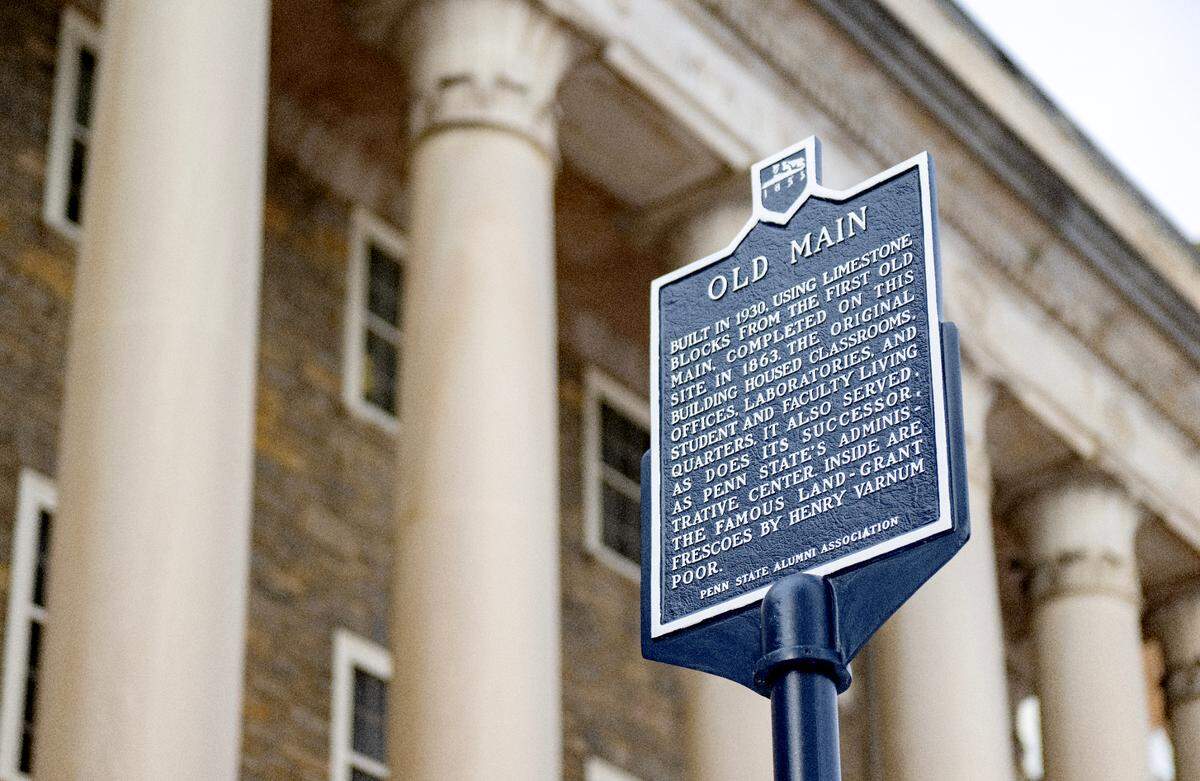
“The plaques consist of paint on cast aluminum, and they’re expensive, $1,500 to $2,500 each. As you might imagine after three decades, some of the markers have been showing their age, the paint chips, they fade, they bend, occasionally they’re stolen,” she said. The alumni association decided last year to pause on adding new markers so they could focus on restoring or replacing old ones.
But they made an exception, she said, to add a marker for Penn State’s official birthplace — just outside the Centre Furnace Mansion near the corner of Porter Road and East College Avenue.
“The markers are a constant, consistent reminder of the academic prowess at Penn State, and we’re proud to support that. We will continue to support that,” Tom Hammond, executive director of engagement for the Penn State Alumni Association,said during the award ceremony.
Below are the markers and where to find them.
University Park
Old Main: Two identical markers are located near the front and rear entrances of Old Main. The building was built in 1930 using limestone blocks from the first Old Main, which was completed in 1863. The original building had classrooms, offices and some student and faculty living quarters. The current building serves as Penn State’s administrative center, which the original building also had.
Evan Pugh: A marker for Evan Pugh, the university’s first president from 1859-64, is located on Allen Street Mall between Old Main and Willard Building. Pugh is the reason Penn State was named Pennsylvania’s sole land-grant college in 1863. He was an advocate of adding science, agriculture and engineering to traditional collegiate studies.
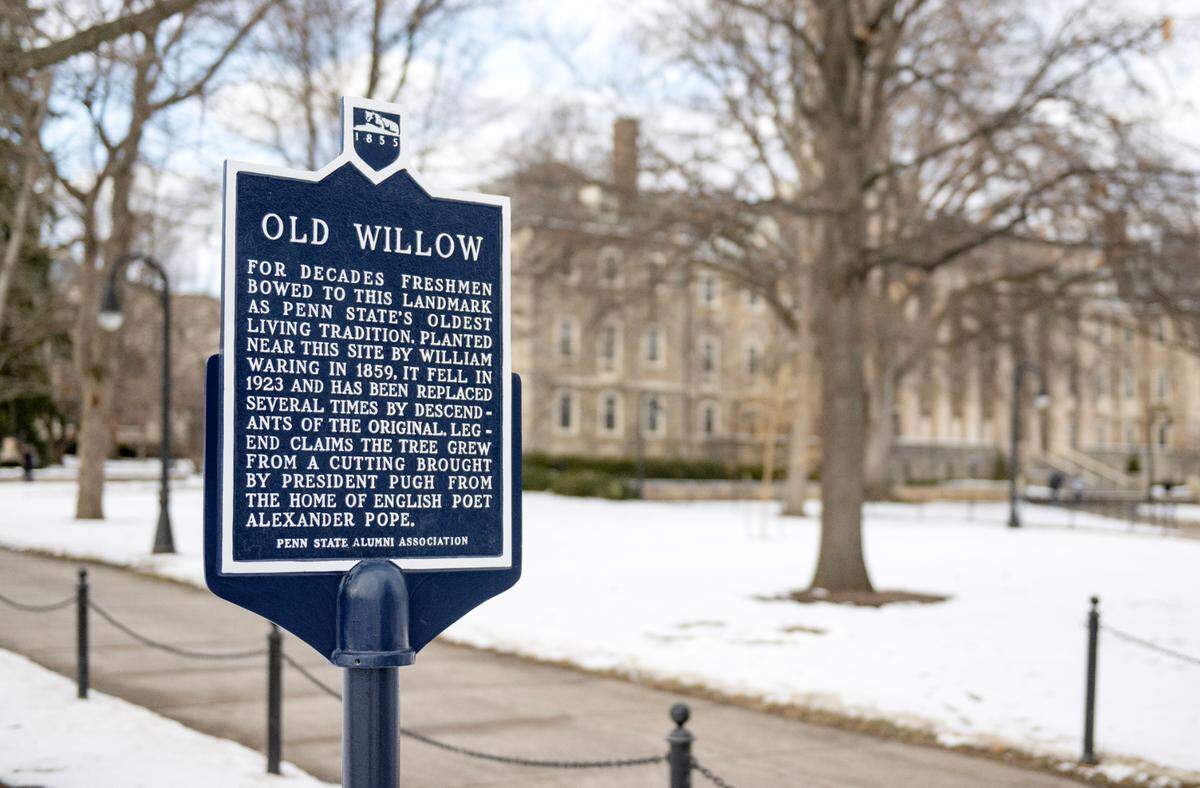
Old Willow: Located on the Allen Street Mall, opposite of the Sackett Building, there is a marker for Old Willow, one of Penn State’s most historically significant trees. William Waring planted the tree near this site in 1859. It fell in 1923 but has been replaced several times by the original tree’s descendants.
University House: between the Sackett Building and the Hintz Family Alumni Center you’ll find a marker for the home of 11 Penn State presidents from 1870-1970. The house was designed and even financed in part by the university’s first president, Evan Pugh.
Industrial Engineering: Penn State established the country’s first academic department and baccalaureate curriculum in industrial engineering in 1909 in Engineering Unit A, which is why there’s a historical marker for industrial engineering behind the Sackett Building.
Architectural Engineering: People can find a marker for this field at the east entrance to Engineering Unit A because Penn State offers the nation’s oldest continuously accredited curriculum in architectural engineering.
Industry Research: Located on College Avenue at the east end of the Hammond Building, a marker for Industry Research is placed because it used to be a petroleum refining lab at that site. Starting in 1929 chemists conducted Penn State’s first major industry-sponsored research.
Diesel Engineering: A marker is placed on College Avenue adjacent to the Hammond Building because professors Paul Schweitzer and K.J. Dejuhasz began one of the first systematic research programs in the field at a college campus near this site in 1923.
Applied Research Lab: The Applied Research Lab, founded in 1945, succeeded Harvard University’s underwater sound lab as the Navy’s principal academic center for basic research in underwater weaponry. The marker is located on the east side of the lab.
Water Tunnel: When built in 1945 with the Navy, it was the world’s largest water tunnel. It was used to test properties of torpedoes, submarine hulls, propellers and more. The marker is located on the North Atherton Street entrance to the water tunnel building.
Driver Education: Amos Neyhart, a professor of industrial engineering, taught the nation’s first classes for driver education teachers in 1936 near where the marker is located at the north end of the parking lot behind Hintz Family Alumni Center.
Atmospheric Research: A marker is located on Burrowes Road, adjacent to the Deike Building for atmospheric research because work that meteorologist Hans Panofsky did at Penn State led to a new understanding of atmospheric turbulence, air pollution, ozone depletion and planetary atmospheres.
PENNSTAC: A marker for PENNSTAC, the first fully electronic digital computer built by Penn State — and among the first to be built on any college campus — is located on the south side of Electrical Engineering West.
Nittany Lion Shrine: Perhaps one of the most iconic University Park campus landmarks, the Nittany Lion Shrine previously had a marker but it was removed and replaced with an interpretative sign. The Class of 1940 paid artist Heinz Warneke to sculpt the lion out of limestone.
Management Education: The program was established in 1915 and was one of the first continuing education programs for business and industry in the United States. The programs help boost the state’s economy. The marker is located at the Fischer Road entrance to the Keller Building.
Bernreuter Inventory: Robert Bernreuter, a psychology professor, established a psycho-education clinic here and began developing his “Bernreuter Personality Inventory,” a test of traits that became the standard to measure other personality tests. The marker is located on the south side of the Moore Building.
American Literature: Penn State was one of the earliest centers for American Literature studies with the arrival of Fred Lewis Pattee in 1894. Pattee was the first person in the country to have the title of “professor of American Literature.” A marker is located at the north end of the mall near the main entrance to Pattee Library.
Postwar Authors: located at the south end of the Burrowes Building is a historical marker for postwar authors like Joseph Heller, Theodore Roethke and John Barth.
Carnegie Building: This building served as the university’s first library building when it was completed in 1904. The marker is located on the Allen Street mall, adjacent to the building’s main entrance.
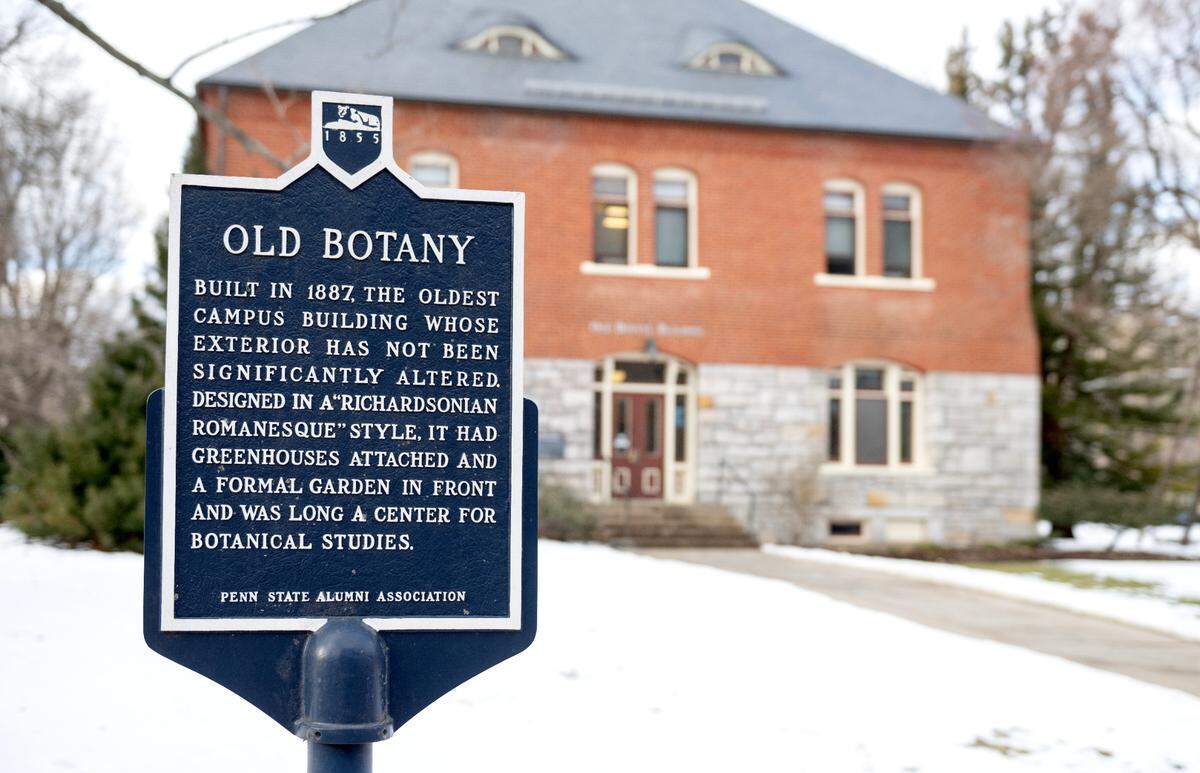
Old Botany: The oldest campus building, built in 1887. Its exterior has not been significantly altered. It had greenhouses attached and a formal garden in the front, and for a long time was a center for botanical studies. The marker is located in front of the Old Botany Building on Pollock Road.
President Atheron: George Atherton, Penn State’s seventh president from 1882-1906, is buried on campus and a marker is located at his gravesite on Pollock Road, on the north side of Schwab Auditorium.
Schwab Auditorium: This building was the first campus building to be financed by a private gift. Founder of Bethlehem Steel Corp. Charles M. Schwab — also a university trustee — gave $150,000 to build it. The marker is located near the front steps of Schwab Auditorium, along the Pattee mall.
Combinatory Logic: Haskell Brooks Curry, a professor and pioneer of modern mathematical logic, developed combinatory logic. A marker is located on Pollock Road near the McAllister Building.
Progesterone: Steroid chemist Russell Marker discovered the first practical synthesis of progesterone, the pregnancy hormone, in 1937 in Pond Lab. A marker is located on the southeast corner of the Arts Cottage.
Atom first “seen”: Erwin Mueller, a professor of physics, became the first person to “see” an atom in 1955 in the Osmond Laboratory by using a field ion microscope he invented. The marker is on Pollock Road in front of Osmond Lab.
Jordan Soil Plots: Beginning in 1882, more than 100 plots between where Eisenhower Auditorium now stands and College Avenue were part of a “pioneering attempt” to determine the long-term effects of fertilizer on soil and crops. A marker is on Shortlidge Road, south of the Tyson building.
Faculty Cottages: When Penn State was still a new university, the institution had on-campus residences as part of faculty compensation. The Pine (built in 1888) and Spruce (built in 1889) Cottages were later used as sorority housing and academic/administrative offices. The historical marker is on the north side of Pine Cottage.
Pure Food Laws: A marker is located on the north side of Frear Building for the work of chemist William Frear, whose work and analyses of food helped the state enforce truth-in-labeling laws.
Ag Hill: This area became the center of ag research and instruction at the university in the 1880s when the Experiment Station was founded. A marker is near the southeast corner of Armsby Building.
Calorimeter: The calorimeter was designed and first operated by Henry Armsby, an animal nutritionist, in 1902. The marker is on the east side of the Calorimeter Building, which was specially built.
Art Education: Penn State was the international center for art education in 1946 when Viktor Lowenfeld, a highly influential art educator, arrived. He taught at Penn State until he died in 1960. The marker is on Curtin Road near the former Palmer Museum of Art building.
Artificial Insemination: A marker on Curtin Road at the southwest corner of Borland Lab recognizes the work of John Almquist, who is known around the world for his work in artificial insemination and cattle reproductive physiology.
The Creamery: Penn State offered the nation’s first collegiate ice cream manufacturing instruction in 1892 which has helped make Penn State an international center for frozen confections, the marker states. The marker is located at the “new” Berkey Creamery building, although the original creamery building was in the “College Barns,” behind where Old Main stands today.
First Ag Degrees: Penn State is known for its agriculture programs and in 1861 was the first university in the United States to award baccalaureate degrees, and graduate degrees in 1863, in agriculture. The marker is at the northeast corner of Curtin and Shortlidge Roads.
Correspondence Courses: Penn State was the first American higher education institution to offer correspondence courses in agriculture. The marker is located near the Shortlidge Road entrance to the Ag Administration Building.
Heart-Assist Pump: The heart-assist pump was developed by faculty in the colleges of medicine and engineering in 1976. The tool helps extend the lives of cardiovascular patients. This has a historical marker at Penn State Hershey and on College Avenue at the west end of the Hammond Building on the University Park campus.
R Values: Everett Shuman in 1945 first proposed standardized measures of resistance to heat transfer. The marker is on the northeast corner of College Avenue Burrowes Road.
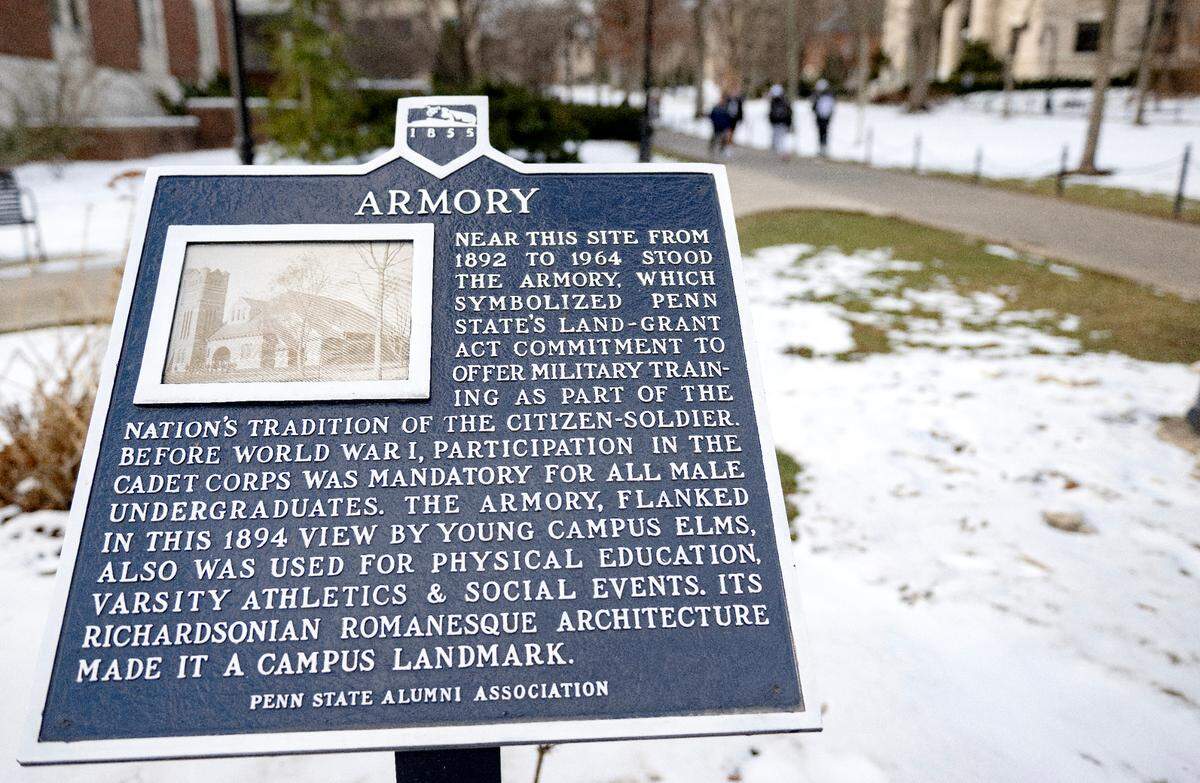
Armory: From 1892 until 1964 an armory, which symbolized the university’s Land-Grant Act commitment to offer military training, stood near where the historical marker is today, on the mall near the southeast corner of the Willard Building. The Richardsonian Romanesque architecture made it a campus landmark, it states.
Mushroom Science: Penn State became the first lan-grant college to start a comprehensive mushroom research program in the 1920s. The marker recognizing it is at the west entrance of Buckhout Lab.
Science, Technology, Society: Faculty from several colleges, including Earth and Mineral Sciences, Engineering, liberal arts, and science founded America’s first interdisciplinary program in science, technology and society. The marker is near the Old Botany Building.
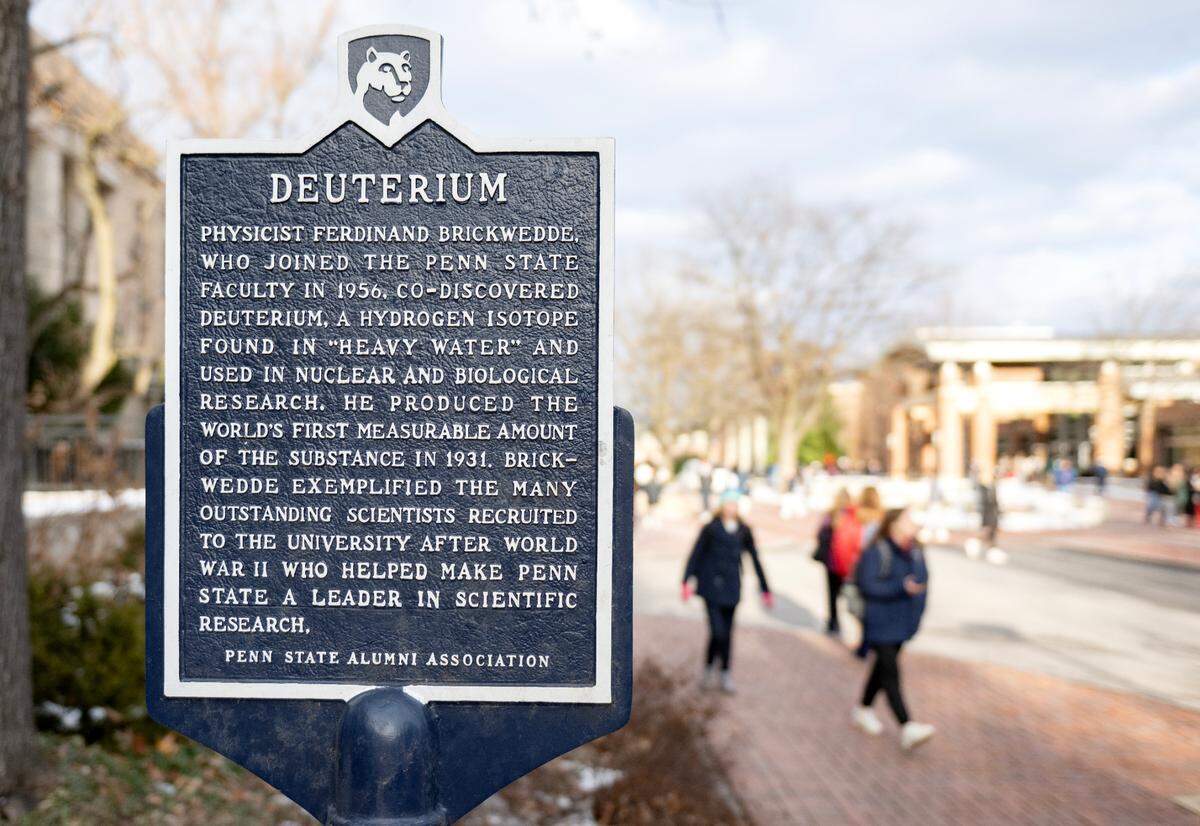
Deuterium: A marker in front of the Davey Laboratory recognizes the work of physicist Ferdinand Brickwedde who co-discovered deuterium. He joined the faculty in 1956.
Ag Experiment Station: On the southeast corner of Arts Cottage a historical marker stands to recognize the Ag Experiment Station which was housed there beginning in 1889 after the Hatch Act was passed.
Atoms for Peace: Penn State was the first university licensed by the Atomic Energy Commission to operate a nuclear reactor as part of “Atoms for Peace,” one of President Dwight Eisenhower’s programs. It is located on Hastings Road adjacent to the Breazeale Nuclear Reactor.
Materials Research: Penn State started America’s first interdisciplinary curriculum in solid state technology in 1960 and two years later created the materials research lab. It was the first unit in the United States organized without federal block support. It is located at the Hastings Road entrances to the Materials Research Lab.
Indian Leadership: Penn State established its American Indian Leadership Program in 1970 and is the oldest and most successful of its kind, the marker states. It was one of the first graduate fellowship programs to offer Native Americans formal opportunities that strengthened their administrative and leadership skills. The marker is located at the north end of the Rackley Building.
American Elms: A historical marker on the mall north of the Allen Street gates showcase the American Elms, which line the mall and were part of an early campus landscaping plan. Penn State has one of the largest elm stands in the country.
Big Ten: Penn State was admitted into the Big Ten on June 4, 1990 as its 11th member. The marker is located on Curtin Road by the Bryce Jordan Center.
Continuing Education: Located between the Keller Building and the Nittany Lion Inn is a historical marker recognizing when, in 1935, Penn State centralized its correspondence and evening courses, technical institutes and most of its other continuing education opportunities — a model that many other universities adopted.
Old Engineering: A marker at the foot of the Allen Street Mall notes the Old Engineering Building opened in 1892 and hours civil, mechanical, electrical and mining engineering. The building was destroyed in a fire in November 1918.
Mount Nittany: Between the Bryce Jordan Center and Beaver Stadium is a marker for Mount Nittany, a mountain that has been part of the Penn State tradition since the Nittany Lion was named its mascot.
Old Beaver Field: This was where students played baseball in the 1870s and where Penn State began intercollegiate athletics. Governor James Beaver secured state funds to improve the field in 1891, and it was named in his honor. It paid for the fields, running track and a small grandstand. The marker is located on the east side of Whitmore Lab.
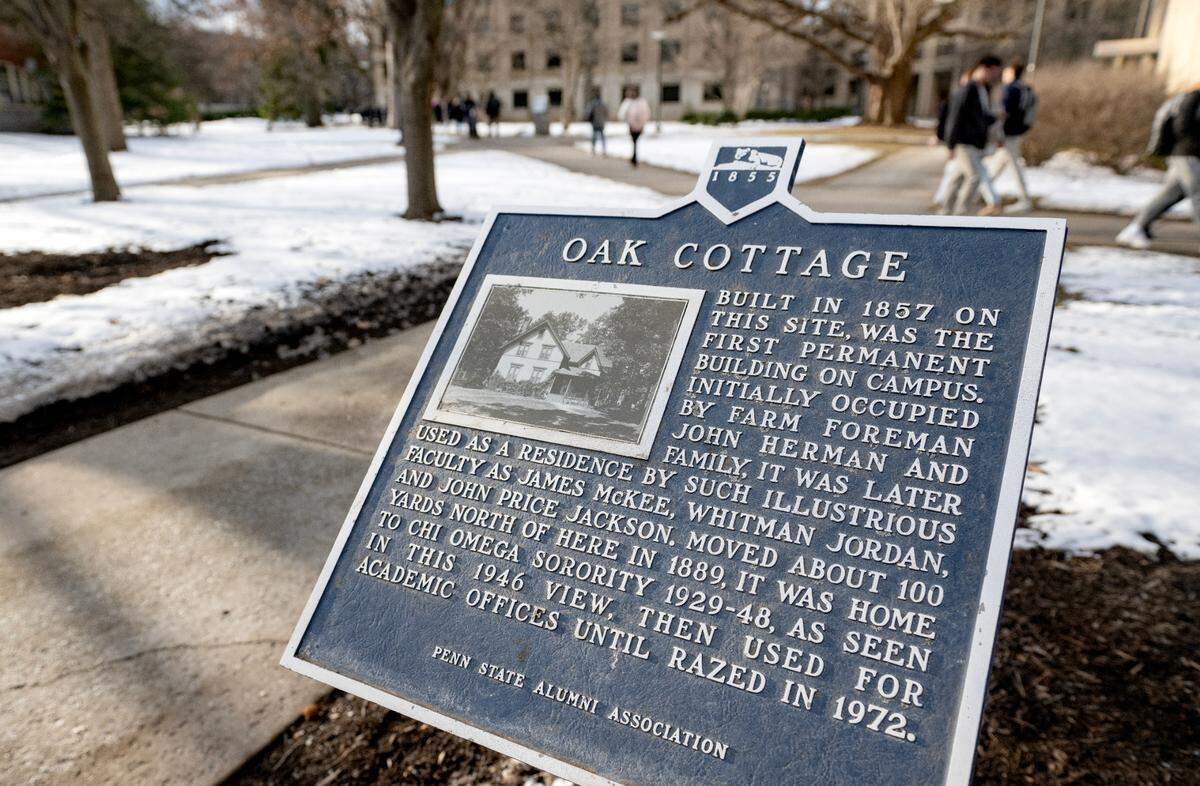
Oak Cottage: The first permanent building on campus, built in 1857. The marker is on Pollock Road near the Chandlee Lab.
Daily Collegian: The Daily Collegian is one of the oldest college daily newspapers in the United States. The marker is on Pollock Road near the Carnegie Building.
James A. Beaver: Located along Curtin Road next to Beaver Stadium is a marker for James A. Beaver. He was a Bellefonte attorney and fought in the Civil War, and chaired the Penn State trustees for 24 years and was governor from 1887-91. He was popular with the students and secured funds to improve the university’s first football field, which was named in his honor.
Moses Thompson: Moses Thompson was a partner in Centre Furnace with James Irvin and helped select the site to establish Penn State on furnace company land. The marker is on the grounds of the Centre Furnace Mansion along Porter Road, just off of East College Avenue.
Ionospheric Research: A marker near the east entrance to the Electrical Engineering East Building recognizes the work of faculty and students in 1967 to develop a radio wave cross-modulation facility, which consisted of a high-power transmitted and antenna beamed to the ionosphere.
Martin Luther King Jr.: The civil rights leader spoke to a crowd of 8,000 people at Rec Hall on Jan. 21, 1965 to draw attention to voting rights reform to prevent discrimination against African Americans. The marker is near Rec Hall on the corner of Curtin and Burrowes Roads.
Wake Turbulence: A marker in Foundry Park, adjacent to the Hammond Building, recognizes the work of aerospace engineer Barnes W. McCormick, who led a research team that made the first measurements of the details of wake turbulence trailing an airplane.
Biomechanics: Penn State’s biomechanics lab was established in 1967 and was among the first of its kind in the world. The marker is located at the southwest corner of the Biomechanics Teaching Lab (Old Water Tower), between the tower and Carpenter Building.
Labor Education: Penn State was among the first American universities to create an academic program focusing on labor in American society and offer labor studies for college credit. The marker is in front of the Keller Building.
Champions for Equality: South of Beaver Stadium, visitors will find a historical marker remembering when Penn State led the way in breaking the color barrier in intercollegiate athletics in the south.
Public Speaking: Located at the south end of the Sparks Building is a marker for public speaking, in which Penn State has led in the study since John Henry Frizzell founded the speech department in 1935. Penn State has taught public speaking to more students than any other university.
Walnut Building: The Walnut Building first served as a war-suplus structure in Lebanon and relocated to campus to serve as a temporary student union building. Later, it became the university’s first center for minority student social and cultural life. The marker is located on the mall north of the Allen Street gates.
Student Broadcasting: Penn State has been a leader in college radio broadcasting since 1912. The marker is outside of the corner of Sparks Building along Pattee Mall.
Hospitality Management: Penn State’s School of Hospitality Management is one of America’s oldest, established in 1937. The marker is near the sidewalk in front of Mateer Building.
Educational Television: A marker at the corner of the Nittany Lion Inn remembers when, in 1952, education, broadcasting and government leaders met at the Inn to “accept a challenge” from the FCC to begin a noncommercial educational TV service.
Birthplace of Penn State: A marker at the Centre Furnace Mansion, 1001 E. College Ave., recognizes the birthplace of Penn State.
Human Performance Research: The country’s first free-standing research institution for the study of human performance is Noll Laboratory, established in 1973 by Elsworth R. Buskirk. The marker is outside of Noll Laboratory.
Penn State Milton S. Hershey Medical Center
The following markers are located at the Penn State Milton S. Hershey Medical Center in Hershey.
Medical Center: A historical marker for the College of Medicine.
Behavioral Science: Penn State’s Department of Behavioral Science was established in 1967 and the second of its kind.
Family Medicine: Penn State established the United States’ first Department of Family Medicine in 1967 in Hershey.
Founding Dean: A historical marker for the founding dean of Penn State’ College of Medicine, George T. Harrell Jr. is located at the Hershey Medical Center. He was the only person to preside over establishing two major medical centers, the marker states.
Humanities: Penn State started the first humanities department in a College of Medicine in 1967 and served as a role model for schools internationally.
Heart-Assist Pump: The heart-assist pump was developed by faculty in the colleges of medicine and engineering in 1976. The tool helps extend the lives of cardiovascular patients. This has a historical marker at Penn State Hershey and on College Avenue at the west end of the Hammond Building on the University Park campus.
Cervical Cancer Prevention: College of Medicine researchers finalized a technique for propagating the human papillomavirus, the primary cause of cervical cancer in the 1980s.
Penn State Erie
Behrend Family: A historical marker honors the Behrend Family. Mary Behrend gave Penn State her 400-acre Glenhill Farm Estate, which included her farmhouse, painting studio, barn and carriage house, in honor of her late husband, Ernst, who co-founded Hammermill Paper Co. His brother, Otto, also left a $2 million gift to the college.
Erie Hall: Completed in 1952, this was the first building at Penn State Behrend built using private donations.
Penn State Mont Alto
Mont Alto: Pennsylvania purchased the surrounding lands from the Mont Alton Iron Co. in 1893. In 1903 the State Forest Academy was established and in 1929 it merged with Penn State’s school of forestry. It expanded its academic programs in 1963 and became a commonwealth campus.
Penn State Abington
Ogontz Campus: A marker honors the Chestnut Street Female Seminary founded in 1850 in Philadelphia, which was later moved to Jay Cooke’s estate, Ogontz, and was renamed. Principal Abby H. Sutherland moved it to Abington in 1916 and after her retirement, donated the buildings and land to Penn State. It became Penn State’s first commonwealth campus in southeast Pennsylvania.
Penn State Berks
Berks Campus: Wyomissing Polytechnic Institute was established by Textile Machine Works in 1927 to give their apprentices a work-study program. This was the predecessor of Penn State Berks. It became The Penn State Wyomissing Center in 1958 and it became part of the commonwealth campus system. It relocated in 1978 to the current site as the Penn State Berks campus.
Penn State DuBois
DuBois Campus: A marker notes that the DuBois campus was founded in 1935 to make Penn State education more accessible to residents in the area. The campus moved to its present location on land from the heirs of John E. DuBois Sr. in 1938.
Penn State Fayette, The Eberly Campus
Fayette Campus: Fayette County leaders approached Penn State in 1964 about opening a local campus. A temporary campus in Uniontown opened and later the permanent campus opened in the current site in 1968.
Penn State Greater Allegheny (McKeesport)
McKeesport Campus: The campus opened as a Penn State Center in Dravosburg in 1948 to give occupation training to veterans. It expanded its offerings and moved to McKeesport in 1952. Willian L. Buck donated land in 1956 for a new campus at the present site and students began classes in the first permanent building in 1957.
Penn State Schuylkill
Schuylkill Campus: The campus opened in 1934 as one of the first two in a series of Penn State Undergraduate Centers statewide. The campus moved to its present site in 1967.
Penn State Lehigh Valley
Penn State Lehigh Valley: Lehigh Valley has offered instruction since 1912, making it the oldest continuous classroom operation beyond University park.
Penn State Scranton
Penn State Scranton: located outside of the Study Learning Center is a historical marker remembering when Penn State offered evening technical programs in 1923 through a branch school in Scranton. When it outgrew the space, it moved in 1968 to where it currently stands.