Why Penn State’s latest high-profile hire may have violated PA’s Open Meetings Law
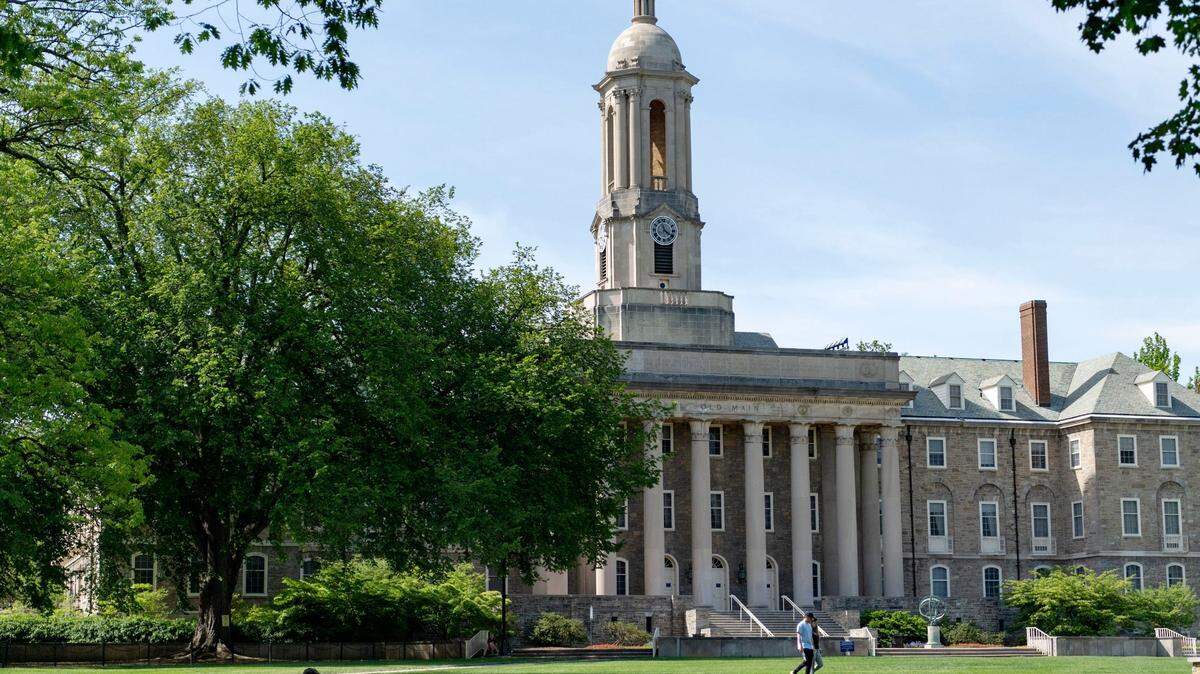
When a committee of Penn State trustees met Monday to approve hiring a new football defensive coordinator, the meeting lasted less than two minutes, without any trustee saying the name of the person they were hiring.
It’s not the first time a meeting for a high-profile hire was conducted in such a way, but the board’s process may be in violation of the state’s Open Meetings Law and raises questions about the board’s transparency, according to a legal expert.
During a special meeting of the Penn State board of trustees’ committee on equity and human resources, the committee unanimously approved the proposed terms of employment for Penn State’s football defensive coordinator. But the public wouldn’t have known the committee planned to take that action just by looking at the agenda prior to the meeting, which listed “personnel matter” as the only item of business with no other details.
And although committee chair Matt Schuyler did say at the start of the meeting that they were taking action to approve the proposed terms of employment for a football defensive coordinator, neither he nor anyone else on the committee ever said the name of who they were hiring. Intercollegiate athletics sent a press release after the meeting, stating Jim Knowles was hired for the position.
The committee, made up of 10 trustees and two non-trustees, did not publicly discuss the candidate or contract terms; Schuyler said they discussed it during an executive session prior to the public meeting. The state’s Sunshine Act does allow for executive sessions, where the members can privately discuss certain business, including personnel matters.
Knowles joins the Nittany Lions on a three-year deal that will pay him $3 million in his first year, $3.1 million in his second year and $3.2 million in his third year, according to a source with knowledge of the contract. It makes him the highest-paid defensive coordinator in college football.
The process used on Monday raises Sunshine Act compliance issues in more than one way, Melissa Melewsky, media law counsel for the Pennsylvania NewsMedia Association, of which the Centre Daily Times is a member, said in an email.
In short, the Pennsylvania Sunshine Act, or Open Meetings Law, requires agencies to deliberate and take official action on business in an open and public meeting. The law requires that an agenda is posted 24 hours prior to the meeting and includes all issues that will be deliberated on and any planned official action, like votes, among other things.
“The agenda requirements exist so that the public can understand the issues to be discussed or acted on during a public meeting so that they can attend if the issue is important to them,” Melewsky said. “A generic agenda item like ‘a personnel matter’ is not consistent with the intent of the law because it tells us nothing about what will be discussed or acted upon and does not enable (meaningful) public input or oversight.”
Considering the number of employees at Penn State, the lack of details on the agenda is “especially problematic,” she said.
Beyond that, taking a vote without disclosing details also interferes with the public’s ability to understand what action is being taken, Melewsky said.
“The law requires votes to be made in a public meeting so that people understand public officials’ actions. A generic vote to hire someone for an undisclosed job at an undisclosed salary defeats the purpose of a public vote,” she said.
Penn State didn’t directly answer questions about why more information isn’t included on the agenda or stated during the public meeting.
“The University released the details regarding the hire via a press release immediately after the vote. It has been the Board’s practice to thoroughly discuss personnel matters during executive sessions, reserving the public meeting for official action with the candidate selection announced following the meeting,” spokesperson Wyatt DuBois said.
When a subcommittee approved hiring a new men’s basketball coach in March 2023, they did not reveal the coach’s name during the meeting either. The same process was used when the subcommittee hired a new football offensive coordinator in December 2023.
“Penn State can and must do better, especially considering the fact that they are currently involved in several lawsuits arising from their Sunshine Act and other transparency practices,” Melewsky said.
Will Penn State release Knowles’ contract?
As far as Knowles’ contract details, the university did not answer questions about if it would release his contract, or why it chooses to release some contracts for coaches and other high-profile positions and not others.
For example, the university has released contract information after the hiring was approved, including for men’s Basketball Coach Mike Rhoades, Athletic Director Pat Kraft and Football Coach James Franklin. But it hasn’t released details on contracts for football Offensive Coordinator Andy Kotelnicki or wrestling head coach Cael Sanderson.
Contract details were also not released for former men’s basketball coach Micah Shrewsberry, which attorney Craig Staudenmaier told the CDT and Spotlight PA in 2023 was likely a violation of the Sunshine Act.
“There are personnel issues they can discuss in an executive session but, in terms of making a final decision, they’re supposed to deliberate in public,” Staudenmaier told the news organizations. “And it seems to me that hiring another coach and paying him or her a certain amount of money would be something you deliberate on and do it in the public and vote on it.”
Due to Penn State’s status as a “state-related university,” Penn State isn’t required to disclose salary information outside of an annual disclosure of top salaries.
In the past, the university only had to disclose salaries for the top 25 paid employees and its officers and directors under the state’s Right to Know Law. That was expanded last year when Governor Josh Shapiro signed HB 1556 into law; that requires additional disclosures to be made part of that annual disclosure including the top 175 salaries paid. That information will be part of the annual May 30 disclosure. It’s possible that some of these contracts will fall into that category.