
Preliminary plans conditionally approved for $23.6M Penn State lab expansion. What to know
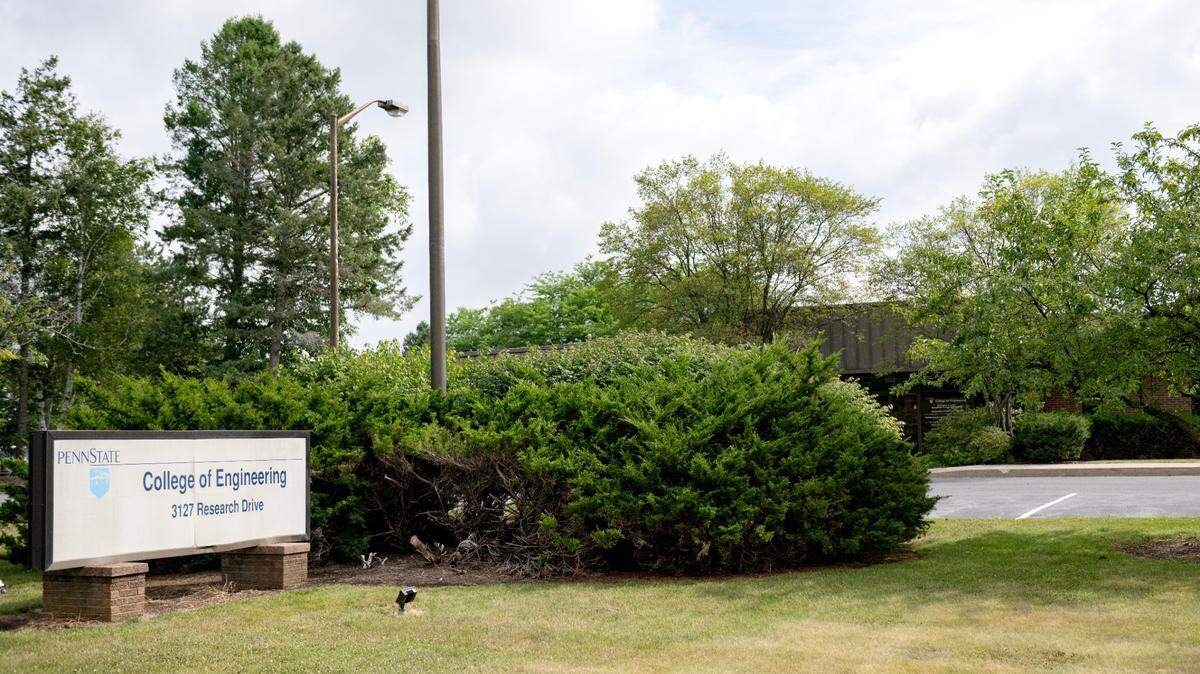
The Ferguson Township Planning Commission conditionally approved on Monday a preliminary plan for a $23.6 million addition and renovation to Penn State’s Lidia Manson Building, a move that would expand the university’s nationally acclaimed Steady Thermal Aero Research Turbine (START) Lab.
Located at 3127 Research Drive in the CATO Park business complex, the lab has been in operation since 2012 and was built to perform airplane turbine aerodynamic and heat transfer studies, as well as to conduct research aimed at increasing the efficiency of gas turbine engines.
The lab’s expansion plans include a 13,050-square-foot addition on the northern side of the building, the construction of a 7,990-square-foot storage yard and several other smaller additions, including an ADA-compliant concrete sidewalk, an updated parking lot, a new patio and a stormwater retention pond.
The lab’s preliminary, and eventually final, land development plans have yet to be approved by the township’s supervisors, and no timetable has yet been made available. Still, Penn State officials are already excited about what opportunities the expansion will provide.
“The START Lab has been a national leader in turbine testing for more than a decade, and these additions and renovations will provide the lab with the facilities it needs to continue leading the nation in critical research toward the reduction of carbon dioxide emissions from aviation,” Tonya Peeples, the dean of Penn State’s College of Engineering, said in a September 2024 news release.
The expansion plans also include a decrease in the amount of parking available at the lab from 72 spaces to 64 spaces. Also, while 49 of the lab’s pre-existing 175 mature trees will be removed during the expansion, 105 new canopy trees and 118 shrubs will be planted.
Those adjustments are in line with Ferguson Township’s code of ordinances.
Another Penn State news release from March 2023 detailed exactly what would be going into the expanded space: START+ — a new two-stage test turbine designed to help researchers understand impacts of shrinking the turbine’s core — and four new compressors, or machines that provide the turbine with high-pressure air.
Scott Fishbone, a START Lab research engineer, said in the release that the new additions will help the team develop a new generation of more efficient turbine engines for aviation, which includes turbines relevant to future hybrid electric propulsion concepts. “This is a major upgrade to our testing capabilities and one that our industry partners are excited to have,” Fishbone said.
Because the lab’s new additions require so much electricity to run, the building’s power supply needs to be increased, meaning that a new substation must be built during the expansion.
Additional measures are also being taken to continue to mitigate noise coming from the facility — a problem that garnered complaints from nearby residents in the lab’s early days.
According to Wyatt DuBois, Penn State’s communications director, the facility has “consistently been in compliance” with Ferguson Township’s noise ordinances over the past decade, with several measures being taken to reduce noise levels over the years. These measures include the installation of an eight-foot-tall sound wall and acoustical blankets on the lab’s roof, meant to block sound being made from rooftop air intakes and exhausts.
Acoustically-lined exhaust-fan weather hoods on the side of the building were also installed, DuBois said, and even more measures are going to be taken to mitigate the lab’s noise levels with the coming expansion.
“Optional add-ons will be purchased for the new equipment with the goal of making the new equipment at least 50% quieter than existing equipment,” DuBois wrote in an email to the CDT. “Additional investment also is planned to further decrease sound levels of existing equipment as part of the expansion process. To support these targets, the lab is working with an external noise consulting firm to determine the best approach for noise mitigation.”
While a specific noise-management approach has not been provided yet, Penn State’s September news release shared that “prioritizing noise management” would be a main focus of the project.
On the township side of things, the university’s preliminary plan first appeared before the planning commission at its December meeting for public review and comment, with the building’s sketch plan first being viewed last July.
The preliminary plan was approved unanimously, conditionally and with little discussion by the planning commission Monday, provided that Penn State completes and records an adequate stormwater management plan and agreement.
After that, Penn State will need to bring forth a final land development plan to be approved by the planning commission and the township’s supervisors — then construction can start.
Further updates on the START Lab’s expansion will be provided at future Ferguson Township planning commission and supervisor meetings. The planning commission meets at 6 p.m. on the second and fourth Mondays of the month, and the supervisors meet at 6 p.m. on the first and third Tuesdays of the month.
This story was originally published March 15, 2025 at 5:30 AM.