
How a Penn State initiative helps educators navigate difficult topics like the Holocaust
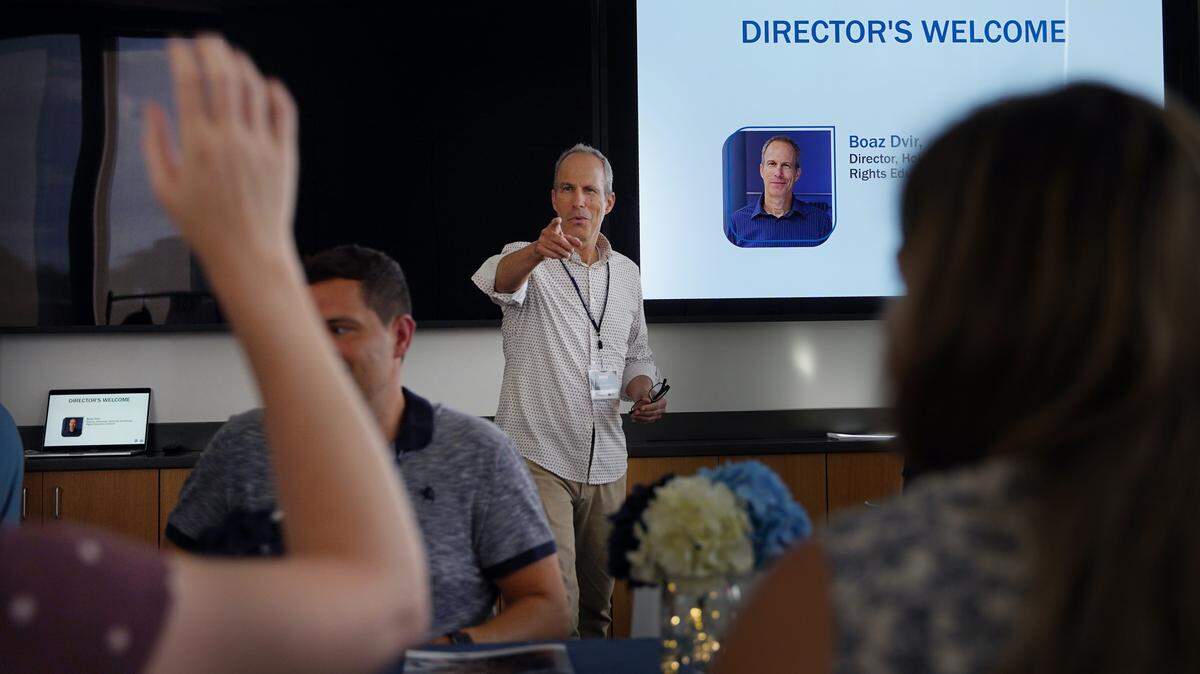
During a screening event at a university in the South for a rough cut of his documentary feature “Cojot” in 2019, Boaz Dvir, associate professor in Penn State’s Donald P. Bellisario College of Communications and award-winning filmmaker, had a jarring interaction with two students that set in motion a groundbreaking initiative to fundamentally change how difficult topics like the Holocaust are taught in K-12 schools.
Now titled “To Kill a Nazi,” the documentary depicts Michel Cojot’s story starting at 4 years old living in Nazi-occupied Paris with his parents and ending with his heroism during Operation Entebbe, the rescue mission during which 102 hostages were freed from terrorist control on July 4, 1976. It is set for wide release later this year.
During World War II, young Cojot’s father was captured and died at Auschwitz.
During the 2019 rough-cut screening, two freshman students approached Dvir and admitted they had never heard of the events explored on screen. Dvir expected this — he often centers his films on what he considers ordinary people like Cojot who rise to the occasion in extraordinary circumstances, becoming trailblazers and game changers.
“They weren’t talking about Michel Cojot’s story,” Dvir said. “They were talking about the Holocaust. They never heard of it.”
That was one of the moments that convinced Dvir that Holocaust education has failed.
Astounded by the interaction, he began to research education efforts in the United States only to discover that instruction on all difficult topics was deteriorating. He also learned how rote memorization was prioritized over critical thinking, fact finding, primary research, active listening and civic discourse in curriculums across the country.
This was the genesis of Dvir’s idea for the Holocaust, Genocide and Human Rights Education Initiative at Penn State (the Initiative). A groundbreaking program that equips K-12 educators with the tools to teach difficult topics in the classroom while empowering their students, and themselves, to transform their education through inquiry.
“We’re bringing K-12 students the vital skills they’re too-often missing,” Dvir said, explaining his basic plan for the initiative. “For whatever reason, the education system generally will not give them enough opportunities to develop these skills, but these kids need them more than ever.”
Initial research and development for the Initiative began during the 2019-20 academic year. Dvir put together a group of pedagogical and content experts that work with educators to facilitate professional learning around how to approach, teach and critically discuss difficult topics in the classroom.
Difficult topics include the Holocaust, racism, gender, evolution, human right violations, use of media in the classroom and any other social or historical topic teachers are dealing with. These topics may already be in the curriculum or pop up spontaneously in the news or community that students want to talk about.
Though the first year was stalled due to COVID, educators have been partnering with Initiative staff and affiliated faculty, who are all former teachers themselves, through a combination of in-person training, virtual support, online training modules and hands-on assistance in the classroom.
Dvir said the first step is reinstating curiosity by showing teachers how to help students come up with their own questions.
“We’re trying to go from what we describe as a sage on the stage to a teacher who sets the stage for experiential learning and gives students agency to explore the topics for themselves,” he said.
Each teacher who participates in the program receives individualized assistance based on their goals and needs. Dvir described the Initiative’s instruction as similar to improvisation versus working from a defined script – the situation is different every time, but the facilitators adapt to the questions and problems the participants bring up.
“Our facilitators are not going in with a list of tips and protocols to hand over to participating educators, which is the typical fashion for these kinds of professional development programs,” Dvir said. “We’re going in as listeners. You have to be very focused, very present. You’ve got to withhold judgment.”
The initiative currently has a team of 15 staff and affiliated faculty members and operates in school districts in six states – Pennsylvania, Arizona, Colorado, Florida, New Jersey and South Carolina. Dvir said the Initiative is expanding every year and that he hopes to eventually work with school districts in all 50 states.
Various semester and yearlong programs, as well as workshops and online modules, are available for teachers, as well. Dvir said the yearlong programs are most popular because of the hands-on content and continued support for teachers.
The model, Dvir said, is working. Over the years, Initiative staff has gathered data to produce and publish six papers in peer-reviewed academic journals.
The early success of the program, Dvir said, would not be possible without the support of the Hammel Family Human Rights Initiative, which he also directs.
Vic and Dena Hammel, both Penn State alumni, met Dvir at a rough-cut screening for “Cojot” at the Fox Berkshire Theatre in Wyomissing, Pennsylvania. Later, they realized they had common visions for the betterment of education and society.
The couple announced their first project to support the Initiative with permanent funding in 2022.
‘Making a difference’
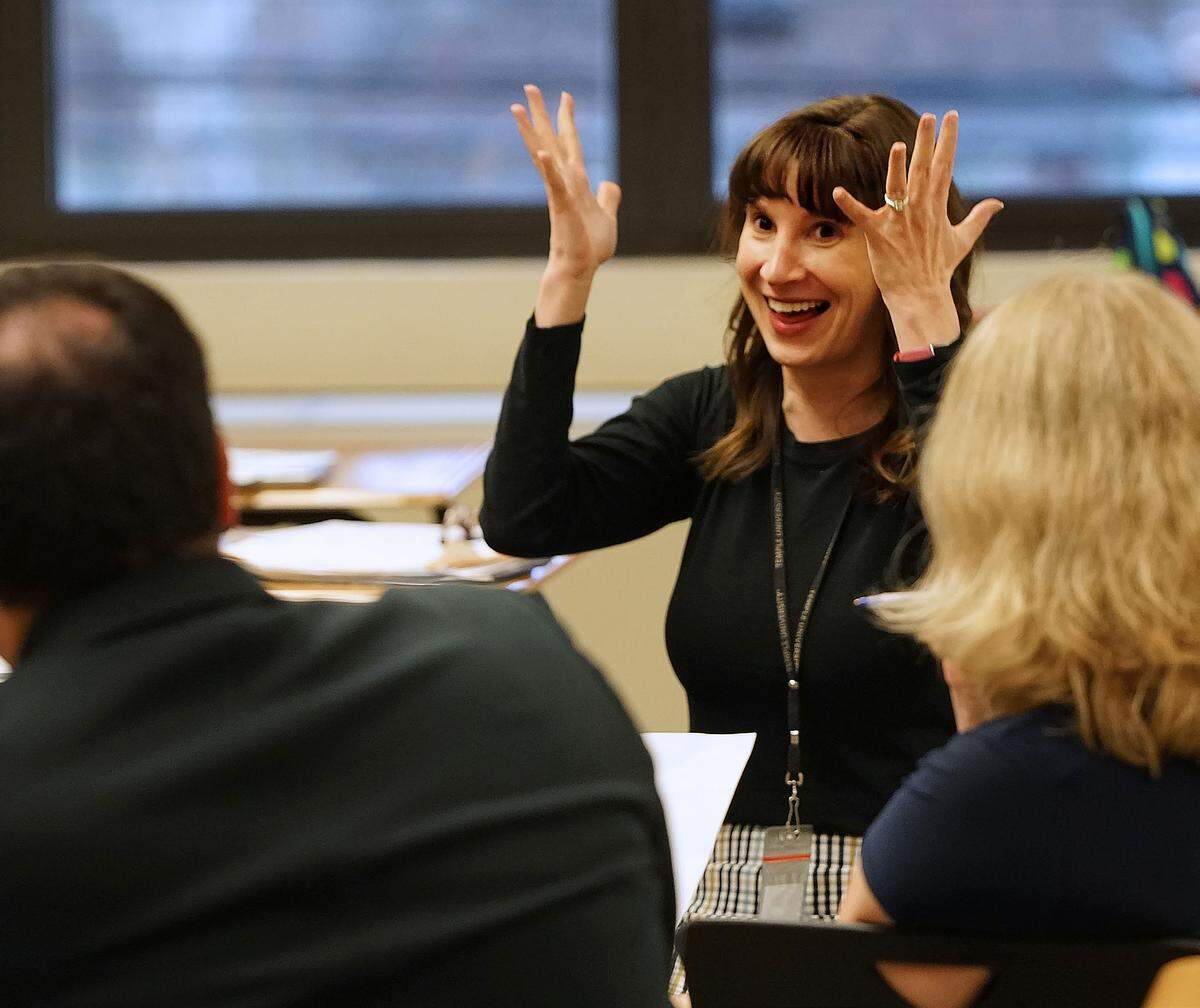
Kayleen Sidisky is one of the initiative’s education program specialists. She travels to school districts in Pennsylvania and New Jersey to lead programs with K-12 educators. A former social studies teacher, Sidisky said she felt stuck during her time in the classroom.
“I felt like I was beating my head off the wall,” she said. “Nothing was sticking with students, at least from my perspective, and I felt trapped. I really wanted to help create these good citizens, and it just didn’t feel like it was working.”
She said one of her main goals working for the Initiative is to promote intentional reflection and collaboration so everyone – students, facilitators and teachers alike – can benefit and build each other up.
“This program gives teachers a place where they can collaborate, have their voices heard, just feel like they’re making a difference,” she said.
Performing well on standardized tests is important for school funding and programming, but Sidisky said the Initiative’s pedagogy can translate to better test-taking ability in due time.
“Once they [students] start asking deeper questions, they’re going to retain that meaning because they’re going to be doing and researching and learning so much more,” she said.
Mya Trauger, a seventh-grade reading learning support teacher from Bellefonte, Pennsylvania, completed her second year with the Initiative in the 2024-25 academic year. Only in her third year of teaching, Trauger said the program has helped her be more confident and comfortable having hard discussions with students.
As a learning support teacher, Trauger said she would run into issues with her students speaking inappropriately or offensively. She said getting involved with the Initiative changed her perspective on how to deal with conflict and difficult moments.
“Sometimes you need to stop and take a teachable moment where a kid says something inappropriate,” she said. “A lot of teachers will just brush past it. We’re going to take this as a learning moment to really dive into it, explain why you’re doing it and how it’s affecting others. I think it’s [the Initiative] helped me a lot in that sense.”
Trauger said she first learned about the Initiative through other teachers at her school who were already participating in the programming and thought it would be a great way to build empathy and communication skills among her students who were constantly bickering and arguing.
After beginning the program in 2023, Initiative facilitators assisted Trauger in picking an inquiry, or a “wondering,” to address a classroom challenge. Her first compelling question was how to build empathy in her students.
“I want them to be able to read, but I want them to be good human beings,” she said. “They just spew hatred even if they don’t know where it’s coming from. I wanted to take a step back and address that. I wanted to help them relate to one another.”
With the facilitators’ help and the Initiative’s learning modules, Trauger built a program to instill mindful and compassionate behavior in her classroom. She led discussions about coping with anxiety, conducted activities for students to relate to each other and even partnered with the SPCA where everyone could bond over their love for animals.
Students made posters to hang around the classroom detailing ways to build mental health and worked together to make a guide booklet for how to deal with difficult emotions.
Building on the success she had during her first year partnering with the Initiative, Trauger said her compelling question in the 2024-25 academic year was how pen pals might improve students’ motivation to write and their ability to communicate with others.
“Kids nowadays don’t really know how to talk to one another,” she said. “They don’t write letters, and I just noticed that they hate to write.”
Trauger partnered with another teacher in a different Bellefonte school to establish the pen pals program. The classes hosted a Zoom call before Christmas where the students saw their pen pals for the first time and planned an ice cream social for the end of the year to meet in person.
“It’s really motivated my kids to want to write, which is something I’m super excited about,” Trauger said.
Asking compelling questions
Sara Strouse is a seventh and eighth grade social studies teacher at Keystone Central School District and has completed three years with the Initiative. Now a cofacilitator for the initiative at her school, she plans sessions, meetings and presentations for other teachers.
“Some educators like hearing form someone who’s within the school and who’s also an educator in the school district that can understand what they’re going through,” Strouse said.
She said she and the Initiative facilitators have a small group of teachers that continue the program and new teachers who join each year.
Strouse’s goal in joining the Initiative was implementing a more inquiry-based curriculum for her honors students, which would allow them to create their own questions on the lesson topics.
“Sometimes it might be more guided, but it’s fueling their curiosity as humans,” Strouse said about her new teaching style. “It’s multiple correct answers, and it’s giving them skills to collaborate with each other and to research, to think deeper and more critically about things instead of just ‘here are the facts’ and that’s it.”
Strouse said she appreciates the Initiative because it enables her to learn based on her own challenges as a teacher and explore it alongside her students.
“It’s not something I have to do on my own later,” she said, “but it’s during work hours and in a professional development setting with colleagues.”
Working with other teachers and now taking a leadership role in her school district’s push for high-quality professional development was a large benefit of the Initiative work, she said.
“I love to talk to them [facilitators and other teachers] about it and hear their explorations, wonderings, what they’ve figured out,” Strouse said. “To learn from them has been a strength of this as well – just to have each other to bounce ideas off of and share things is really helpful.”
The Initiative’s pedagogical model for classroom instruction is being implemented into schools in six states, and of the educators who have participated, approximately 50% of those who finish a whole year have chosen to continue for a second.
Dvir said the Initiative’s model is effective because it adds four lenses to how teacher’s typically view instruction on difficult topics.
There’s a trauma informed lens to not shock students into paying attention, and a local contextualization lens that enables teachers to make topics relevant to students. Dvir said students learn and retain more if the material is personally relevant to them.
The third lens is about apolitical and equity-based learning.
“We have no agenda whatsoever,” Dvir said. “We simply bring the pedagogical tools that help our partners achieve their goals and help them teach their students. It doesn’t matter where you are on the political spectrum; you want your students to do well, right?”
The final lens is asset based, which helps students and teachers see the strengths in themselves, each other, and students. This builds a stronger base for discussion and exploration.
The six Initiative research papers demonstrated how programming helps K-12 educators address difficult topics. The papers were published in School-University Partnerships, Journal of Practitioner Research, Action in Teacher Research, Journal of Teacher Education, Teaching and Teacher Education, and Social Studies Research and Practice.
Preparing for a sixth year of offering professional learning to K-12 educators, Dvir said he’s excited to see the Initiatives continuous growth. He said the next steps will be expanding the programming to other states and school districts and continuing research, and building on the first year of offering training to pre-k teachers.
As the initiative grows, so does the staff and affiliated faculty, teachers and students. Dvir said one of the best parts is seeing everyone learn from each other.
“Listen, ask questions and guide in a subtle way to let the participants find the answer on their own,” Dvir said, explaining how the initiative faculty interacts with teachers. “The beauty of this is not only do we do this with the teachers, but in doing it we model for them how they should be with their students.”
Visit www.bellisario.psu.edu/research/centers/holocaust-genocide-and-human-rights-education-initiative-at-penn-state for more information or to learn how to get involved with the Initiative at Penn State.
Merrick Morneweck is 2025 graduate of Penn State with bachelor’s degrees in journalism and English. She is currently working on a biography of internationally renowned trauma surgeon Norman McSwain.