Penn State president says university would not join Trump’s higher education compact
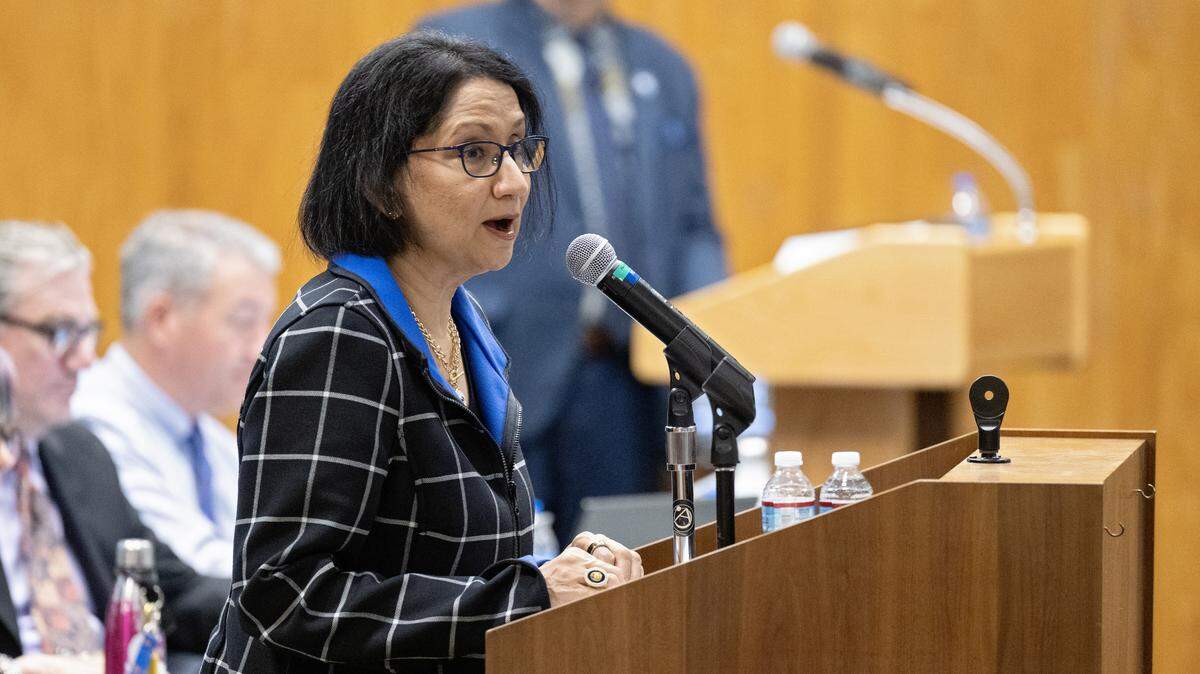
The Penn State president said the university would not sign a compact with the federal government, although they have not been approached about it.
During the “State of State” town hall on Oct. 30, university leadership gave updates on a range of topics, including the challenges higher education is facing, the commonwealth campuses, research, funding and more.
One submitted question during the town hall was about the “Compact For Academic Excellence In Higher Education,” which the Trump Administration proposed to nine universities last month. Universities that agreed to the compact would receive priority access to federal funds. Penn State President Neeli Bendapudi said Penn State has not been approached by the federal administration regarding the compact.
“We have not been approached, as you know, and if we were, we would not sign it,” Bendapudi said. “And that’s because of a number of reasons that we could go into, but we would not sign it.”
Penn State’s strategic communications team previously did not respond to an inquiry from the Centre Daily Times about the compact. There was also no response to an email sent to the 38-member board of trustees.
Bendapudi did not go into specific reasons during the event and the university did not immediately respond to an inquiry for more information on Monday. WPSU reported a student news outlet asked about those reasons after the State of State event, and quoted Bendapudi saying: “As we look at it, for us the notion of merit being the reason for why you would get grants or not is important,” she said. “Academic freedom is a very important principle.”
The PSU chapter of the American Association of University Professors voted unanimously in support of the national association’s statement urging leadership at universities to oppose compacts and sent a letter to Bendapudi and the board of trustees on Oct. 13 asking them to stand with the universities and communities targeted by the “loyalty compact” — and to not support this compact or ones that may be presented in the future.
They still have not received a response as of Monday, Michelle Rodino-Colocino, president of the Penn State AAUP, told the Centre Daily Times.
Rodino-Colocino took Bendapudi’s opposition to the compact as a small victory. The National AAUP has been fighting hard on the issue of “loyalty oaths,” she said, and have encouraged local chapters to take action and write their own statements, like the Penn State chapter did. The university’s opposition shows that it makes a difference when faculty speak out together across the country and do the work locally, she said.
“We have to realize that it matters that we take action nationally and locally. It matters, and that we have to keep doing this. We have to keep going to defend higher ed right now, which is still under threat from within, from the federal government,” Rodino-Colocino said. “So it’s good that Penn State administration has acknowledged the moment that we’re in and has chosen to be on the side of academic freedom, and has chosen to be on the side that faculty is demanding all across the country and right here at Penn State.”
Still, Rodino-Colocino said she’d like to see improved communication from the university leadership.
“It would be nice to have heard the reasons up front. It would be nice to be having communication with the administration and the faculty representative groups. So, that would be even better,” she said. “But we’ll recognize that this is a win for organizing nationally and locally on campuses.”
In October the Trump administration asked nine universities — Brown University, Dartmouth College, Massachusetts Institute of Technology, University of Arizona, University of Pennsylvania, University of Southern California, University of Texas at Austin, University of Virginia and Vanderbilt University — to sign onto a “Compact For Academic Excellence In Higher Education.” It listed a number of things the universities would have to agree to in order to receive priority access to federal funds.
The compact would require the schools to limit international student enrollment, require standardized tests for admission, block transgender people from using restrooms or playing in sports that align with their gender identities and other items that align with Trump’s politics, NPR reported. Most of the universities declined the proposal. Following sending the compact to the nine universities, Trump opened it up to any university, Bloomberg reported.
The AAUP statement, in collaboration with the American Federation of Teachers, said the offer “stinks of favoritism, patronage, and bribery. It is entirely corrupt.” It continued to say the “compact would steer tax payer money in ways that violate core principles of US higher education and democracy and cripple innovation. They would reward campuses that toe the party line and punish those that cherish their independence. In doing so, it would commit the very viewpoint discrimination it claims to redress.”