TikTok can’t get over how this mule alerted his rider to a grizzly bear. Check it out
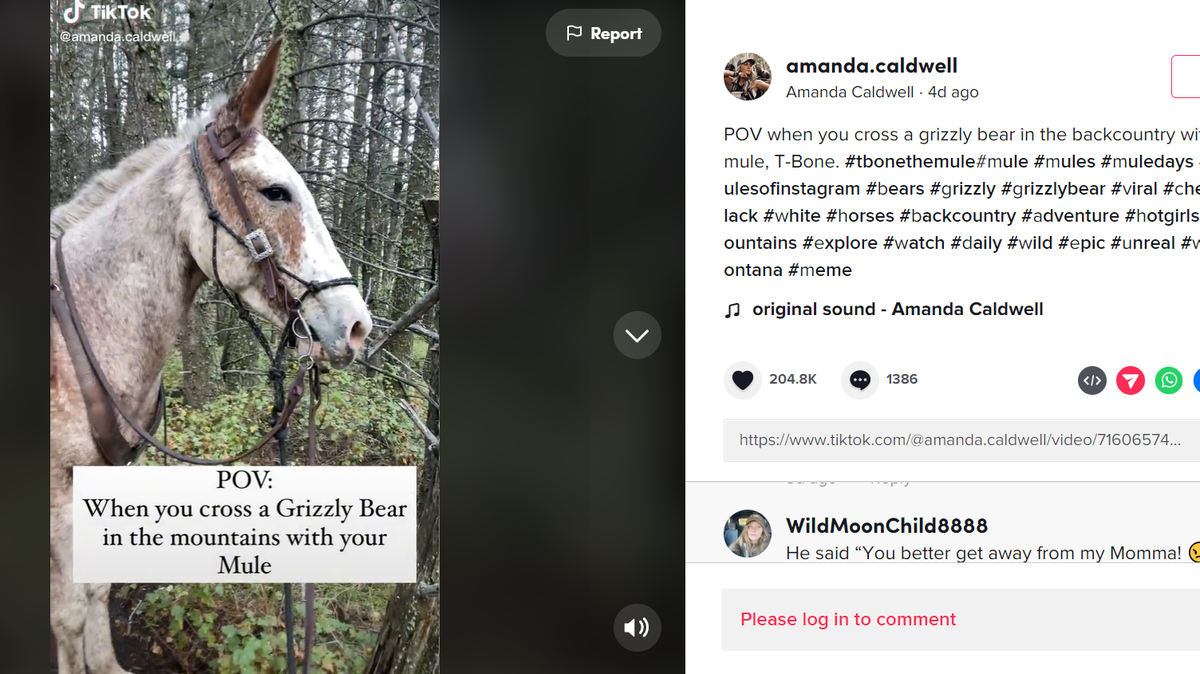
He doesn’t have sharp teeth and claws — or the brute strength of a bear — but a mule in Montana showed he had the heart to defend his herd from a grizzly bear if it came to that.
Amanda Caldwell posted a video on her TikTok account of her mule, T-Bone, alerting her that a grizzly was too close for comfort while out in the backcountry. He planted his feet and gave a few warning snorts in the bear’s direction, almost as if he was squaring up with it.
“POV when you cross a grizzly bear in the backcountry with your mule, T-Bone,” she wrote.
Her video got over 1 million views in one day. People commented that the mule sounded scarier than any grizzly, and some said he sounded more reptilian than mammal.
“Good news is bears are scared of dragons,” one user commented.
“T-Bone said ‘I’m big and bad, too’,” another wrote.
A few people commented they thought T-Bone seemed ready to bolt, but mule owners were quick to share stories of mules fighting off all kinds of predators in the comments — everything from snakes and coyotes to cougars and black bears.
“Always get off, my mule annihilated (sic) a cougar when I got off. She stomped him out,” one user commented.
Another agreed: “Yup. Warning blast doesn’t always mean they bail. Sometimes they need battle space.”
Ultimately that’s what Caldwell did. In the video, she cuts from showing her riding on T-Bone’s back to showing him snorting in the grizzly’s direction while she’s on the ground beside him.
Caldwell didn’t elaborate on T-Bone’s behavior or her strategy of dismounting. Some speculated in the comments that the mule was not only warning both the grizzly and his rider, but that he might even be mimicking the sounds bears use in the wild to diffuse tension.
“Bears make a similar sound to diffusion tension/warn off danger,” someone explained.
Another called T-Bones’ noises a “bluff growl.” They explained bears rely mostly on their senses of smell and hearing.
“People hear the dragon blast and confuse it with fear,” someone else chimed in. “It’s a double edged warning. Rider and bear take heed.”
The National Park Service confirmed on its website that bears may “react defensively by woofing, yawning, salivating, growling, snapping their jaws, and laying their ears back.”
Officials didn’t say what to do if you’re out packing in bear country with livestock animals such as mules and horses. But the department did say you’re better off in a group because it can be more intimidating to bears.
Officials also stressed the importance of remaining calm and avoiding high-pitched sounds or sudden movements — like bolting — that would indicate you’re a prey animal.
The NPS also stressed not to run away, suggesting instead to “stop and hold your ground.”
“Bears can run as fast as a racehorse both uphill and down,” the organization said. “Like dogs, they will chase fleeing animals.”
Based on the NPS bear encounter guidelines, T-Bone appeared to be doing everything right.
“Remember that most bears do not want to attack you; they usually just want to be left alone,” officials said.
This story was originally published November 4, 2022 at 3:02 PM with the headline "TikTok can’t get over how this mule alerted his rider to a grizzly bear. Check it out."