Stray cat leaves man with massive swelling from never-before-seen bacteria, study says

A middle-aged man in the United Kingdom was bitten by a feral cat, leading to an extreme reaction — and a scientific discovery.
In 2020, a 48-year-old man walked into the emergency department in the U.K. with painful swelling in his hands, according to a case report published in Emerging Infectious Diseases in August.
He told doctors he had been bitten by a stray cat about eight hours earlier, and now both his hands were swelling.
The doctors saw he had puncture wounds on his hands and forearms and multiple abrasions, according to the case report.
His wounds were cleaned and bandaged, and he was given a tetanus vaccine booster. The man was allergic to penicillin, a general antibiotic, so instead he was given a different oral antibiotic cocktail and was sent home, the case report said.
The man took the antibiotics, hoping to fend off any infection that may be causing the swelling.
Just 24 hours later, he came back into the emergency department with more serious symptoms, according to the case report.
He had developed a flexor sheath infection in two of his fingers, and there was cellulitis spreading up both his forearms, the doctors said.
A flexor sheath infection occurs when bacteria enters the flexor tendon and tissues that connect arm muscles to the bones in the hand, making it extremely painful to move a finger that has become infected, according to physician Jonathan Cluett with verywellhealth.com.
Cellulitis, a bacterial infection of the skin, can spread rapidly, causing the skin to become inflamed and painful to the touch, the Mayo Clinic says.
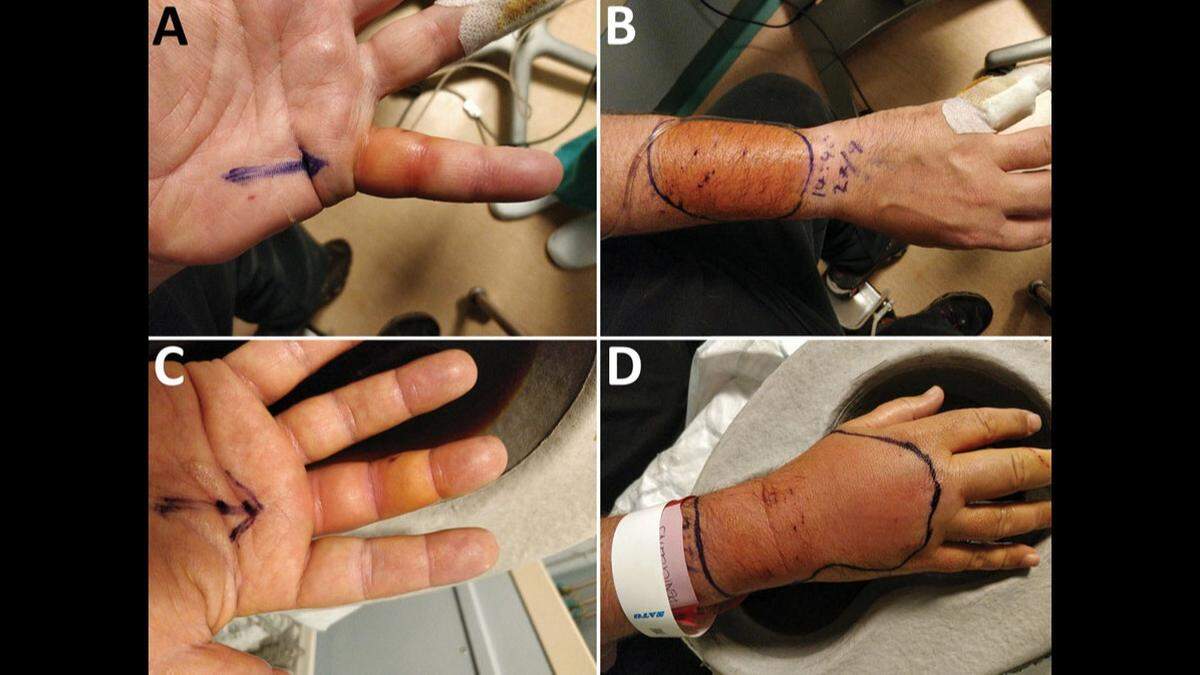
Something was different about this infection, so the doctors tried an alternative approach.
The wounds were again cleaned, then the damaged tissue was removed from his fingers, according to the case report. This time, he was given more antibiotics through an IV, a more direct attack on the bacteria.
After five days of additional oral antibiotics, the man was able to make a full recovery, the doctors said.
The doctors took samples from the man’s tissue when he was having the damaged portions removed and completed a microbiological analysis.
Inside the samples were a never-before-seen species of bacteria, according to the case report.
Genetic testing confirmed that the bacteria was a new species of Globicatella, a rare pathogen genus.
The bacteria has been known to cause infections in the bloodstream, central nervous system and urinary tract, according to a 2017 study from the Open Forum Infectious Diseases, but it rarely infects humans.
For the 48-year-old man in the U.K., the new species was injected into his system after it hitched a ride on the teeth of a stray cat, maybe for the first time ever in humans.
The doctors said “cat bites are common sources of zoonotic infection,” meaning illnesses and diseases that start in animal hosts and are transferred to humans through contact.
Other serious zoonotic diseases, like HIV and COVID-19, started in animal hosts before they ever infected a person, according to the World Health Organization.
“This report highlights the role of cats as reservoirs of as yet undiscovered bacterial species that have human pathogenic potential,” the doctors said.
This story was originally published August 7, 2023 at 3:51 PM with the headline "Stray cat leaves man with massive swelling from never-before-seen bacteria, study says."