Trump extends Iran ceasefire, even as peace talks are put on hold
By Jonathan Swan, Maggie Haberman, Elian Peltier and Farnaz FassihiNYT News Service/Syndicate Stories
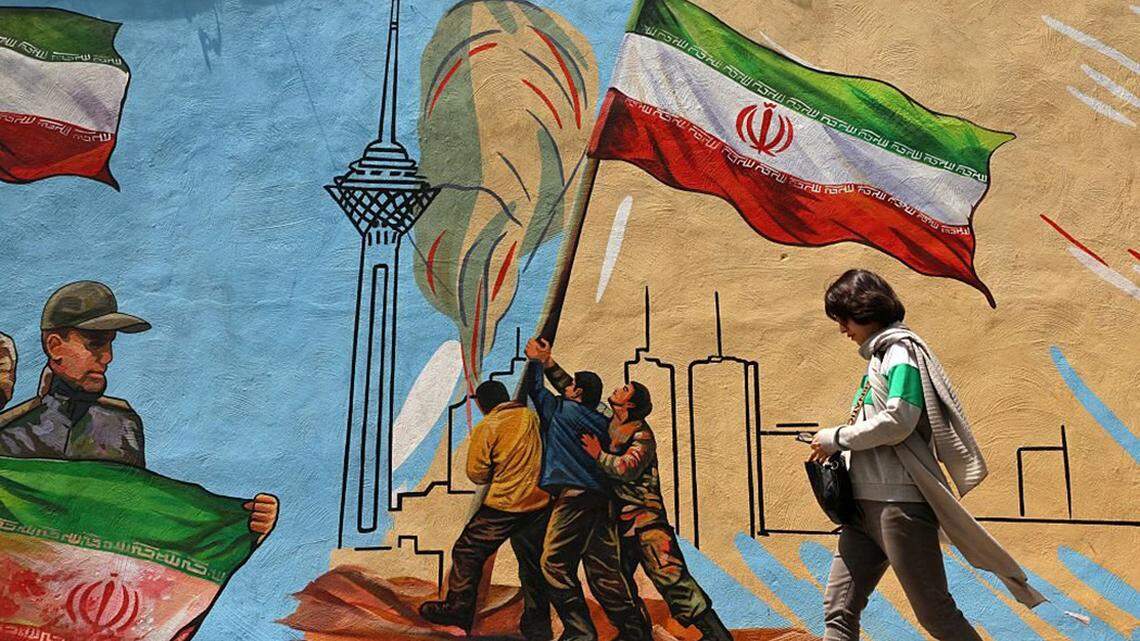
An Iranian woman walks past an anti-U.S. and anti-Israel mural in Tehran on Tuesday. President Donald Trump announced he was extending a ceasefire with Iran indefinitely, a day before it was set to expire, even as plans for a fresh round of talks between the two countries fell apart.
ATTA KENARE
AFP via Getty Images
President Donald Trump said Tuesday that he was extending a ceasefire with Iran that had been about to expire, even as Vice President JD Vance’s trip to Pakistan for a second round of negotiations with Iran was put on hold after Tehran failed to respond to American positions.
Trump said on social media that, at the request of Pakistan’s leadership, the ceasefire would stay in effect until Iran’s “proposal is submitted, and discussions are concluded, one way or the other.” The president, however, said that the U.S. military would continue to blockade Iranian ports.
That stance appeared to be a major sticking point for Iran. The country’s foreign minister, Abbas Araghchi, said on social media earlier Tuesday that the blockade was “an act of war and thus a violation of the ceasefire.”
Although the two-week truce, which had been set to end Wednesday in Iran, was extended, it was unclear what steps Iran or the United States would take next.
Vance, who had been expected to travel to Pakistan on Tuesday morning, was staying in Washington to attend additional policy meetings, a White House official said. The official spoke on condition of anonymity to discuss potential scheduling.
A spokesperson for Iran’s Foreign Ministry, Esmaeil Baghaei, said Iran had not decided whether to send its negotiators to Pakistan. Baghaei blamed “contradictory messages, inconsistent behavior and unacceptable actions by the American side,” according to Iran’s state broadcaster, IRIB.
In private, two senior Iranian officials had said Monday that Mohammad Bagher Ghalibaf, a former Revolutionary Guard commander and speaker of the Iranian parliament, would attend negotiations in Pakistan if Vance were there.
As recently as Tuesday morning, Vance had still been planning to travel to Pakistan. But because Iran had given no response to the Trump administration’s negotiating positions, the U.S. official said, the diplomatic process was in effect paused.
The talks could be back on at a moment’s notice if Iran’s negotiators respond in a way that Trump deems acceptable. U.S. officials were also looking for a clear sign that Iran’s negotiators had been fully empowered to reach an agreement.
The delay was another hurdle in the Trump administration’s push to secure an agreement that would curb Iran’s nuclear program, and it came as U.S. forces remain poised to launch another wave of strikes on Iran, having maintained their substantial presence in the Middle East.
Even if the sides return to the negotiating table, many sticking points remain on Iran’s nuclear program and the Strait of Hormuz, a strategic conduit for oil and gas off Iran’s southern coast. The threat of Iranian attacks has throttled ship traffic through the strait, prompting an American blockade of Iranian ports that the U.S. Navy says has forced 28 ships to turn around.
The United States recently transmitted a written proposal to the Iranians intended to establish baseline points of agreement that could frame more detailed negotiations. The document covered a broad range of issues, but the core sticking points were the same ones that have bedeviled Western negotiators for more than a decade: the scope of Iran’s uranium enrichment program and the fate of its stockpile of enriched uranium.
It’s unclear what exactly the United States has proposed or what the president would be willing to accept. The American position could range from demanding that Iran abandon enrichment entirely to allowing a limited civilian program under strict oversight by the International Atomic Energy Agency, paired with the closure of Iran’s underground nuclear facilities.
One of the ideas discussed during negotiations last year was a multinational consortium working with Iran to enrich uranium for civilian uses; potential locations included an island in the Persian Gulf. Regarding the stockpile, negotiators are weighing options, including whether Iran should surrender its enriched uranium directly to the United States or transfer it to a third country.
Also on the table is what the United States might offer in return. Iran has hundreds of billions of dollars in assets frozen under American sanctions as part of Trump’s maximum-pressure campaign, and administration officials are debating whether releasing some of those funds could be part of a final deal. Officials have also discussed whether the United States and Persian Gulf partners such as Saudi Arabia and the United Arab Emirates might offer broader economic integration to Iran.
Trump has been adamant in private conversations that his deal must be better than the one struck by President Barack Obama in 2015. Knowing that, Iran hawks close to the president have repeatedly invoked Obama’s deal as a tactic to keep him from agreeing to what they view as dangerous concessions.
Any American position on enrichment will have to contend with Iran’s long-standing argument, rooted in its accession to the Nuclear Nonproliferation Treaty, that the pact guarantees signatories the right to enrich uranium for peaceful purposes.
The pause in talks capped a turbulent few days of public messaging from Trump, whose statements have at times appeared at odds with the state of the negotiations.
In a telephone interview with CBS News on Friday, Trump declared that Iran had “agreed to everything” and described a joint operation to remove Iranian nuclear material. “Our people, together with the Iranians, are going to work together to go get it. And then we’ll take it to the United States,” he said. Iranian officials quickly disputed that characterization.
Then on Sunday, Trump wrote on Truth Social that Iran had violated the ceasefire by firing on commercial vessels in the Strait of Hormuz, including a French ship and a British freighter. That same day, U.S. military forces seized an Iranian-flagged ship, the Touska, that Trump said had tried to evade the blockade on the country’s ports.
On Tuesday, the U.S. military stopped and boarded a tanker in the Indian Ocean that was carrying oil from Iran, the Pentagon said. It was the latest effort by the Trump administration to squeeze Iran’s oil-reliant economy since the United States and Israel began attacking Iran on Feb. 28.
“We will pursue global maritime enforcement efforts to disrupt illicit networks and interdict sanctioned vessels providing material support to Iran -- anywhere they operate,” the Defense Department said in a statement that included a video that appeared to show Navy SEALS landing by helicopter on the ship, the M/T Tifani.
The Pentagon added that it would “continue to deny illicit actors and their vessels freedom of maneuver in the maritime domain.”
With the M/T Tifani now at least temporarily in the custody of the military, a U.S. military official said it was up to the White House to decide what to do with the sanctioned vessel and its cargo, which the official said was in the Bay of Bengal.
In Lebanon, more fighting between Israel and Hezbollah, a militia backed by Iran, threatened a 10-day ceasefire announced by Israel and the Lebanese government last week.
Hezbollah confirmed Tuesday that it had fired rockets and drones into northern Israel in what it said was a response to Israeli violations of the ceasefire. The Israeli military has kept up its strikes against Hezbollah in southern Lebanon, citing a right to “self-defense” as outlined in the truce.
Workers dig near the graves of Hezbollah members in a damaged cemetery in the southern Lebanese village of Mansouri, on Tuesday, April 21, 2026. The U.S. State Department will host a second round of ambassador-level talks between Israel and Lebanon, which are in a cease fire, on Thursday, the department said. (David Guttenfelder/The New York Times) DAVID GUTTENFELDER NYT
A family drives through the ruins of the southern Lebanese village of Mansouri, on Tuesday, April 21, 2026. The U.S. State Department will host a second round of ambassador-level talks between Israel and Lebanon, which are in a cease fire, on Thursday, the department said. (David Guttenfelder/The New York Times) DAVID GUTTENFELDER NYT
A man stacks bottles of water in the ruins of the southern Lebanese village of Mansouri, on Tuesday, April 21, 2026. The U.S. State Department will host a second round of ambassador-level talks between Israel and Lebanon, which are in a cease fire, on Thursday, the department said. (David Guttenfelder/The New York Times) DAVID GUTTENFELDER NYT
Mourners, some wearing yellow Hezbollah scarves, during a mass funeral for 20 people in the southern Lebanese village of Qlaileh, on Tuesday, April 21, 2026. The cease fire has given families who had fled because of Israeli evacuation warnings the opportunity to return to the village and bury their relatives killed during the war after being temporarily buried in transit cemeteries. (David Guttenfelder/The New York Times) DAVID GUTTENFELDER NYT
A grieving man, with a tattoo of the late Hezbollah leader Hassan Nasrallah on his arm, touches a coffin draped in the Hezbollah flag during a mass funeral for 20 people in the southern Lebanese village of Qlaileh, on Tuesday, April 21, 2026. The cease fire has given families who had fled because of Israeli evacuation warnings the opportunity to return to the village and bury their relatives killed during the war after being temporarily buried in transit cemeteries. (David Guttenfelder/The New York Times) DAVID GUTTENFELDER NYT
Mourners carry a coffin draped in the Hezbollah flag during a mass funeral for 20 people in the southern Lebanese village of Qlaileh, on Tuesday, April 21, 2026. The cease fire has given families who had fled because of Israeli evacuation warnings the opportunity to return to the village and bury their relatives killed during the war after being temporarily buried in transit cemeteries. (David Guttenfelder/The New York Times) DAVID GUTTENFELDER NYT
People pass near a billboard depicting American aircraft in a net in Enghelab Square in Tehran, on Monday, April 20, 2026. Despite sending mixed signals in recent days, both the United States and Iran gave clearer indications on Monday that they were planning to send negotiators to peace talks in Pakistan this week. (Arash Khamooshi/The New York Times) ARASH KHAMOOSHI NYT
Clerics and others rest at the Grand Bazaar near images of Iranian Revolutionary Guard commanders and officials killed in airstrikes in Tehran, on Monday, April 20, 2026. Despite sending mixed signals in recent days, both the United States and Iran gave clearer indications on Monday that they were planning to send negotiators to peace talks in Pakistan this week. (Arash Khamooshi/The New York Times) ARASH KHAMOOSHI NYT
People people cross a street packed with taxi cabs in Tehran, on Monday, April 20, 2026. Despite sending mixed signals in recent days, both the United States and Iran gave clearer indications on Monday that they were planning to send negotiators to peace talks in Pakistan this week. (Arash Khamooshi/The New York Times) ARASH KHAMOOSHI NYT
People walk at the Grand Bazaar under a banner of Ayatollah Ali Khamenei, Iran's slain supreme leader, in Tehran, on Monday, April 20, 2026. Despite sending mixed signals in recent days, both the United States and Iran gave clearer indications on Monday that they were planning to send negotiators to peace talks in Pakistan this week. (Arash Khamooshi/The New York Times) ARASH KHAMOOSHI NYT
People walk under a banner of Ayatollah Ali Khamenei, Iran's slain supreme leader, in Tehran, on Monday, April 20, 2026. Despite sending mixed signals in recent days, both the United States and Iran gave clearer indications on Monday that they were planning to send negotiators to peace talks in Pakistan this week. (Arash Khamooshi/The New York Times) ARASH KHAMOOSHI NYT
A group of internally displaced people expand their shelter in Beirut, Lebanon, on Monday, April 20, 2026. The Lebanese president said he had appointed a former ambassador to the United States to lead talks aimed at ending war with Israel and achieving a complete Israeli withdrawal from southern Lebanon. (Diego Ibarra Sánchez/The New York Times) DIEGO IBARRA SANCHEZ NYT
A group of internally displaced people spend the evening under a shelter in Beirut, Lebanon, on Monday, April 20, 2026. The Lebanese president said he had appointed a former ambassador to the United States to lead talks aimed at ending war with Israel and achieving a complete Israeli withdrawal from southern Lebanon. (Diego Ibarra Sánchez/The New York Times) DIEGO IBARRA SANCHEZ NYT
Men stop to photograph a bridge, which was destroyed by an Israeli airstrike before a recent ceasefire, over the Litani River near the village of Tayr Felsay in southern Lebanon, on Monday, April 20, 2026. The Lebanese president said he had appointed a former ambassador to the United States to lead talks aimed at ending war with Israel and achieving a complete Israeli withdrawal from southern Lebanon. (David Guttenfelder/The New York Times) DAVID GUTTENFELDER NYT
Mourners gather around coffins draped in the Lebanese flag during a mass funeral in the southern Lebanese village of Bazourieh, on Monday, April 20, 2026. Families gathered for the funeral of nine people -- both Hezbollah fighters and civilians -- who were killed in recent weeks.(David Guttenfelder/The New York Times) DAVID GUTTENFELDER NYT
Family members grieve over a loved-one's coffin draped in the Lebanese flag as a convoy of ambulances arrive in the southern Lebanese village of Bazourieh for a mass funeral, on Monday, April 20, 2026. Families gathered for the funeral of nine people -- both Hezbollah fighters and civilians -- who were killed in recent weeks (David Guttenfelder/The New York Times) DAVID GUTTENFELDER NYT
Family members grieve as a convoy of ambulances carrying the coffins of their loved ones arrive in the southern Lebanese village of Bazourieh for a mass funeral, on Monday, April 20, 2026. Families gathered for the funeral of nine people -- both Hezbollah fighters and civilians -- who were killed in recent weeks (David Guttenfelder/The New York Times) DAVID GUTTENFELDER NYT
Mourners gather by coffins draped in the Hezbollah flag as a convoy of ambulances arrive in the southern Lebanese village of Bazourieh for a mass funeral, on Monday, April 20, 2026. Families gathered for the funeral of nine people -- both Hezbollah fighters and civilians -- who were killed in recent weeks (David Guttenfelder/The New York Times) DAVID GUTTENFELDER NYT
Family members grieve as the coffins of their loved ones arrive in a convoy of ambulances in the southern Lebanese village of Bazourieh for a mass funeral, on Monday, April 20, 2026. Families gathered for the funeral of nine people -- both Hezbollah fighters and civilians -- who were killed in recent weeks (David Guttenfelder/The New York Times) DAVID GUTTENFELDER NYT
A man holds up a portrait of the slain Hezbollah leader Hassan Nasrallah as he is driven past the wreckage of a building destroyed in an Israeli airstrike in Dahiyeh, the suburb south of Beirut, Lebanon, on Monday, April 20, 2026. Joseph Aoun, the Lebanese president, said that he had appointed Simon Karam, a former ambassador to the United States, to lead talks with Israel aimed at ending the war and achieving a complete Israeli withdrawal from southern Lebanon. (Diego Ibarra Sánchez/The New York Times) DIEGO IBARRA SANCHEZ NYT
A man surveys the wreckage left by Israeli airstrikes in Dahiyeh, the suburb south of Beirut, Lebanon, on Monday, April 20, 2026. Joseph Aoun, the Lebanese president, said that he had appointed Simon Karam, a former ambassador to the United States, to lead talks with Israel aimed at ending the war and achieving a complete Israeli withdrawal from southern Lebanon. (Diego Ibarra Sánchez/The New York Times) DIEGO IBARRA SANCHEZ NYT
A boy is welcomed by his aunt and uncle on Monday, April 20, 2026, as he and his family, in the background, cross the wreckage of a bridge over the Litani River that was destroyed in an Israeli airstike near the village of Tayr Felsay, Lebanon. The boy and his family are among those displaced by the fighting who are returning to their homes in southern Lebanon as a cease-fire between Israel and Hezbollah appears to be largely holding. (David Guttenfelder/The New York Times) DAVID GUTTENFELDER NYT
A man cleans off a portrait of the slain Hezbollah leader Hassan Nasrallah while clearing debris from a building destroyed in an Israeli airstrike in Dahiyeh, the suburb south of Beirut, Lebanon, on Monday, April 20, 2026. Joseph Aoun, the Lebanese president, said that he had appointed Simon Karam, a former ambassador to the United States, to lead talks with Israel aimed at ending the war and achieving a complete Israeli withdrawal from southern Lebanon. (Diego Ibarra Sánchez/The New York Times) DIEGO IBARRA SANCHEZ NYT
Workers dig near the graves of Hezbollah members in a damaged cemetery in the southern Lebanese village of Mansouri, on Tuesday, April 21, 2026. The U.S. State Department will host a second round of ambassador-level talks between Israel and Lebanon, which are in a cease fire, on Thursday, the department said. (David Guttenfelder/The New York Times) DAVID GUTTENFELDER NYT