
Iran offers plan to focus on Strait of Hormuz and delay nuclear talks
Iran has offered the United States a new proposal for negotiations that focuses on opening the Strait of Hormuz and lifting the U.S. sea blockade on Iran as a way of ending the war and then tackling nuclear negotiations later, according to three Iranian officials.
Iran’s foreign minister, Abbas Araghchi, delivered this latest plan to Pakistan on Sunday, after an initial proposal from Iran a day earlier had been rejected by President Donald Trump, according to the Iranian officials familiar with the details of negotiations who asked not to be named because they were discussing sensitive diplomacy.
Trump has told advisers he is not satisfied with Iran’s latest proposal to reopen the Strait of Hormuz and end the war, according to multiple people briefed on discussions in the White House Situation Room on Monday.
It is not clear precisely why the president is not satisfied with the proposal, but he has repeatedly insisted that Iran cannot have nuclear weapons. A U.S. official also said that accepting it could appear to deny Trump a victory.
The White House declined to comment on Trump’s thinking, but officials noted that discussions would continue over the war and Iran’s enrichment efforts.
“The United States will not negotiate through the press — we have been clear about our red lines and the president will only make a deal that’s good for the American people and the world,” Olivia Wales, a White House spokesperson, said in a statement.
“They have achieved none of their goals, and this is why they are asking for negotiations; we are now considering it,” Araghchi said to a Russian reporter Monday, according to a video of the interview.
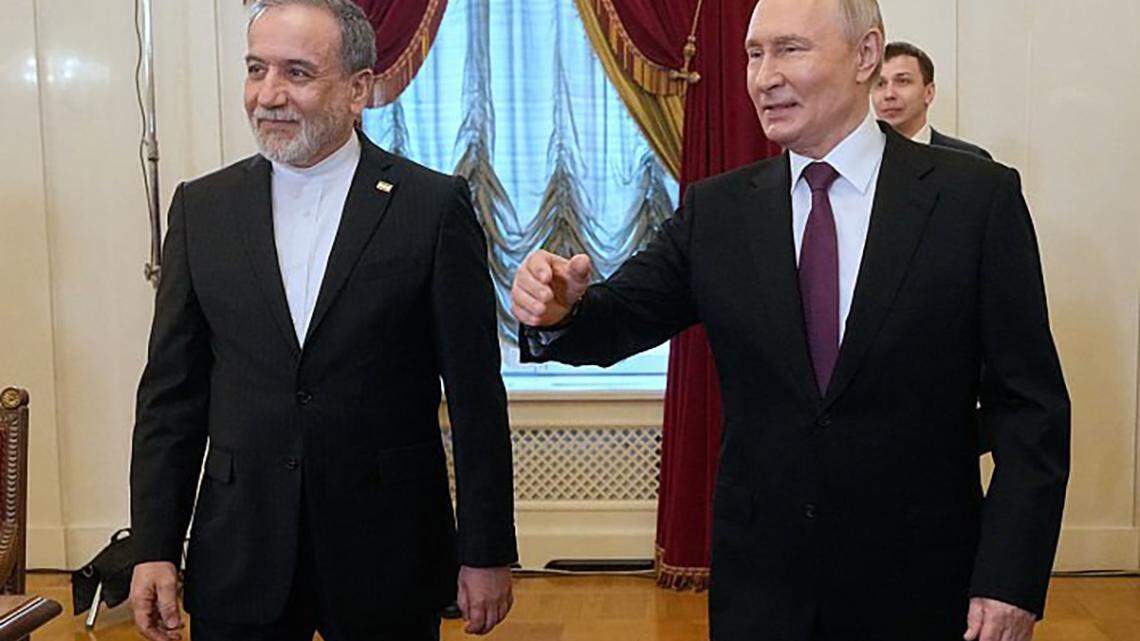
During a meeting with President Vladimir Putin and Foreign Minister Sergey Lavrov in Moscow on Monday, Araghchi said he’s committed to strengthening the country’s partnership with Russia, as talks with the U.S. on ending an eight-week war remain at an impasse.
Araghchi added that the Iranian people are able to resist “U.S. aggression and will be able to overcome it,” Iran’s state-owned Nour News said on Monday.
Iran’s new proposal was delivered after weeks in which Tehran and Washington exchanged draft proposals but made no headway on the thorny issues surrounding Iran’s nuclear program. The United States has demanded that Iran suspend its nuclear program for 20 years and hand over its 972-pound stockpile of highly enriched uranium, which could quickly be turned into several bombs if Iran chose to militarize its program.
Iran has refused, calling the U.S. demands overreaching. In the proposal Iran delivered to Pakistan on Saturday, Iran had offered a five-year suspension of its uranium enrichment, followed by five years of very low-grade civilian enrichment in labs. It would have diluted its stockpile and kept half of it at home under international inspectors while giving the other half to Russia, an ally.
But the United States rejected the offer. Trump said Saturday that Iranians had given him a response that was “not good enough.”
So Iran came up with another idea: Leave the harder issues for later.
“This is a face-saving change in sequencing: put Hormuz first as part of war-ending arrangements, not formal negotiations, lift the blockade, and defer the harder issues so they don’t sink the process at the outset,” said Ali Vaez, the Iran director for the International Crisis Group, a conflict-prevention research organization.
Since the war started, a cohort of senior generals of Iran’s Revolutionary Guard have been running the war and making key decisions about strategy, ceasefire and talks with the United States, according to Iranian officials. The new supreme leader, Ayatollah Mojtaba Khamenei, gravely injured and isolated in hiding, has deferred authority to the generals.
On Monday, 261 Iranian lawmakers from various political factions signed a statement in support of the negotiating team, led by parliament Speaker Gen. Mohammad Bagher Ghalibaf, to signal unity. But five lawmakers from the ultra-hard-line faction, opposed to any concessions with Washington, refused to sign.
In the new proposal made on Sunday, Iran said that it plans to monetize the Strait of Hormuz, once it is open to maritime traffic, by charging a toll or service fees to passing tankers. Some Iranian officials have publicly floated the idea of a $2 million per vessel toll, saying the money would exceed Iran’s oil revenues. But Oman, which also shares the southern part of the Strait, and other Arab countries in the Persian Gulf, oppose this idea and have called for unconditional opening of the waterway.
The idea to leave nuclear talks for a later date is an attempt to break the current stalemate, with a fragile ceasefire barely holding. The three Iranian officials said Iran does want to return to the negotiating table with the Americans, recognizing that the current status quo was not tenable, but does not want to do it while under the blockade of the U.S. Navy.
Over the weekend, Trump abruptly canceled the trip of his negotiators to Pakistan, where they were supposed to meet indirectly, through mediation by Pakistan, with Araghchi.
But after Iran said it had no plans to meet with the Americans, the foreign minister departed Pakistan, and Trump said special envoy Steve Witkoff and his son-in-law Jared Kushner were not traveling to Islamabad for nothing.
The American sea blockade on Iran is causing economic duress in the aftermath of bombings by the United States and Israel that left much of Iran’s infrastructure and industries in ruins.
Iranian officials said there was concern that storage warehouses for basic food items would become empty within a few weeks. The war has disrupted domestic production, and the blockade is preventing Iran from importing goods through its major shipping ports along the Persian Gulf. The government has already started contingency plans for alternative routes, trucking in goods from Pakistan and Turkey and shipping smaller loads from Russia via the Caspian Sea, the officials said.
Oil rose further on Monday, with the strait remaining largely impassable. Brent settled at $108.23 a barrel, up more than 2% since Friday.
Analysts at Goldman Sachs Group Inc. upgraded their fourth-quarter forecast for Brent crude to $90 a barrel from $80 per barrel, saying they now see a “normalization” of crude exports from the Persian Gulf by the end of June, versus mid-May previously.
Bloomberg News contributed to this report.
This article originally appeared in The New York Times.
Copyright 2026 The New York Times Company