
Josh Shapiro isn’t Harris’ VP pick, but PA remains crucial in 2024’s race. Here’s why
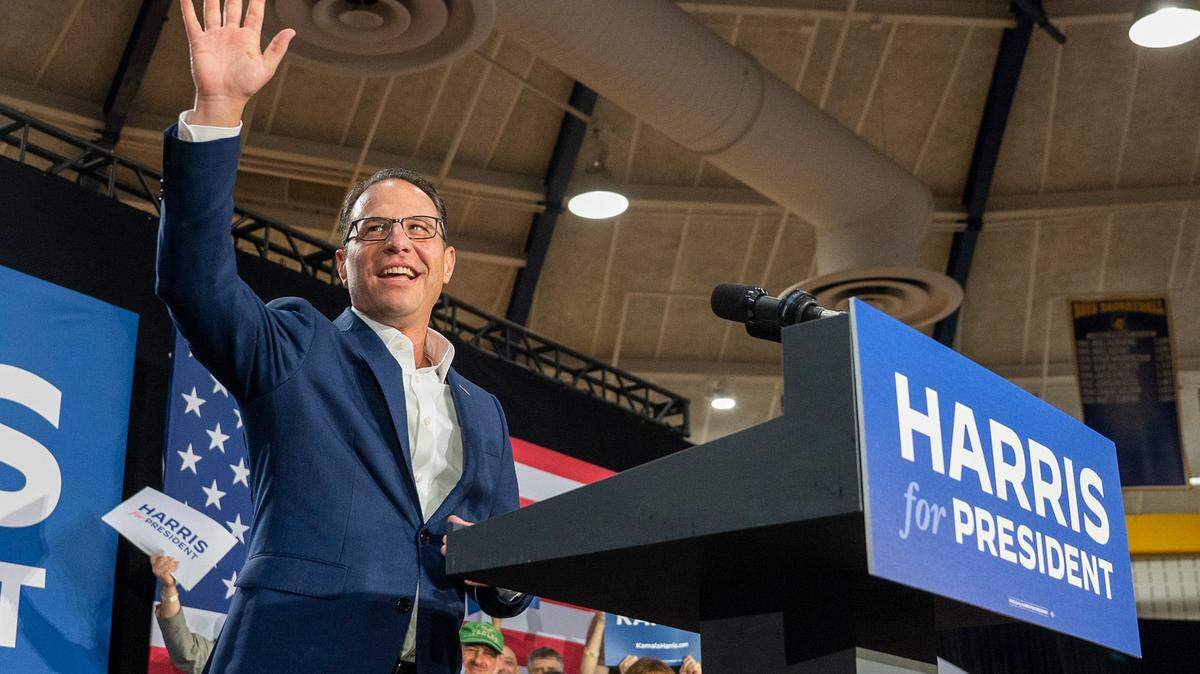
Gov. Josh Shapiro is sticking around in Pennsylvania for now.
Vice President Kamala Harris, the Democratic nominee for president, has selected Gov. Tim Walz of Minnesota as her running mate, she announced Tuesday morning. As the pair campaigns for the Oval Office in 2024, Shapiro will remain in Harrisburg as Pennsylvania’s first-term governor until at least early 2027.
Although Shapiro missed the chance to join Harris’ ticket, Pennsylvania remains a critical focus of the Republican and Democrat campaigns this election cycle. Here’s why the Keystone State is so important on Election Day and beyond.
A crucial swing state
Unlike some other states like California or Texas, Pennsylvania is widely recognized as a “swing state” — one that can reasonably be won by either the Republican or Democratic candidate in statewide or national elections by even a razor-thin margin. Swing states, including Pennsylvania, Arizona, Michigan and Wisconsin, are often the deciding factor in helping either party’s candidate pass the required simple majority of 270 electoral votes to win a presidential election.
Over the last 50 years, Pennsylvania has almost always wound up swinging toward the eventual elected president. Here’s a look at how the Keystone State has swung since the 1976 general election, with candidates who were elected president highlighted in bold text:
- 1976 — Jimmy Carter (D), 27 electoral votes
- 1980 — Ronald Reagan (R), 27 electoral votes
- 1984 — Ronald Reagan (R), 25 electoral votes
- 1988 — George H. W. Bush (R), 25 electoral votes
- 1992 — Bill Clinton (D), 23 electoral votes
- 1996 — Bill Clinton (D), 23 electoral votes
- 2000 — Al Gore (D), 23 electoral votes
- 2004 — John Kerry (D), 21 electoral votes
- 2008 — Barack Obama (D), 21 electoral votes
- 2012 — Barack Obama (D), 20 electoral votes
- 2016 — Donald Trump (R), 20 electoral votes
- 2020 — Joe Biden (D), 20 electoral votes
Since 1900, Pennsylvania has voted for the overall winning candidate in 24 of 31 general elections (77%). However, the results are often close, especially in recent years. Biden won the Keystone State by just 1.2% in 2020, while Trump claimed the commonwealth by an even more narrow 0.7% edge in 2016.
The allocation of electoral votes to each U.S. state changes every decade to reflect population changes, which are recorded by the U.S. Census Bureau. Pennsylvania’s ultimate influence on the election has remained strong despite losing eight electoral votes since 1976, dropping down to 19 for the 2024 and 2028 elections.
Pennsylvania still has the fifth-most electoral votes among all states, tying with Illinois at 19.
The Shapiro sweepstakes are over
Shapiro, who became Pennsylvania’s 48th governor after assuming office in 2023, is the latest Keystone State politician to fail to reach the White House.
In a statement released Tuesday morning, Shapiro endorsed Walz as Harris’ running mate and said he remains committed to Pennsylvania through the end of his term.
“As I’ve said repeatedly over the past several weeks, the running mate decision was a deeply personal decision for the Vice President — and it was also a deeply personal decision for me,” Shapiro wrote in a statement. “Pennsylvanians elected me to a four-year term as their Governor, and my work here is far from finished — there is a lot more stuff I want to get done for the good people of this Commonwealth.”
Despite its history as the second-oldest state in the union, Pennsylvania can claim only one elected vice president. That would be George Mifflin Dallas, the former Philadelphia mayor and Pennsylvania attorney general who served under President James K. Polk from 1845 to 1849.
No sitting Pennsylvania governor has significantly pursued a presidential or vice presidential bid since Milton Shapp did in the mid-1970s. Former governors such as William Scranton and Robert E. Pattison also vied for the Republican and Democratic nominations for presidents, respectively, but lost their bids.
James Buchanan, who served as president from 1857 to 1861 and is known for remaining a lifelong bachelor, is the only president primarily affiliated with Pennsylvania to hold the nation’s highest office. Joe Biden, who was born in Scranton and is the only other president born in Pennsylvania, moved out of the commonwealth with his family as a young child and spent most of his adolescence and adult life in Delaware, which he represented as a senator for nearly four decades.
Where does Shapiro stand on key issues?
Although Shapiro isn’t heading to the White House anytime soon, he seems primed for higher ambitions after serving as Pennsylvania’s governor. Here’s a look at his public stances and accomplishments on a few key issues:
Abortion and health care
Shapiro has voiced strong support for abortion rights in Pennsylvania. During his campaign for governor, he vowed to veto bills banning or restricting abortion access in the commonwealth. He seeks to protect “the freedom of Pennsylvanians to make their own health care decisions,” according to his administration’s website.
The governor previously signed a landmark bill into law that requires insurers to cover preventative screenings for breast and ovarian cancer for high-risk patients at no cost. He also used an executive order to establish the Pennsylvania Behavioral Health Council, which works to “address any gaps in access, affordability and delivery of mental health and substance use disorder services” in the commonwealth.
Both state budgets passed so far under Shapiro’s watch have included substantial funding boosts for mental health initiatives, including $100 million to support such programs for K-12 schools.
As attorney general, Shapiro led efforts to protect health care access for nearly 2 million Pennsylvanians by forcing an agreement between health care giants UPMC and Highmark. He also helped negotiate $1 billion for Pennsylvania as part of a national opioid settlement.
School choice and education
Shapiro’s support for a traditionally conservative idea — taxpayer-funded private school vouchers — came under scrutiny as he attempted to work with lawmakers to pass the commonwealth’s 2023-24 budget. Ultimately, the budget passed once he struck the $100 million state-backed voucher program from the package.
Shapiro has since tempered his position on creating a voucher program by stating he would only support it if it does not draw money away from public education. Though voucher programs vary, they generally help pay for tuition at private and religious schools by diverting funding from public schools.
The state budgets passed under Shapiro’s watch have included significant investments in public education, including sufficient funding to provide universal free breakfast for about 1.7 million students. The recently approved $47.6 billion 2024-25 budget includes $1.1 billion in new spending on K-12 education, marking the biggest one-year increase for school spending in the commonwealth’s history, the governor said.
Israel and the war in Gaza
Shapiro has broadly embraced his Jewish identity as a politician and said he supports Israel’s right to exist as a Jewish state.
The 51-year-old governor recently drew scrutiny for an essay he penned three decades ago for his college newspaper, in which he argued Palestinians were “too battle-minded” to coexist in the Middle East alongside Israelis peacefully, according to the New York Times. Shapiro attempted to distance himself from those remarks during a news conference Friday.
Now, Shapiro publicly backs a two-state solution in the region. He has long been critical of Israel Prime Minister Benjamin Netanyahu and said global leaders “can’t ignore the death and destruction” occurring in Gaza. Shapiro supported Israel’s “right to defend itself” following Hamas-led terrorist attacks in October 2023.
Back in May, Shapiro quietly advised his administration’s code of conduct to prevent state employees from engaging in “scandalous or disgraceful” behavior — a move aimed at curbing antisemitism and other forms of hate speech, according to Spotlight PA. Shapiro has argued some demonstrations against Israel’s war in Gaza have crossed a line into bigotry. The governor notably called on University of Pennsylvania students to disband an on-campus protest encampment “to restore order and safety.”
Taxes
Shapiro recently defended his support for “aggressive” corporate tax cuts in Pennsylvania, which are already on their way down thanks to a deal struck by former Gov. Tom Wolf. Despite bipartisan support in the state Senate, a $3 billion tax cut plan that would lower the personal income tax and hasten that reduction on corporate income tax did not wind up in the approved $47.6 billion state budget for 2024-25.
On July 30, Shapiro announced a partnership that will bring the Internal Revenue Service’s Direct File to Pennsylvania for the 2025 filing season. The free tool allows all Pennsylvanians to file federal income taxes online and build on myPATH, the commonwealth’s own tool that helps taxpayers file state income taxes and apply for tax cuts.
This story was originally published August 6, 2024 at 10:42 AM.
%202.JPG)