
Pennsylvania adds 6 more counties to spotted lanternfly quarantine. What to know
An invasive pest that poses a significant threat to the commonwealth’s agriculture continues to make inroads in Pennsylvania.
Friday, the state Department of Agriculture added the following counties to its ongoing spotted lanternfly quarantine list: Butler, Clearfield, Clinton, Fayette, Lawrence and Somerset counties. Businesses must acquire a permit to move products and vehicles through and between affected counties.
Following the latest additions, 51 of Pennsylvania’s 67 counties are quarantined.
Although the added counties are not fully infested, the invasive insects have been found in some municipalities within their borders, the Department of Agriculture said.
.png "PA_SLF_Quarantine_2.25.23 (003).png")
“Spotted lanternfly is an invasive pest that is disruptive and damaging to our agriculture commodities and a nuisance pest for all Pennsylvanians,” Agriculture Secretary Russell Redding said in a statement. “Through collective and intentional efforts, including instituting quarantine zones, we continue to slow the spread of this insect, and I call on all Pennsylvanians to assist.”
In a statement, Redding said the Pennsylvania Farm Bill Rapid Response and Disaster Preparedness Fund will make $150,000 available for county conservation districts across the commonwealth. Officials can apply for up to $25,000 to help improve quarantine compliance for businesses and residents.
Applications for the grant will open March 5 and close April 7, the department said.
What does a spotted lanternfly quarantine mean?
Pennsylvania’s spotted lanternfly quarantine prohibits the intentional movement of the insects in any living stage, including egg masses, nymphs and adults. Violations can result in civil or criminal penalties and fines, the Department of Agriculture said.
Quarantine restrictions apply to several regulated products, the commonwealth said, including the following:
- Landscaping, remodeling or construction waste
- Logs, stumps or any tree parts
- Firewood of any species
- Grapevines for decorative purposes or as nursery stock
- Nursery stock
- Packing materials such as pots, crates, pallets, etc.
- Outdoor household articles including recreational vehicles, tractors and mowers, grills and furniture and their covers, tarps, mobile homes, tile, stone, deck boards, mobile fire pits, any associated equipment and vehicles not stored indoors
The Department of Agriculture maintains a running list of businesses that do and do not require permits while operating in counties under spotted lanternfly quarantine. A flow chart is also available to guide business owners through the steps needed to follow quarantine orders.
While residents and homeowners are not required to file for permits, they are encouraged to check for the insects at home and inspect their vehicles to keep spotted lanternflies from spreading. Pennsylvanians living in quarantine zones can also review and sign a compliance checklist.
Anyone can report a spotted lanternfly sighting by calling 1-888-422-3359 or visiting the Department of Agriculture’s interactive map, available online.
If fresh egg masses are found, experts recommend scraping them into a bag or container filled with hand sanitizer or rubbing alcohol to prevent hatching.
“The purpose of expanding the quarantine is to raise awareness and slow the spread of the spotted lanternfly,” Ruth Welliver, Ph.D., director of the commonwealth’s Bureau of Plant Industry, said in a statement. “Thanks to an actively engaged community, and aggressive treatment and monitoring by the Department of Agriculture and our partners, we are limiting the spread and impact of this pest across the Commonwealth and are assisting our commodity growers in protecting their crops.”
About the spotted lanternfly
The spotted lanternfly is an invasive insect native to Asia. It was first discovered in Pennsylvania in Berks County in 2014. Since then, the invasive species has made its way through most of the commonwealth, as well as several other mid-Atlantic states.
The lanternflies feed on sap from several plants, which can decrease plant health and, in some instances, lead to their death. While feeding, the insects leave behind honeydew, a sugary waste product that builds up over time and can lead to the growth of sooty mold and black-colored fungi, experts say.
Spotted lanternflies are harmless to humans and animals, but their sap-sucking habits can devastate crops. In 2019, Penn State researchers estimated the planthopper pests could annually cost Pennsylvania’s economy up to $325 million by destroying susceptible trees and plants, including nurseries, vineyards, hardwood products and Christmas tree farms.
Like any living creature, spotted lanternflies follow a yearly growth pattern from egg masses to full-blown adults. The following chart, presented by the state Department of Agriculture, shows how the insects appear at each point in their life cycle.
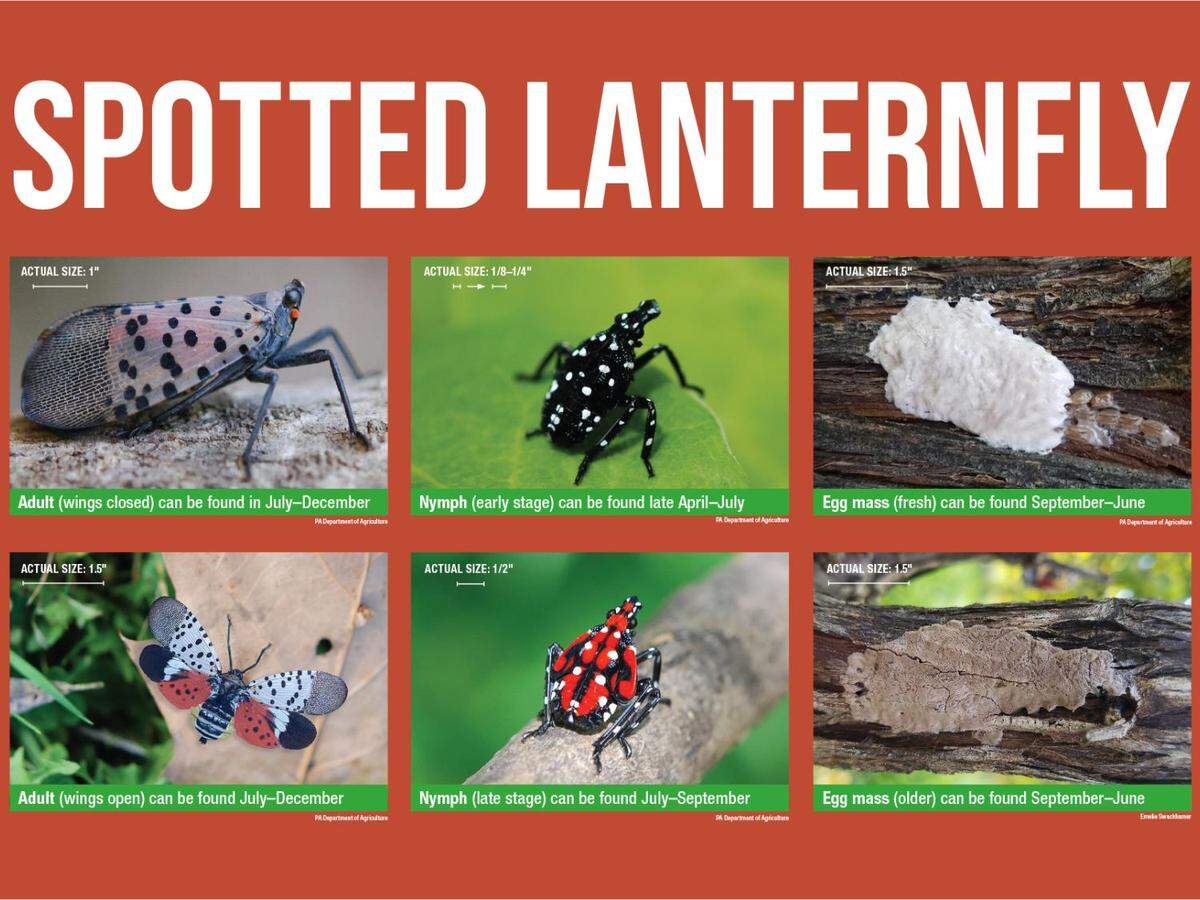
Spotted lanternflies lay their eggs in the fall, and they hatch between late April and June. Winter and early spring are generally the best times to find and destroy egg masses on your property, experts say.
The insects will lay eggs on just about any flat surface, including tree trunks and branches, rocks, outdoor equipment and even the sides of homes. Egg masses usually contain between 30 and 50 eggs. You can destroy them by scraping or by dropping egg masses in strong enough alcohol solutions.
When the lanternflies are spotted in their nymph or adult stages, stomp away. They’re known to jump from place to place, so you’ll need to be quick.
For more information on destroying spotted lanternflies and their egg masses, browse this comprehensive pamphlet produced by Penn State Extension.
%202.JPG)