
The inside story of how one man remade a small Pa. city while allegedly ripping off his neighbors
This story was produced by the State College regional bureau of Spotlight PA, an independent, nonpartisan newsroom dedicated to investigative and public-service journalism for Pennsylvania. Sign up for our regional newsletter, Talk of the Town.
DUBOIS — This is the city Herm Suplizio helped build.
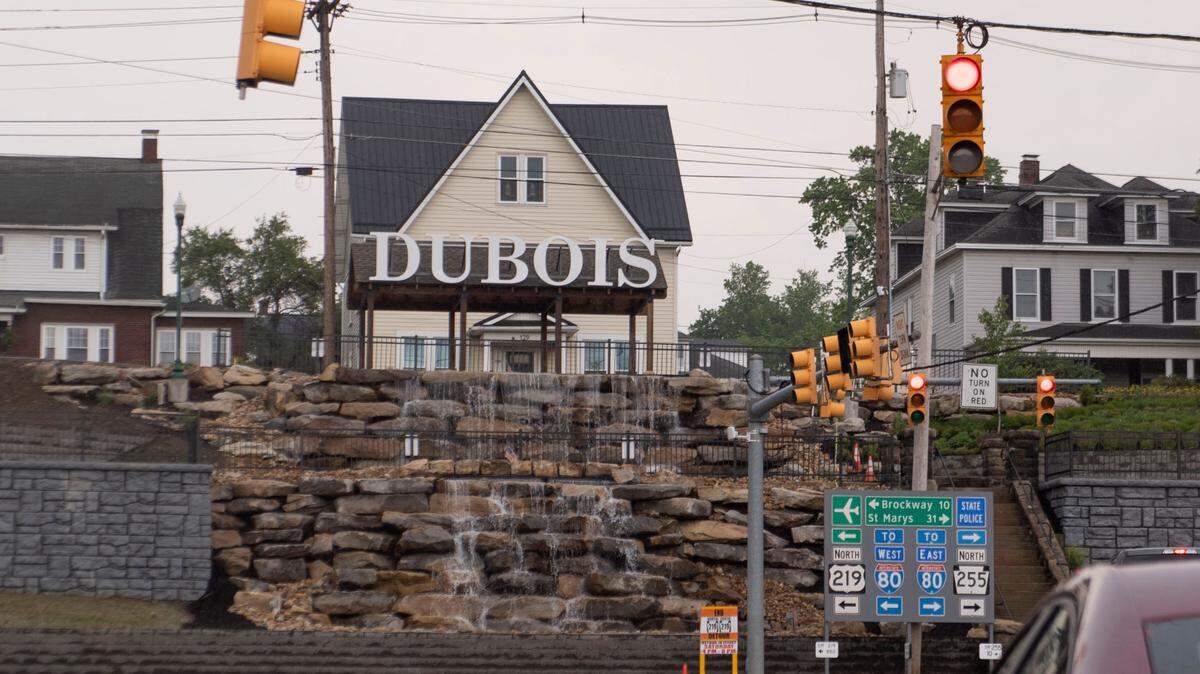
As you enter from the east, a large sign is perched on an embankment covered with gray stone and a gentle waterfall. It towers over DuBois Avenue, and spells out D-U-B-O-I-S in bold, four-foot-tall white letters — the result of $2.3 million in federal, state, and city funding that Suplizio oversaw.
The small city about 100 miles northeast from Pittsburgh is home to three first-rate ball fields, each molded according to Suplizio’s dream to be a destination for youth and collegiate sports. He oversaw their development, and found the money to pay for them.
On the north end of town, Suplizio upgraded the Tannery Dam area, a serene and beloved local fishing spot, by adding lighting, restrooms, and a sidewalk. The money came via the state with help from former Pennsylvania Senate President Pro Tempore Joe Scarnati — a “true friend” of DuBois, Suplizio has said.
This small city of about 7,400 people is in many ways an aberration. As many others like it across Pennsylvania have struggled to attract residents and investment, attention from Harrisburg, and coveted redevelopment dollars, DuBois — led by its city manager, Suplizio — has excelled.
As one of his supporters put it, he’s made DuBois “one of the richest little cities in all of Pennsylvania.”
But a massive corruption case brought against him by the state Office of Attorney General alleges Suplizio, too, was getting rich off DuBois’ success. Authorities allege he shrewdly used his power, network of political connections, and control over local organizations and charities to line his own pockets for almost a decade.
In all, they allege Suplizio stole hundreds of thousands of dollars in public and nonprofit funds. And the investigation appears to be expanding. Spotlight PA has learned that at least one current city official received a subpoena late last month to testify before a federal grand jury in Pittsburgh — while another employee was interviewed by the FBI — a sign that DuBois’ time under a microscope is far from over.
Suplizio has been suspended from his city job with pay since the charges were announced. He and his lawyers have said little publicly about the case, and have denied multiple requests for an interview for this story. He’s signaled to supporters that it’s all a big misunderstanding over what amounts to bad bookkeeping, and his allies on the City Council, along with the city’s solicitor, have circled the wagons around him.
For the past seven months, Spotlight PA has crisscrossed the city to speak with more than two dozen residents, elected officials, local business owners, community organizers, and nonprofit organizations. The newsroom filed a half dozen public records requests seeking a wide range of financial records — including city budgets, audits, legal bills, contracts, and bonus history — and attended city meetings and court hearings about Suplizio’s case.
The charges have led to uncomfortable questions about Suplizio’s time as city manager. Do his achievements stand on their own, or were they only borne out of entrenched corruption? If so, how could such crimes have gone unnoticed for so long?
But the story that emerges is as much about Suplizio as it is about a deep-rooted sense that if good things are happening in a community — especially amid the adversity faced by other small cities and towns in Pennsylvania — why question them, even when there are red flags?

Suplizio’s fields of dreams
The Suplizios are something of a political dynasty in DuBois.
Herm Suplizio was the youngest of seven children who grew up in the “flats” of DuBois, a section of the city that would often flood. His father, the late Dominick G. Suplizio Jr., was also born and raised in DuBois, and worked as a carman for the Baltimore and Ohio Railroad and the Chesapeake and Ohio Railroad for over four decades.
Throughout his life, Dominick Suplizio was deeply involved in DuBois’ storied volunteer fire department — a point of great pride for the city — as well as local government. He passed both traditions down to his son.
“I started off low, I started off at the bottom,” Herm Suplizio told a local television station in 2020 during an unsuccessful run for the state Senate.
A 1978 graduate of DuBois Central Catholic School, Suplizio built his reputation early on as a dedicated firefighter. Once recognized in Congress for his service to the city’s volunteer fire department, he became the fire chief in the 1990s and was a hands-on leader.
“He wasn’t just standing on the sideline. He was the first one running into the building,” said Shannon Gabriel, who until recently served on the DuBois City Council, and whose husband is also a volunteer firefighter. “As a wife of a firefighter, he is the one I would want by my husband’s side.”
Suplizio joined the city government in 2000 as mayor and president of the City Council. His priorities then were simple and included things like paving alleys and fixing sidewalks.
“I’m someone who likes to get things done,” Suplizio told the Lock Haven Express in 2020, highlighting his efforts to bolster the city’s infrastructure and pursue streetscape projects.
In testimony to the Pennsylvania Utility Commission, Suplizio said he was acting city manager “from the Fall of 2000 through 2002, and June of 2006 through 2010” at the same time that he was mayor. State law prohibits this conflict of power, and the DuBois City Council did not answer Spotlight PA’s questions about whether Suplizio’s statement was accurate or if anyone raised concern about the potential violation.
When Suplizio officially became city manager in 2010, he stepped into a position with vast powers. In 1980, DuBois adopted an optional “council-manager” plan for its government — one of only two Pennsylvania cities to do so. Under this structure, the appointed city manager becomes the chief administrator of the city, directing nearly all city staff and acting as a link — and a firewall — between the council and city departments.
As city manager, Suplizio’s vision for the city became bolder, one with a Field of Dreams-like quality: turning his small town into a world-class venue for youth and collegiate baseball. Build the fields, and the rest — tourists and all the benefits they would bring to the local economy — would follow.
It is the kind of dream that requires more cash than what a small-town budget can typically afford. Local governments in Pennsylvania rely heavily on property taxes for revenue, and ambitious projects with high price tags are often out of reach.
DuBois, records show, solved that problem in large part with state grants. In fact, it received far more than other cities of similar size.
A Spotlight PA analysis of state grants to Pennsylvania cities with populations from 5,000 to 10,000 people found DuBois raked in more than $13 million between 2014 and July 2023. That was the most per capita of any of its peers and more than double the average total.
Some of the money funded water and sewage projects. Other dollars went toward improving a bridge, a park, and the city’s pool, according to state data.
Through more than $600,000 in federal dollars and nearly $750,000 in state grants, for instance, DuBois financed the “top of the boulevard” project that erected the towering DuBois sign. (The city also paid over $1 million for it.) The site, Suplizio told the Courier Express newspaper, was “another way to add things to our city.”
Some of the largest grants went toward constructing or upgrading ball fields, records show.
Starting in 2013, the city launched a major renovation of one of its facilities, Showers Field. These days, it is home to the Small College World Series, among other competitions.
“It was the vision of City Manager, John ‘Herm’ Suplizio, to make the fields of the City of DuBois small versions of minor league ball fields and a place people would seek to play,” the city website proclaims. “That dream was achieved, as the City of DuBois is home to three of the best fields in the Tri-State area.”
More fields followed.
The city redeveloped a softball field into a “miracle” field in 2016 for players with disabilities. Formally called the Rose and Dennis Heindl Memorial Field, it is now a multipurpose facility that hosts the Little League Challenger Division.
The city paid for it, in part, with a $1.25 million grant from the state. In making the announcement, Suplizio thanked one person in particular: Joe Scarnati, then-president pro tempore of the Pennsylvania Senate.
A network of powerful friends
In DuBois, Scarnati was considered a friend. He hailed from Brockway, just a few miles to the north.
As the chamber’s top lawmaker until his retirement in 2020, Scarnati was in a prime position to help steer state money toward his own district.
In the years before the Republican lawmaker retired, grants that flowed to the city were even dubbed “Scarnati grants,” according to one DuBois employee who was not authorized to speak publicly on behalf of the city and asked to remain anonymous.
“We literally had CDs that were called ‘Scarnati Grant 1’ and ‘Scarnati Grant 2,’” the employee said, referring to the bank certificates of deposit that were created when the funding arrived.
Scarnati did not respond to requests for comment for this story.
Many of the state grants DuBois received over the past decade flowed from the Department of Community and Economic Development. Others, like the $1.25 million for Heindl Field, came from the state Redevelopment Assistance Capital Program, or RACP.
Though grants through RACP require a lengthy application process, politics fuels which projects are funded as much as merit, according to interviews with current and former Pennsylvania Capitol staffers. Legislative leaders actively participate in the process, lobbying for specific projects in their district and the districts of fellow lawmakers within their party.
Much of that brokering still takes place in secret.
Nathan Benefield, senior vice president of the conservative Commonwealth Foundation in Harrisburg, said many of the grant programs as a whole are more about “political development, not economic development.”
“It’s not transparent at all,” he said. “It’s done very much behind closed doors.”
DuBois also benefited from private donations from wealthy entrepreneurs and organizations. That money, according to interviews, was also leveraged through relationships that Suplizio forged.
How he did it remains opaque. Several people who spoke to Spotlight PA privately attributed his successes to a combination of charm and luck: Suplizio, they said, is charismatic, and he possesses a gift of gab that enables him to sell his vision for the city at every turn.
It also helped that prominent political and business figures hailed from the greater DuBois region.
Heindl Field, for instance, was underwritten by Ridgway businessman Denny Heindl, part owner of the Pittsburgh Pirates. He gave at least a quarter million dollars toward the construction of the venue plus $10,000 every year for the field’s maintenance. Pirates Charities, the team’s nonprofit that supports youth health, fitness, and education programs, donated another $100,000.
Not all of the private donations have been as transparent.
The Frank Varischetti Foundation — created in honor of its namesake businessman and run by his family, which is a minority owner of the Pittsburgh Steelers — donated a total of $100,000 to the City of DuBois between 2018 and 2021, according to its tax filings.
The filings do not detail what the money was intended for, and representatives from the foundation did not return calls or emails requesting comment. DuBois also rejected a public records request by Spotlight PA to provide information about its gifts and donations.
However, earlier this year, the city provided a copy of an agreement between itself and the foundation to LNP | LancasterOnline, a partner newsroom of Spotlight PA. The agreement, dated late November 2017, says the $100,000 was for the construction of a “boundless playground” in the city.
Peter Varischetti, the foundation’s secretary according to its most recent tax filing, has publicly praised Suplizio’s contributions to the city.
“Herm Suplizio gets results,” Varischetti, who did not respond to multiple requests for comment, wrote in a 2020 op-ed.
“I am proud to call Herm a friend.”
The endorsement came as Suplizio ran to succeed Scarnati in the state Senate as his handpicked candidate. Scarnati’s campaign committee donated more than $360,000 to the unsuccessful campaign. Varischetti chaired a political committee that donated more than $26,000 to Suplizio’s campaign.
Since leaving the state Senate, Scarnati has continued to bring money to DuBois in a new role. In 2021, Suplizio awarded the new lobbying firm Scarnati founded with partners Nick Varischetti and Tommy Johnson a $5,000 per month contract with the City of DuBois.
Though larger cities — like Lancaster, Philadelphia, Pittsburgh, and Reading — employ lobbyists, it is not common for smaller towns to have paid advocates in Harrisburg.
The firm helped DuBois land more than $4 million from four different state grants “for the betterment of the community,” it said in an email obtained through a public records request.
Bonus city
As the city benefitted from his connections, Suplizio’s profile — and responsibilities — grew.
But there were concerns about his bookkeeping, according to interviews with current and former city officials.
Suplizio would allegedly sometimes pay bills submitted to the city even when they didn’t have detailed invoices attached. He would also sometimes code expenses across different categories in the budget to help the fire department receive more money for equipment — but also make it hard to track what the money was being used for.
His city manager position gave him broad powers over spending, hiring, firing, and other aspects of running DuBois’ government, an arrangement that made it difficult to question his decision-making. His reputation as a champion of DuBois, and the trust he garnered by securing big money to prop up the city, made it even harder.
He also took care of his employees financially, records show.
Between 2014 and 2022, Suplizio quietly gave more than $561,000 in bonuses from city coffers to key staffers, including the city’s finance director, deputy treasurer, engineer, and redevelopment authority director, according to information obtained through public records requests.
Suplizio also rewarded himself. In fact, he was the biggest beneficiary.
The records indicate he gave himself annual bonuses ranging from $8,000 to more than $64,000. This was in addition to his $108,000 annual salary since 2015 and fringe benefits. In all, he made $357,358.54 in bonuses during that eight-year period, over eight times as much as what the next highest bonus earner received.