
Two invasive insects threaten PA. How to spot the difference and eliminate these pests
Spring is quickly turning into summer, and that means it’s just about time to wrap up the school year, fire up the grill and get outdoors. But if you’re in Pennsylvania, you might need to look out for a few pesky critters, too.
Two of the most prominent invasive insects in Pennsylvania and across the U.S. these days are spongy moths and spotted lanternflies, which share some key similarities and differences. Knowing how to spot them, report their presence and keep their populations at bay can make a significant difference in your own backyard and across your community.
Here’s what you need to know about spongy moths and spotted lanternflies in Pennsylvania this spring and summer.
What do spongy moths look like?
Spongy moths — formerly known as “gypsy moths” — may look like run-of-the-mill caterpillars, but they have a few distinct features that help them stand out.
The mature caterpillars you are likely to see in the early summer months are distinctive in appearance with five pairs of blue spots and six pairs of red spots running down their bodies. These caterpillars are generally quite hairy and usually feature yellow lines running down their backs.
By late June or early July, these caterpillars pupate and emerge as winged adults a few weeks later.
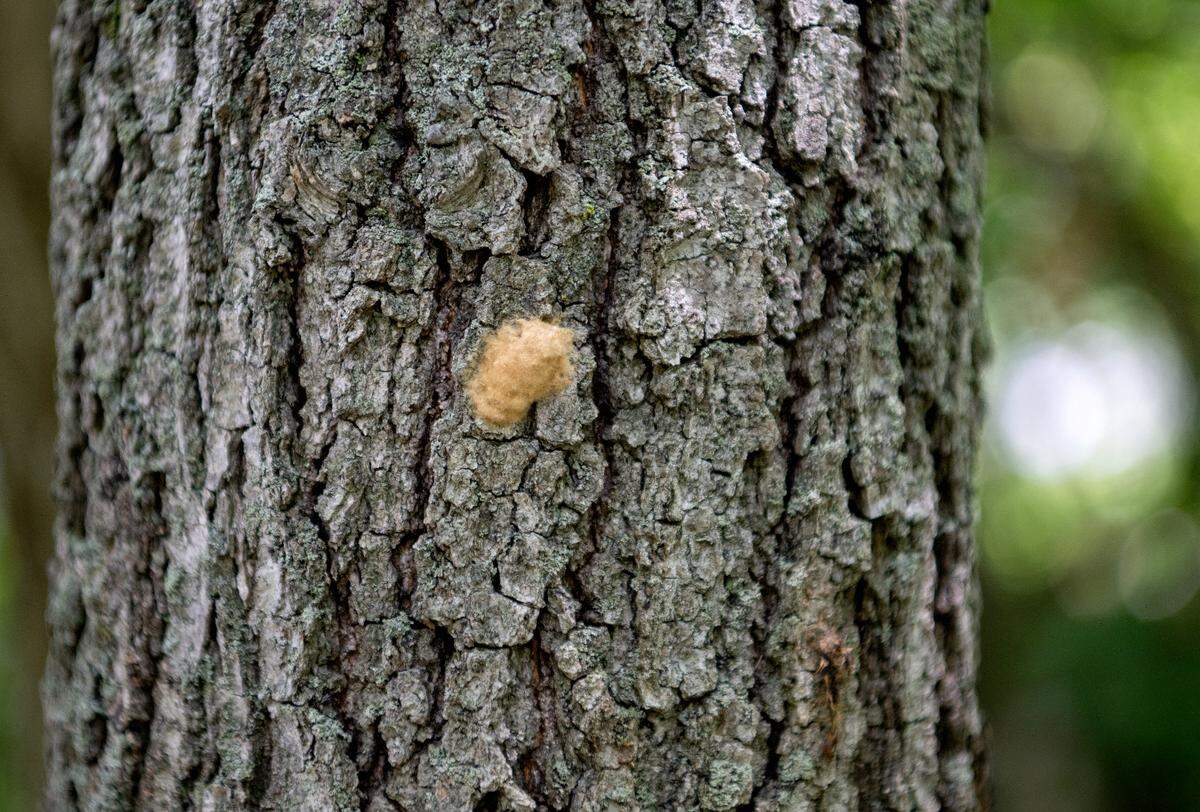
Spongy moth egg masses are fuzzy, tan-colored and felt-like, according to Penn State Extension. Each mass can contain hundreds of eggs. They are often found attached to tree trunks or beneath sheltered branches before they hatch from early April through late May, after which they tend to climb nearby trees to feed as they grow and mature.
Why are spongy moths such a big deal?
These invasive and often destructive insects were first introduced to the U.S. in 1869 when a French scientist attempted to discover a disease-resistant caterpillar to help boost silk production, according to the Pennsylvania Game Commission. They were detected in Pennsylvania by the early 1930s and have produced significant forest damage over the years, including recent outbreaks in 2013, in 2019 and an ongoing outbreak since 2021.
The feeding habits of spongy moth caterpillars can strip trees of their leaves and ultimately destroy them, according to the Pennsylvania Department of Conservation and Natural Resources. That process can take years, but some affected trees may die after just a single season. Strong, healthy trees can foliate again the next year, but weaker ones are especially susceptible to damage.
Spongy moth caterpillars prefer to eat the leaves of oak trees, but they will feed on other tree and shrub species, including apple trees, birch trees, pines, spruces and willow trees. Caterpillars eat the most since they are in the process of growing into adults. Mature moths, however, do not feed.
Spongy moth feeding contributes to the estimated $868 million in annual damage to trees and crops across the U.S., according to the Pennsylvania Game Commission.
How can I recognize spotted lanternflies?
Just like other living creatures, spotted lanternflies follow a growth pattern. They begin their cycles in egg masses and wind up as full-grown adults in just about one year.
Lanternfly egg masses are covered in a white, putty-like substance that can appear similar to cracked mud over time, according to Penn State Extension. They are usually around 1 inch long and laid on hard surfaces, ranging from trees and stones to patio furniture and even vehicles. Old egg masses will boast a darker shade of brown after they hatch between mid-April and June.
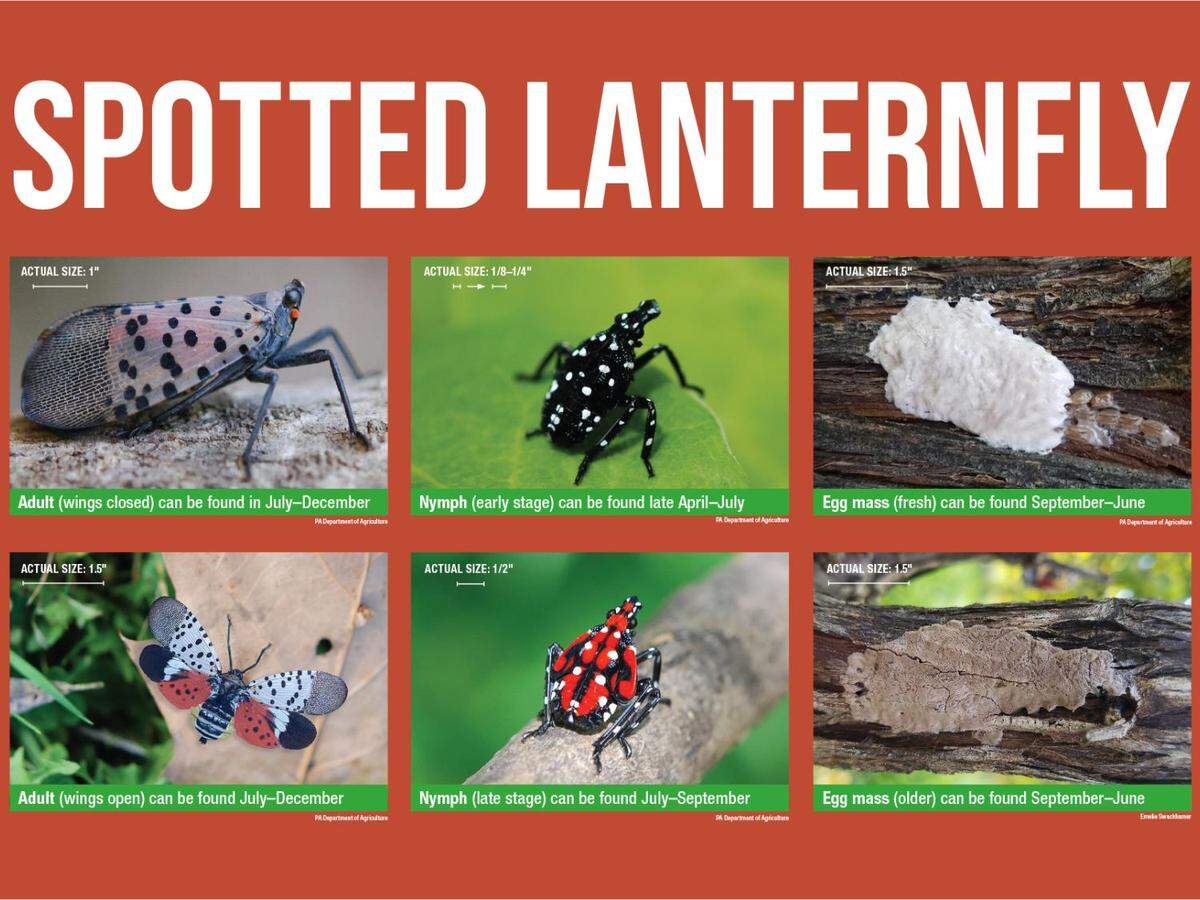
Spotted lanternfly nymphs are small with black bodies and legs covered in white spots. Late-stage nymphs grow to about 1/2 an inch long and sport red coloring along with black strips and white spots.
Adult spotted lanternflies are about 1 inch long, with females generally growing larger than males. They feature pinkish forewings with black spots, plus red hindwings that are noticeable when they fly. Adults can generally be found as early as July and will remain active until frosts begin later in the year. Female spotted lanternflies begin laying eggs in September.
Unlike spongy moths and other caterpillar-like insects, spotted lanternflies are known to be strong jumpers. They hop or fly from place to place instead of crawling, which can help you differentiate them from other species outdoors.
Why are spotted lanternflies such a problem?
The spotted lanternfly, native to Asia, was first spotted in Pennsylvania back in 2014. Since then, it has spread through most of the commonwealth and spilled into neighboring states across the mid-Atlantic.
Spotted lanternflies use their mouthparts to pierce, suck and eventually feed on the sap of many types of trees and plants, but they have a strong preference for the tree of heaven, which is coincidentally an invasive plant itself. No matter what is on the menu, feeding lanternflies excrete honeydew, a sugary substance that can attract other insects and promote the growth of sooty mold and fungi. Damage from feeding can significantly stress trees and plants and contribute to poor health or even death.
Spotted lanternflies don’t bite or sting, but they can become a nuisance when they swarm in great numbers and coat the bark of trees and other outdoor surfaces.
A 2019 economic impact study found these insects could annually cost Pennsylvania $324 million and more than 2,800 jobs if left uncontrolled. Nurseries, vineyards, Christmas tree farms and other sources of hardwood products are susceptible targets for the spotted lanternfly.
As of 2024, the spotted lanternfly is found in 51 of Pennsylvania’s 67 counties. Each affected county is observing a state-imposed quarantine that seeks to prevent the invasive insects from moving to new areas across the commonwealth and the country.
How can I destroy spongy moth and spotted lanternfly eggs?
According to the DNCR, spongy moths lay eggs on trees, stones and other outdoor surfaces each June and July before they hatch the following spring. Each mass can hold up to 1,500 eggs.
Spongy moths are commonly controlled or limited by spraying insecticide, usually Bacillus thuringiensis, subspecies kurstaki (BtK) and tebufenozide, a growth regulator, via helicopter or plane. The DCNR’s Bureau of Forestry oversees a spraying program for state and federal forest lands, while some local municipalities — including Patton and Ferguson townships in Centre County — implement their own programs.
Homeowners can still take action themselves to remove spongy moth egg masses when the time is right, but mechanical methods are not effective for forestwide control. According to the DCNR, you can start by scraping masses into a sealed container or bag and disposing of them.

Late fall, winter and early spring offer the best opportunities to remove spotted lanternfly egg masses, which often contain between about 30 and 50 eggs. You can usually find them on trees near feeding sites or other protected outdoor surfaces (like the underside of tree limbs) or angled horizontally or toward the ground, including exterior walls and picnic tables.
If you found an egg mass on your property and want to remove it, consider the following tips from Penn State Extension:
- Use a plastic card or a putty knife to scrape egg masses off outdoor surfaces. Drop them into a bag or container filled with rubbing alcohol or hand sanitizer and permanently keep them in that solution. Even egg masses that fall to the ground can still hatch.
- Be sure to apply “even and forceful pressure” to the egg mass if you choose to smash an egg mass. Masses that are properly smashed should “burst open.”
- You might still find spotted lanternflies in your neck of the woods despite efforts to remove egg masses around your home. You can still make a difference by reducing local populations. Eliminating the insects entirely is extremely difficult.
Feel free to stomp on any spotted lanternflies you come across during the spring, summer and fall, but know that removing egg masses is the most direct and effective way to keep their numbers in check for the next year.
You can report spotted lanternfly sightings to the Pennsylvania Department of Agriculture by filling out an online form or calling 1-888-422-3359.
This story was originally published May 31, 2024 at 11:19 AM.
%202.JPG)