
A tale of 2 papers: Book explores life inside CDT, Pennsylvania Mirror during the ’70s
In an era where the term “fake news” has become popular, and with media bashing reaching a new peak, it was gratifying for Tom Berner and myself to produce a book that illustrates the excitement and importance of daily journalism, chasing down stories and taking pride in our work. We went back in time to the 1970s when two reporters not much older than ourselves brought down a presidency with their reporting on the Watergate scandal.
The illness and death on May 3 of our colleague, Dennis Gildea, served as impetus for “We Had Ink in Our Blood.” The book’s original outline suggested a tribute to the Pennsylvania Mirror, which existed from late 1968 until the final day of 1977 before folding for financial reasons. With input from Professor Berner, who spent 28 years on the journalism faculty at Penn State, we shaped the book into a collection of memories from 19 former staffers at the Mirror and the Centre Daily Times.
Those 19 chapters carried a collective theme of love and nostalgia for the craft that is newspaper work.
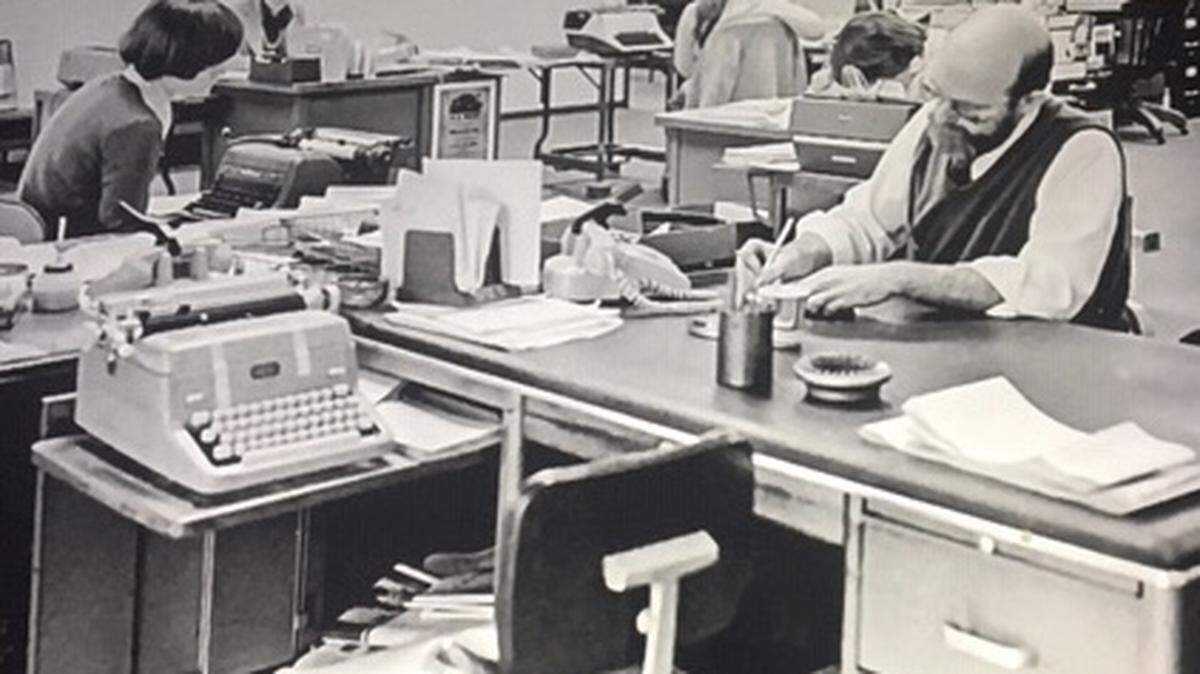
As former Mirror editor Dave Cuzzolina wrote, “A daily newspaper shoots excitement directly into your veins. I yearned for the camaraderie, the banter, the clacking of 20 manual typewriters at once, and from time to time the frantic bell-clanging of the UPI teletype machines screaming, ‘Something urgent has happened in the world, you better come look!’ ”
Longtime CDT sports writer Ron Bracken told the story of how he entered the newspaper business back in 1967. Only 23 years old and already a father, Bracken wrote about working for Penns Valley Publishing, in the same building that then housed the CDT on South Fraser Street in State College. Bored with a tedious job, Ron asked sports editor Doug McDonald if he needed someone to report on high school football games. McDonald, a staff of one, quickly found work for Bracken, who stuck around for most of the next 41 years, and even now continues to cover high school sports in his retirement.
“I still have the clipping from my first story,” Bracken revealed.
Another former CDT scribe, Gary Tuma, recalled his initial encounter with Joe Paterno. Bracken assigned the new Penn State graduate to go over to football practice and ask the fiery coach about a new assistant coach the school had just hired.
“So we hired a guy,” Paterno yelled back at Tuma. “Whaddya coming around here for, asking these questions? Get outta here!”
Tuma eventually would discover the softer side of Joe Paterno on a car ride back from a Big 33 game, but that first encounter still sticks in his memory bank. In his book chapter, Gary remembers thinking, “So this is journalism?”
Timmy Weinstein Shanahan wrote the chapter on her father, Jerry Weinstein, who became the newsroom leader of the CDT for several decades after teaming up with his friend Gene Reilly, who ran the business end of the operation. They joined forces after Weinstein served 37 months with the U.S. Army Air Corps during World War II.
“My father took pride in guiding the Centre Daily Times from a six-page daily into a respectable regional institution,” Timmy wrote, adding that in 1979 the paper was sold to Knight-Ridder for $15.5M.
The Pennsylvania Mirror came into existence because Altoona Mirror publisher J.E. Holtzinger loved everything about his alma mater, Penn State, and wanted to place a newspaper in its hometown. He spared no expense, springing for a state-of-the-art color printing press in an era when hardly a newspaper anywhere published color photos. Executive editor Paul Houck, a CDT and Penn State alum, pushed the envelope and ran color on the day after the U.S. landed a man on the moon. Page one of the Mirror that day featured a color graphic that took up half of the front page.
The Mirror became an irreverent counterpoint to the staid CDT, relying on young journalists, some of them fresh from the Penn State student newspaper.
Tom Berner worked as a sports writer for the Mirror from its inception before moving over to the news side. He would eventually become city editor of the CDT.
“We were very aggressive – or tried to be – in our reporting,” Berner wrote. He described how the original Mirror sports editor, Dave Fay, demanded feature leads on all stories, even though the Mirror was the morning paper, “to take away any chance of the CDT coming up with a more interesting story.”
The book goes on to reveal the ups and downs of the Mirror, and how its original mission to cover all of Centre and Blair County became impossible to sustain. Paul Houck and his newsroom won many awards but the Mirror could never attract enough readers or sell enough advertisements to overcome the CDT’s strong grip on the market. J.E. Holtzinger died early in 1977 and his pet project went out of business on the last day of that same year.
“We Had Ink In Our Blood” is a collection of oral histories that recalls the brief battle for readers in a growing college town during an era when newspapers were a primary source of information and reporters still pounded out stories on typewriters. It can be ordered online for $14.99 at eifrigpublishing.com.