
Under the baobab: Community to gather again to commemorate March on Washington
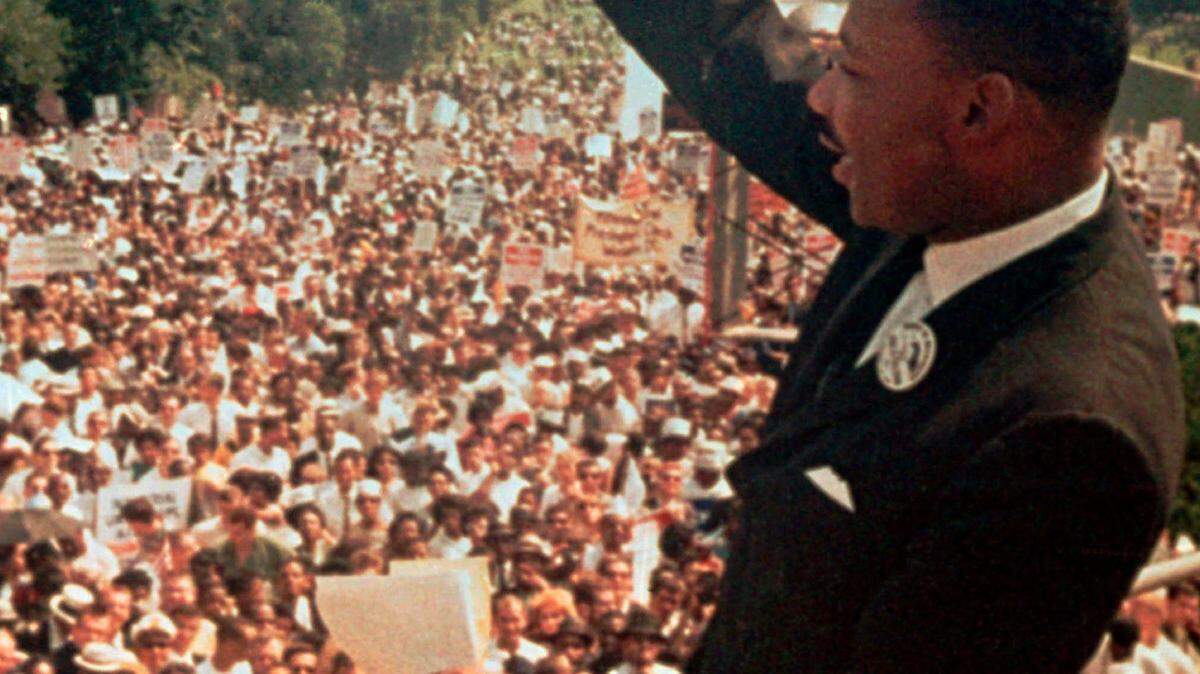
On Sunday, Aug. 28th, the Martin Luther King Plaza Committee will resume its annual commemoration of the 1963 March on Washington for Jobs and Freedom.
The committee, led by Barbara Farmer, Gary Abdullah and Prof. AnneMarie Mingo, includes Catherine Dauler, myself, Carol Eicher, Elizabeth Goreham, Jonathan Friedman, Kevin Kassab, Wanda Knight, Kayla Lafferty, Lisa Thompson, Natalie Vercillo and Carlos Wiley. This year will include a special tribute to Bayard Rustin, one of the primary organizers and facilitators of the March. The MLK Plaza was dedicated on Aug. 28, 2017, pursuant to a resolution introduced in 2012 by then-borough council member Peter Morris.
1963 was an historic year in the struggle for civil and human rights. It was the 100th anniversary of the Emancipation Proclamation and the turning of the tide toward the Union victory in the Civil War. That year the civil rights movement experienced several epic events: Mississippi NAACP chief Medgar Evers was gunned down; freedom activists were attacked in police riots in Birmingham, where attack dogs, fire hoses and batons were used against school children; the Rev. Martin Luther King Jr. wrote his “Letter from Birmingham Jail.” Later that same year four little girls were murdered in Sunday school when their 16th Street Baptist Church was bombed by white supremacists. In November, President John F. Kennedy was assassinated in Dallas.
As our church youth group, led by Fr. George Clements, prepared for our trip from Chicago to Washington, D.C., we didn’t know what to expect. The unions and mostly Black churches had charted an overnight train. Was it going to be another Birmingham police riot? After all, D.C. was a southern city. Most of the police were white with presumably racist attitudes. Many predicted as many as 50,000 people would be at the March.
As we disembarked in Union Station, helmeted police were lined up shoulder to shoulder, gripping their batons; they were all white. Someone began to sing a freedom song. We all joined in. It helped boost our flagging courage. Outside the station, the people, not the police, ruled the streets of our nation’s capital. There were a quarter of a million people there.
The primary leaders of the March, who became known as the “Big Six” were King, A. Philip Randolph, Whitney Young, Roy Wilkins, James Farmer and John Lewis. There were others: Walter Reuther of the United Automobile Workers, Eugene Blake of the National Council of Churches, Rabbi Joachim Prinz, vice-chairman of the World Jewish Congress and Mathew Ahmann of the National Catholic Conference for Interracial Justice.
The primary organizer and mobilizer was Randolph’s deputy, Bayard Rustin. Some of the other leaders were concerned that critics of the March would criticize it because Rustin was gay, a former communist and had protested the draft. He was kept in the background, out of the public eye. Rustin was not the only one. Women like Daisy Bates, Lena Horne, Josephine Baker, Coretta Scott King, Dianne Nash and Ella Baker, the founder of the Student Nonviolent Coordinating Committee, were on the front lines of the working civil rights movement in the ‘60s. There were no women in the public leadership of the March and none were principle speakers.
Those who did speak demanded: an immediate elimination of school segregation, a program of public works, including job training, for the unemployed, federal law prohibiting discrimination in public or private hiring, withholding federal funds from programs that tolerate discrimination, enforcement of the 14th Amendment to the Constitution by reducing congressional representation from states that disenfranchise citizens.
What most people know about the March is MLK’s “I Have a Dream” speech, which came toward the end of the day, was prompted by Mahalia Jackson saying, “tell them about the dream, Martin.”
And he did.