
Under the baobab: Our country, world has been blessed by the life and work of Jimmy Carter
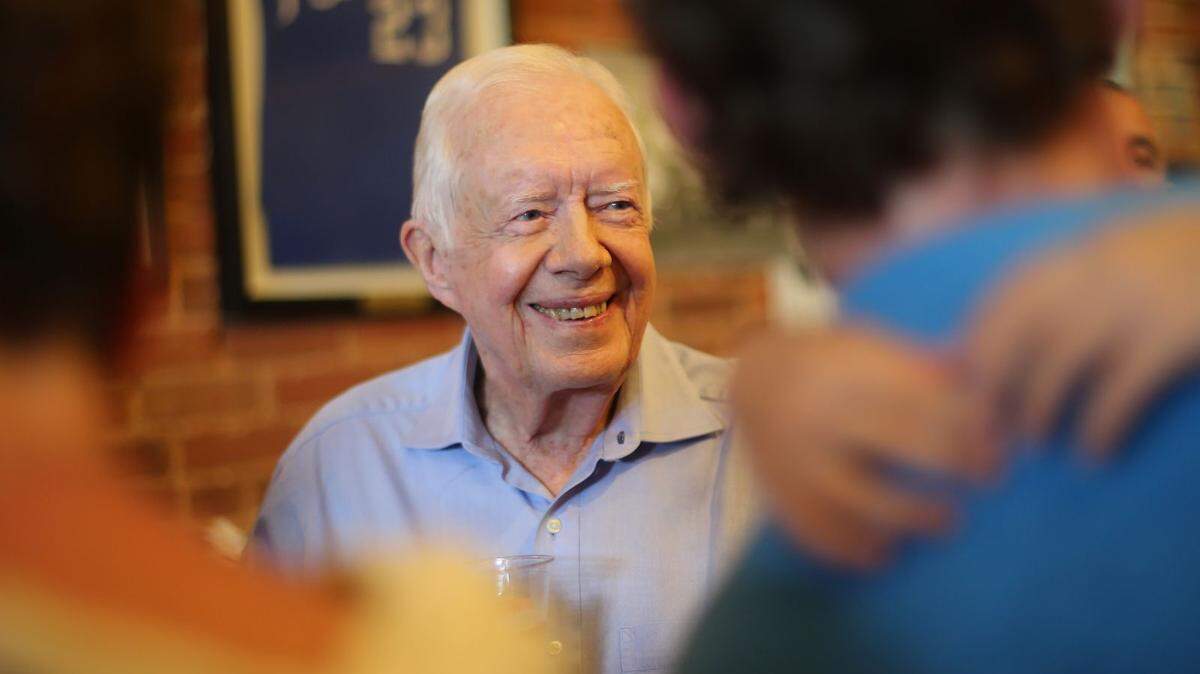
Jimmy Carter, my favorite ex-president and one of the most decent men to ever serve in public office has entered hospice care. Our dad entered hospice care toward end of his struggle with terminal lung cancer. The attending caregiver told us that what makes hospice different from hospital treatment is that when a patient dies during hospital treatment it is considered a failure. In hospice care, death is the purpose of the exercise, and so therefore it is a victory.
I first met Jimmy Carter before he became governor of Georgia, when he was campaigning for governor for the second time. We were in Albany, Georgia doing volunteer work with the Southwest Georgia Project, a 5,000-acre collective farm. It was located about an hour from Plains, Carter’s hometown. He was a white man but a different kind of Southern candidate. His predecessor, Lester Maddox, was an avowed white supremacist who closed his restaurant rather than serve African Americans. At his inauguration in January 1971 Carter declared that “the time of racial discrimination is over.” Carter stood on a nonracist platform and even placed portraits of prominent Georgia African Americans, Lucy Craft Laney, Henry McNeal Turner and Rev. Martin Luther King, in the Capitol Building.
The next time I saw Carter was in 1977. He had appointed Andrew Young as the first African American Ambassador to the United Nations. I was working at the UN Centre for Transnational Corporations on policy recommendations condemning apartheid in South Africa. The president and ambassador had transformed American policy. The U.S. began to support an arms and technology embargo against the racist government of South Africa. That courageous effort combined with the resistance of the South African people ultimately resulted in bringing democracy to the country.
In 1980 I was chosen along with Congressman Charles Rangel (my former boss), superwoman Rep. Shirley Chisholm and a New York State legislator to welcome President Carter to New York City during his presidential campaign. We shook his hand at the airport and escorted him to a Black Baptist Church rally in Brooklyn. We were all running for office. The others won. The president and I lost ... badly.
The last time I talked with President Carter in person was a few years after that election. We both had moved on from electoral politics. I had begun teaching, acting and directing. He was hauling cement on New York’s Lower East Side as a volunteer for Habitat for Humanity. I was able to share some conversation with him, as long as I also shared the task of hauling cement to help build homes for the poor and working people of my neighborhood. I never met him again in person.
Jo and I traveled to Georgia last year. We stayed at the Plains Inn, the only hotel in town. We slept in the presidential suite where “Jimmy and Rosalynn” had first stayed when the place was reopened, hallowed ground. Jimmy was ailing so he missed Sunday school class at Maranatha Church where he faithfully taught every Sunday.
Our country, the world, has been blessed by the life and work of Jimmy Carter. It is past time to give him his flowers. He is one of only four presidents (and one vice president) who have been awarded the Nobel Peace Prize. He is a convener of the Camp David Summit,which anchored the accord between Egypt and Israel and may someday bring lasting peace to the Middle East. My former organization awarded him the United Nations Prize in the Field of Human Rights.
I believe his greatest gift to the world has been his life. He has lived for nearly a hundred years exemplifying Christian charity, love, compassion, decency and civility.
Go with God, President Carter, we honor you, we love you and we will miss you.