
Opinion: A way forward to bridging divides? Yes, really
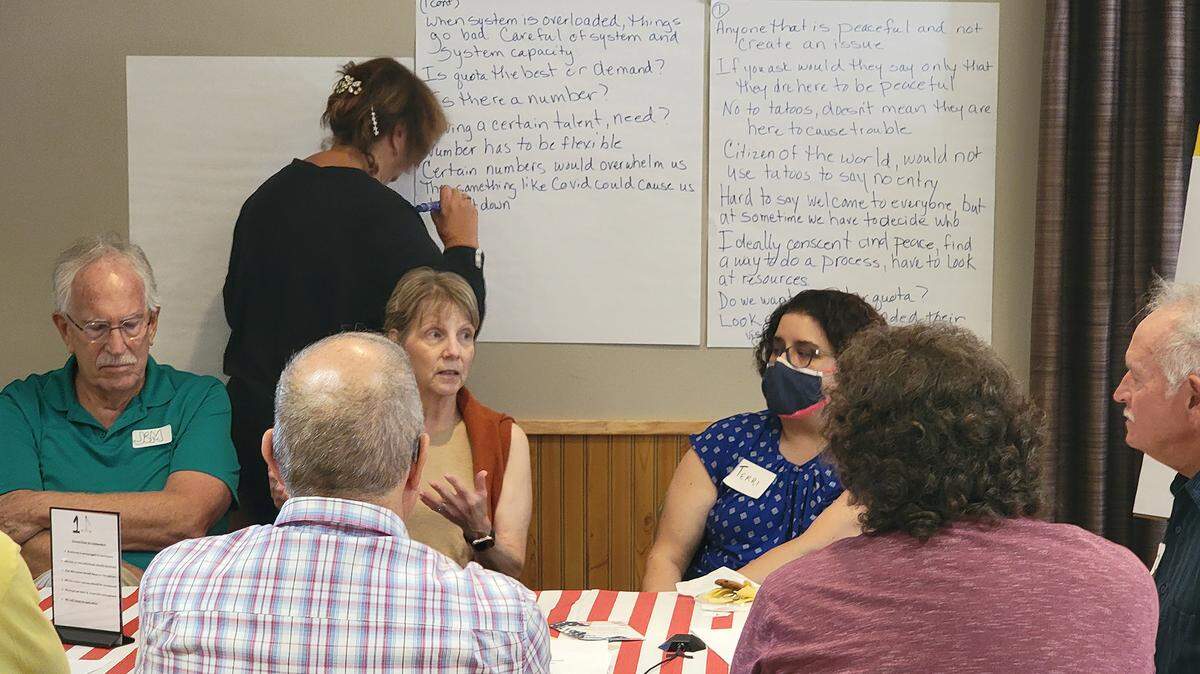
On a non-football Saturday in September, 60 Centre County residents met for three hours to deliberate the issue of immigration policy. What did we learn from that experience? What common ground, if any, did we discover?
First, let me briefly explain how a deliberation is different from the typical public policy discussion. First, a deliberation is not a debate. Deliberations begin with the recognition that almost every controversial issue has more than two sides, and if a “solution” is to be found, it is rarely on one “side” or the other — because there are generally multiple sides.
A deliberation is not a panel discussion of experts, where the primary role of the audience is to listen and ask questions. While both formats have their place, a deliberation is driven by the people in attendance, guided by moderators, and a short list of basic rules. (Stay focused; our priority is to listen to each other; one or two people will not dominate the conversation, etc.)
At the conclusion of our roundtable conversations, each group was asked to identify their areas of common ground. While we did not “resolve” the issue of immigration, what we discovered was useful and suggests a way forward. Both on our national immigration policy, and in the general sense of how we might move forward as a democracy.
Several of our roundtable groups came to the foundational realization that having a diversity of perspective is essential for good decision making. Who is not at the table with us? What perspectives are we missing? Then we need to ask ourselves: What can we do to ensure that other perspectives are present? In a country that feels divided, what can we do to make more people feel welcome to be part of these conversations?
Regarding the immigration policy discussions, another critical common ground realization was a recognition of the value that immigrants have historically brought to our country. (Nearly all of us having been immigrants at some point in our family’s history.) But the most illuminating moment was a recognition of the necessity of seeing people as individual human beings. While this does not suggest what our immigration policy should be, our attendees believed this to be an important foundational principle for moving forward.
Similarly, another group expressed the value in our being welcoming to all — although less sure on how to best implement this. There was, however, general agreement that the processing of immigrants needs to be greatly expedited — and that we currently lack the necessary infrastructure and policy to do so.
Another group emphasized the importance of us having a shared national identity. Similarly, there was a recognition of the significance of producing a sense of fairness and security for everyone who is impacted. We must find a path to a non-partisan solution — and then enforce the law and be fair to those who follow the rules.
There was an understanding that developing effective policy requires good information. If we’re being honest, few of us have all the information necessary for making a solid decision. Some questions are:
What would be the overall cost of the various options? What would be the tax burden on Americans?
What is the actual number of documented vs. undocumented immigrants?
To what extent are immigrants needed for economic growth?
How are local communities impacted?
Finally, there was a general recognition that Americans have more in common than we realize.
These ideas struck me as important foundational principles for how we, Americans, might begin to develop a consensus on a national immigration policy. But beyond that, how we might begin to fulfill the vision of a government “by the people.” As one group concluded: “There is no one right answer; we need to work together to solve it.”
If you are interested as to what a deliberation looks like, the program can be viewed on CNET Community Access Network, or CNET1.org (search for Constitution Day in Centre County, Sept. 14). It includes the presentation of the Madison Award for Civility in the Community and remarks by the honoree Elaine Wilgus-Meder. The link is: bit.ly/3TZ4c4R