
Researchers are workers at Penn State, and they’re ready to form a union | Opinion
Penn State is a level-one research university leading innovation, thanks in large part to the work of research assistants and trainees. Despite being central to Penn State’s mission, researchers have almost no say in their wages, benefits or workplace conditions. This is true of all 5,000-plus graduate student workers at Penn State, which is why last fall thousands of researchers joined their fellow grad workers and signed authorization cards in support of forming a union.
Despite this, Penn State administration now claims that research assistants and trainees are not workers and should be excluded from the union. But there is clear precedent for RAs and trainees to unionize. During Penn State grad workers’ 2017-18 union campaign, the Pennsylvania Labor Relations Board ruled that all graduate assistants —including research assistants and trainees — have the right to unionize. Now Penn State insists on re-litigating this issue, demanding another hearing with the PLRB. This will delay the union vote by months and significantly slow grad workers’ progress toward a fair contract.
Penn State claims that because research assistants and trainees conduct work that relates to their thesis or dissertation project, their duties are part of their degree and not technically “work” under Pennsylvania labor law. While it’s true that RAs and trainees perform research to meet academic requirements, their work extends far beyond that. They manage and maintain labs, teach and mentor undergraduates, perform administrative duties and conduct research for others unrelated to their own dissertations.
Many day-to-day duties of RAs and trainees are administrative, not academic. Tahir is a research assistant in biomedical engineering, researching stem cells. While some of his work contributes to his degree, it also exceeds those bounds. He serves as the lab’s safety manager, completes paperwork for lab inspections, prepares materials for grant submissions, and orders and maintains lab supplies. For Rachel in biochemistry, microbiology and molecular biology, her duties include organizing a journal club for three different labs, training new grad students, cleaning the lab, and caring for mosquito colonies.
Jess is an English RA who works as managing editor of an academic journal. While there is some overlap between the journal’s subject matter and her own research interests, the work that she’s paid for is administrative —coordinating with authors, reviewers and editors throughout the publishing process. Meanwhile, Marissa in ecology coordinates seminar speakers, writes newsletters and performs administrative tasks that are critical for the program but unrelated to her climate research.
Though Penn State claims that teaching assistants are employees while RAs and trainees are not, there is significant overlap between these roles. Louis in entomology helps develop museum exhibits and teaches an online course on wasp identification. Maddy in communication arts and sciences creates training videos on provider-patient communication. Regardless of job title, grad workers produce and disseminate knowledge to many audiences.
Owen in geography has switched between teaching and research assistantships almost every year — an experience common to many grad workers. Drawing a hard line between RAs, TAs, and trainees is impractical, and undermines the democratic will of all graduate workers at Penn State. Splitting up our union would create unequal working conditions for employees who perform essentially the same work. In one semester, we’d have the rights and protections that come with unionization, only to lose them abruptly the next semester. If, to quote President Bendapudi, the university “would shut down” without graduate labor, why does Penn State insist only some of us are workers?
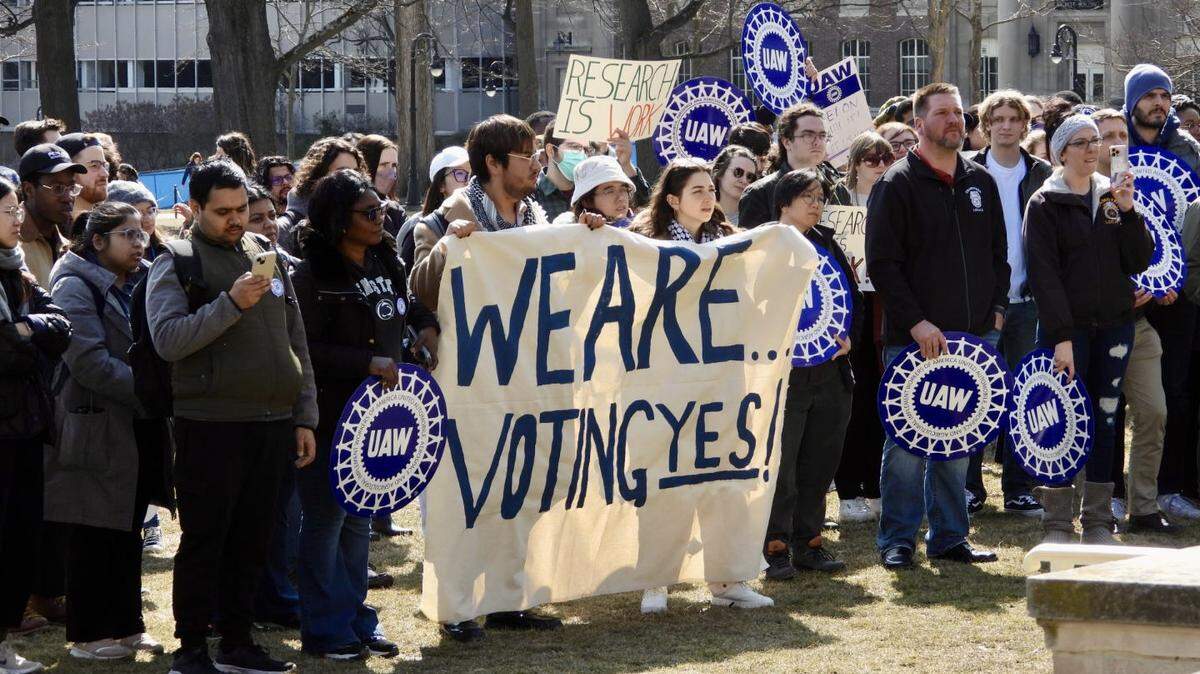
Make no mistake: TAs, RAs, and trainees are workers, and will have our voices heard in a union election. Nearly 500 of us rallied on March 4 to make our intentions clear. We are ready to vote now — we’re just waiting for Penn State to schedule an election. Every day that passes without an election sends the message to all graduate workers that the administration would rather spend money in court than respect the will of the majority who want to form a union. We call on Penn State to withdraw their objection and allow grad workers to hold a union vote this semester. Let’s stop arguing over settled precedent and get back to advancing knowledge, research and innovation in our workplace.