How Penn State baseball’s Matt Wood molded himself into one of the NCAA’s top catchers
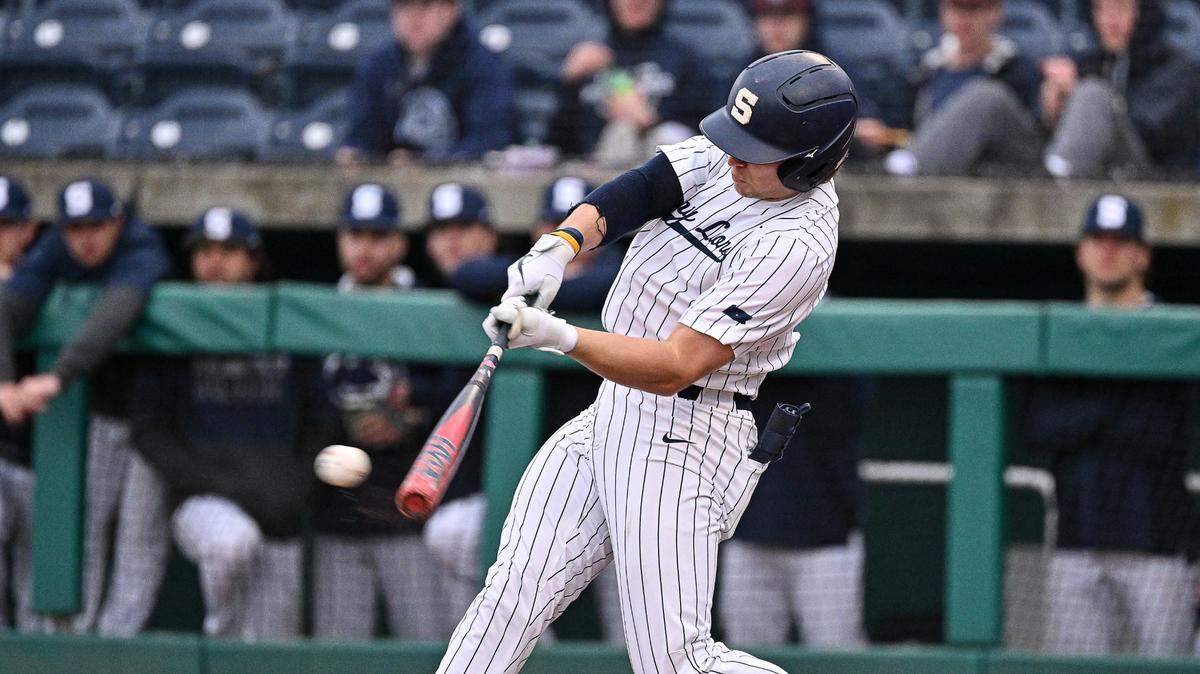
Penn State catcher Matt Wood has meant everything and more to the Nittany Lions’ baseball program for the past three seasons. Now he wants to leave an on-field legacy for all to remember.
That holds a strong importance to Wood and how he goes about his work behind the plate.
“I just want to be remembered as a guy who bled Penn State, who would die for this team,” Wood said. “I want to leave a legacy and set a standard. I want to be able to come back here and talk to future players and be like, ‘This is what we started.’ I want to be the start and I want people to look back and think of us as that team that turned us in the right direction. I think that we can.”
Rob Cooper, Penn State’s head coach, called Wood a “definite leader” and “a guy that’s not going to get too fiery.” Sure, Wood will raise his voice at times, but not in a demeaning way — in a way that notifies his teammates that they need to stay attentive to each detail. He doesn’t make excuses for himself or his teammates and allows his play on the field to usually do the talking for him.
And his play has more than done the talking.
Prior to the season, the junior was added to the Buster Posey Award Watch List. The award is earned by the top catcher in Division I baseball.
Wood hasn’t rested on his laurels and is currently toting a .396 batting average in 106 at-bats this season, ranking ninth among catchers and 53rd in the NCAA among all hitters. He has 42 hits, 24 RBIs, seven doubles, two triples, five home runs and 14 walks. He’s only struck out 10 times in 2022, wielding a massive on-base percentage of .464 and a slugging percentage of .642.
“It’s really cool to be on any watch list that involves a name like Buster Posey — a Hall of Fame career player,” Wood said. “To even just be in that certain group is just an honor. It’s something that I’m very grateful for, but it’s also something that motivates me. I know that people recognize it and now it’s an opportunity to keep getting better and to hopefully prove it to people.”
Certain intricacies of facing batters are through making in-game adjustments. It all comes from the different pieces of the craft of catching that he takes on a day-to-day basis and from watching professional players.
One of those players is former Pittsburgh Pirates catcher Russell Martin, who played for Pittsburgh during the 2013 and 2014 seasons, where he had a 11.6 wins above replacement mark. His 2014 season was one of the best that he had at the plate, putting together a .290/.402/.430 slash line, while hitting 11 home runs and driving in 67 runs.
It’s not just Martin’s ability behind the plate and in the batter’s box that drew Wood’s attention, but it’s also the competitiveness that the former major leaguer displayed as a Pirate. It’s something that Wood looks to emulate for the Nittany Lions.
“Watching him and the competitor that he is, is what I really took away,” Wood said. “Seeing how good of a teammate he is and how he treats his pitchers and how he stands up for them and he really fights for his guys. I really loved his passion and his fire and energy.
“Even though when people think of the best catchers of all-time, you think of Buster Posey and Yadier Molina and those guys, I just think that Russell Martin brought such a dynamic to the team that made them better, even though he wasn’t the best hitter or catcher.”
Just like the mountains that line the scenic view of Wood’s home of Medlar Field at Lubrano Park, he is a constant in Cooper’s lineup. Wood’s bat is inserted into the lineup as a designated hitter on “off nights,” displaying his importance to the team’s offensive output.
Having that type of versatility has made him a dangerous weapon for Cooper’s squad. It also helps that Cooper has other catchers — his son, Tyson Cooper, and Josh Spiegel — to relieve Wood.
“I think that the cool thing about is when you have a guy like Josh Spiegel or Tyson that can give Matt a day off from behind the plate, you’re not going to lose anything because all three of them are really good defenders,” Cooper said. “Knowing that at second base, you’ve got a guy like Derek Cease or a guy like Ben Kailher — it’s being able to move guys around that gives us a little more versatility.”
Leadership on the field
Wood’s leadership shows up through his preparation for games. He watches film of the team that he’s set to play next over the weekend — usually the Monday or Tuesday that they return to the field for practice. Then, he watches throughout the week to get a good idea of the hitters and how to attack them through different pitches. As a catcher, he arrives to the game early and stretches often.
Though Wood is a position player, he yearns to get to know his pitchers in detail. He loves to immerse himself and relate to everyone, which has helped him become a better player. It has also translated to other aspects of his life — allowing him to lead others in specific ways, altering his tone with certain people or speaking in a more enthusiastic way to those who need it.
The connections that he forms with his pitchers is something that he worked on in an abbreviated form during summer league baseball.
Preparation through summer ball
Wood hasn’t made too many extreme adjustments at the plate, taking an approach and quiet confidence that he’s had from playing summer baseball with the Newport Gulls of the New England Baseball Collegiate League. In the 32 games, Wood totaled 116 at-bats, with 39 hits, eight doubles, five home runs and 18 runs batted in for a .336 batting average.
Summer baseball brings different types of competition from across the collegiate baseball sphere. There may be players from the Big Ten, SEC, ACC, Big 12 or PAC-12, but the leagues are also host to players from an abundant group of Division I schools that have allowed Wood to see pitching that he wouldn’t ordinarily see in league play.
“The summer was a great experience for me in a lot of ways,” Wood said. “One — the competition. You get to play guys in conferences and for teams that you’re not used to playing, especially with us only being able to play Big Ten teams last year. ... I learned a lot from some of the different guys that played at different programs and how they like to pitch and a lot about pitch-calling and different philosophies that they used.”
The adjustment period that Wood used for summer baseball was akin to playing in the minor leagues. He traveled for hours on a bus, eating meals from fast food restaurants and having to juxtapose it with completing a strong workout regimen.
Playing day in and day out was a grind for the junior catcher because he couldn’t pick up a specific routine to prepare for games and often had to pick up the nuances of each pitcher’s delivery and pitches that he caught for those games.
Path to the MLB Draft
Wood’s consideration as one of the top catchers in the country has drawn the attention of major league scouts. The 5-foot-10, 190-pound backstop has also received elite marks from MLB prospect blog Diamond Dreams.
“Wood’s swing is remarkably consistent, and while he does use a bit of a pull-heavy approach, his hands are quick enough and he’s a smart enough hitter and good enough at reading break that he has no problem going opposite-field, either to spoil pitches or even to put them in play,” Eephus Tosser wrote. “He’s a tough out because he is hard to fool, and he hits well against both righties and lefties.”
While he may not have the size of recent first-overall catchers like 2019 Orioles draftee Adley Rutschman (6-foot-2, 220 pounds) or of the 2021 first-overall pick of his hometown Pirates’ Henry Davis (6-foot-2, 210 pounds), Wood makes up for it with his mobility behind the plate. He uses his agility to scoop balls in the dirt and it allows him to squat lower for balls to frame them in the zone.
He takes pride in making athletic plays behind the plate to keep his team in games.
Wood has slowly risen up the boards for collegiate draft-eligible catchers, displaying his high rate of contact. He showed off his prowess with the bat when he went 5-for-11 against against Maine from Feb. 25-26, compiling a .454 batting average with two RBIs, four runs and picked up two hits in a 9-3 victory in the third game of the series. The junior was named the Big Ten Player of the Week, the first Penn State Player of the Week since Greg Guers accomplished the feat on April 18, 2016.
Pine-Richland, Wood’s alma mater, produced Major League players Blake Lalli and Neil Walker. Kurt Wolfe serves as Pine-Richland’s head coach and he watched his catcher grow from 2016-2019. Wood went from being one of three freshmen on the 2016 team, to winning WPIAL championship in 2017, to becoming a high-level Division I starting catcher.
Wolfe believes that Wood will follow in the footsteps of Lalli and Walker following his selection in the MLB Draft.
“I’ve been very blessed over the years to have coached many, many, good hitters and he’s right there with them,” Wolfe said. “He’s one of the best hitters I’ve ever coached and his preparation is second to none and that’s what’s going to allow him to be successful. He’s going to tirelessly work at his trade until he reaches his goal of playing in the Major Leagues.”
The MLB Draft will run from July 17-19 this year.
This story was originally published April 13, 2022 at 4:52 PM.