Penn State baseball is a high-tech operation. How the team uses data to boost performance
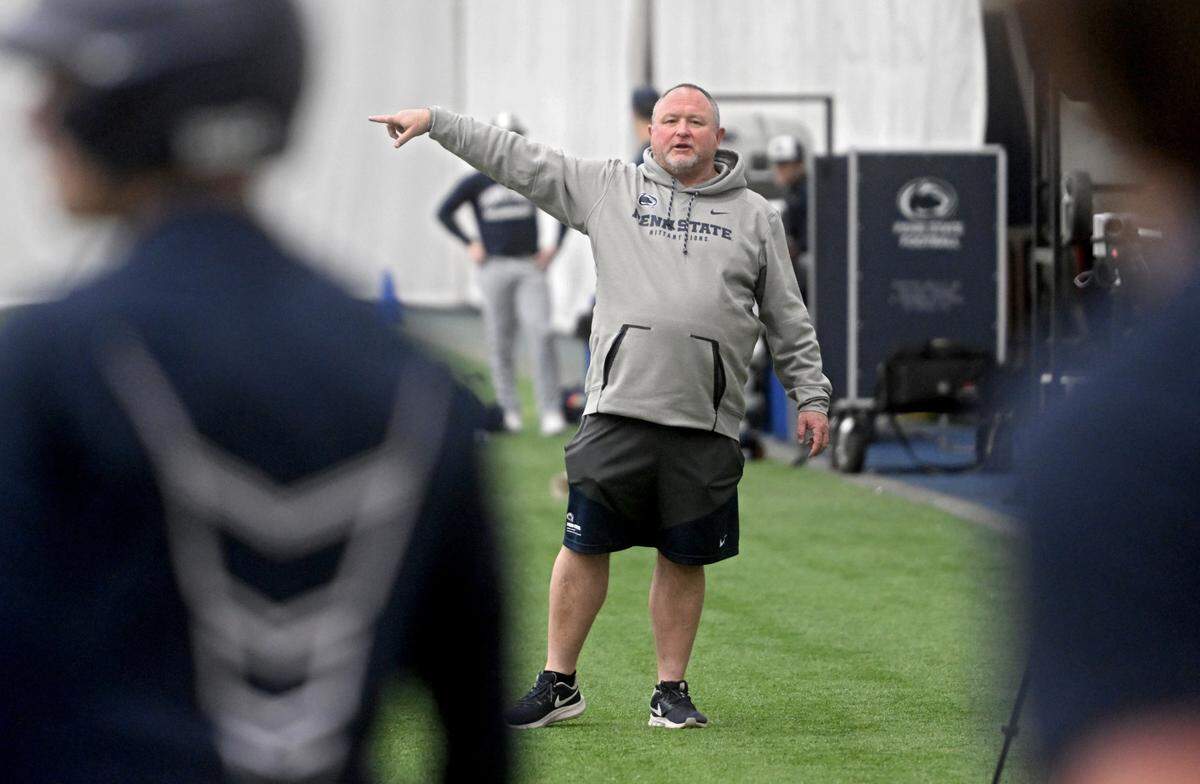
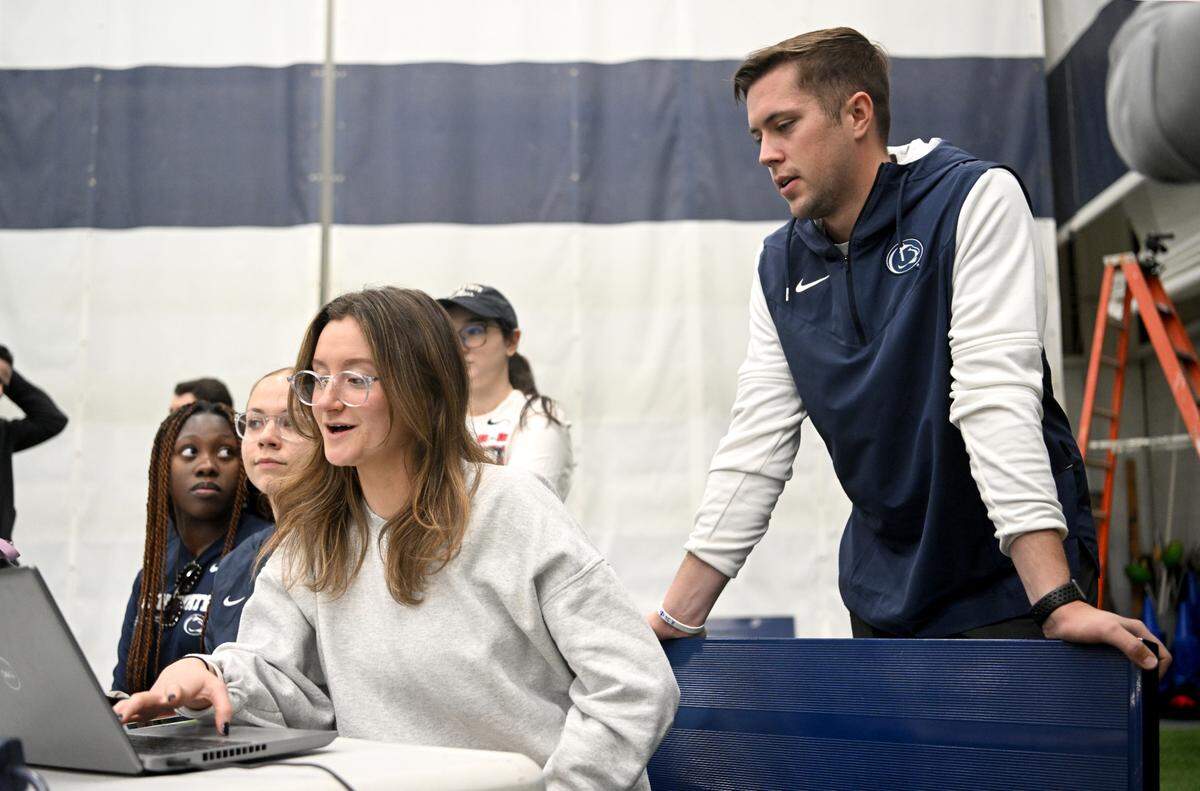
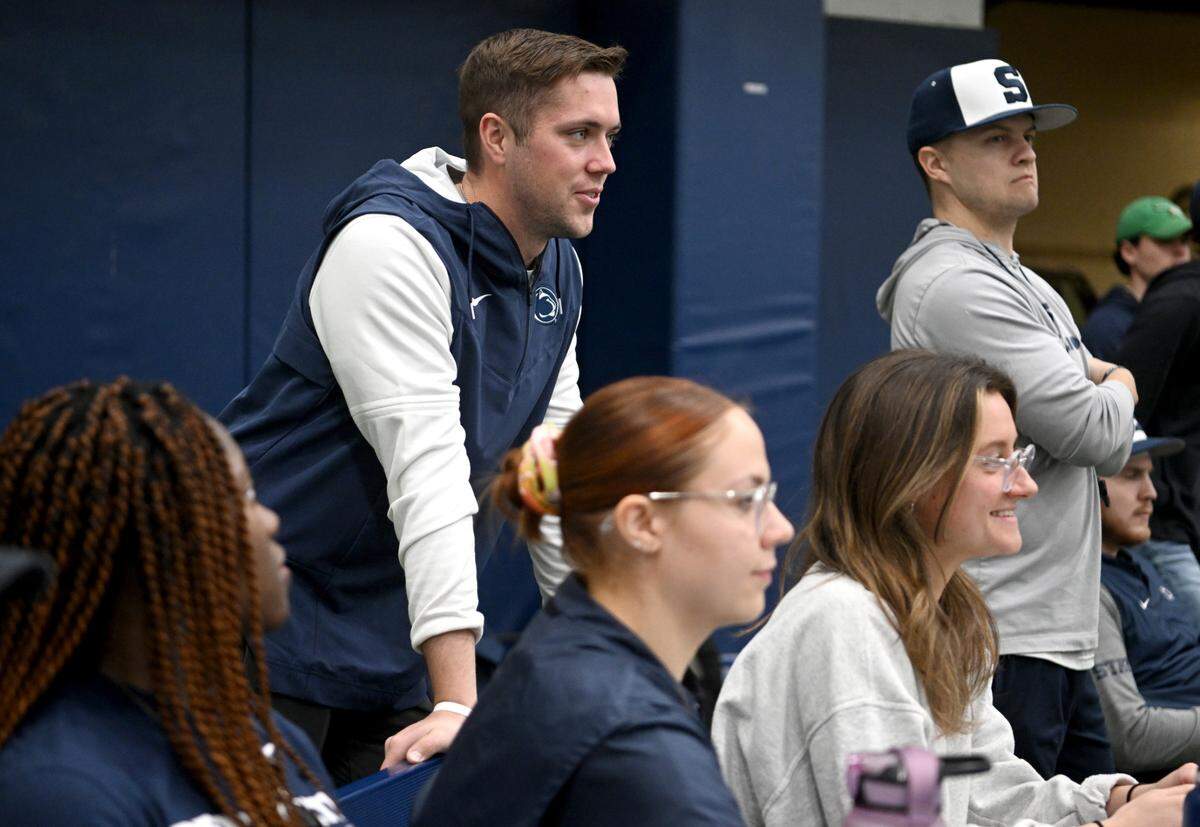
During a recent Penn State baseball practice as the team prepared to open its season, a host of student managers sat on a bench behind the backstop watching a large television screen and computer monitors.
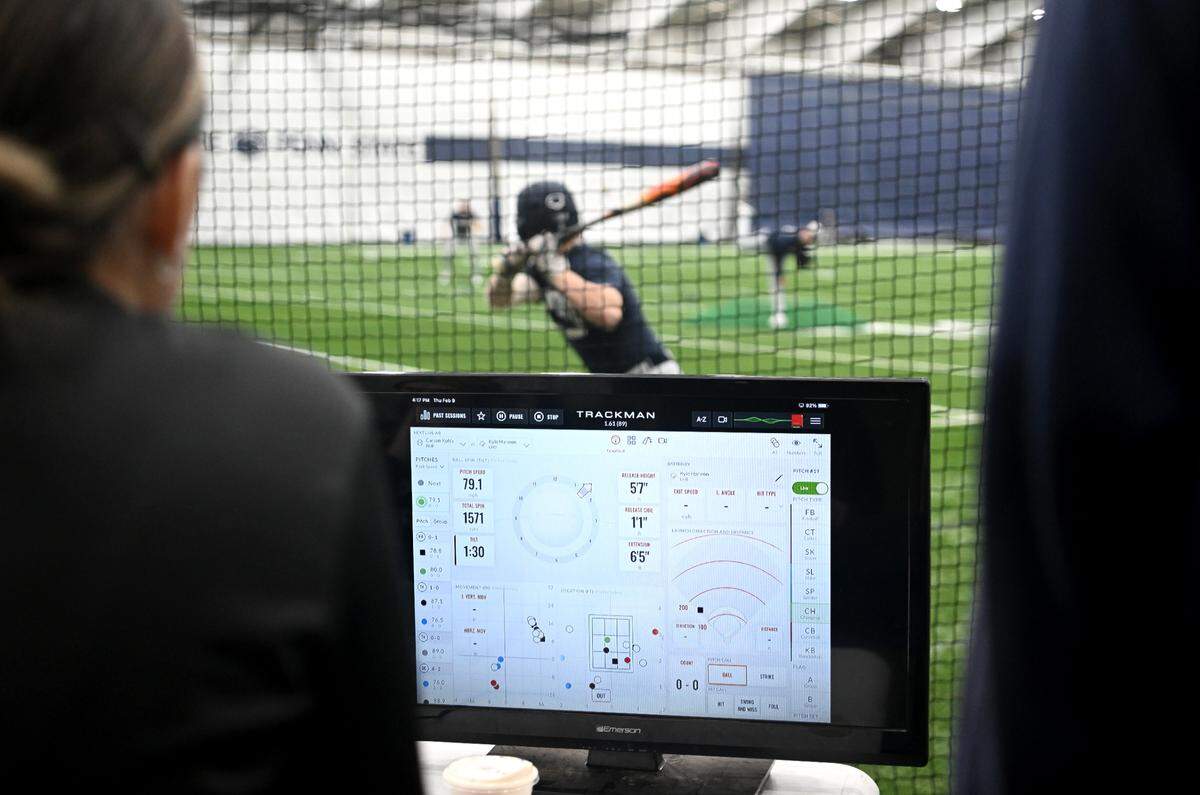
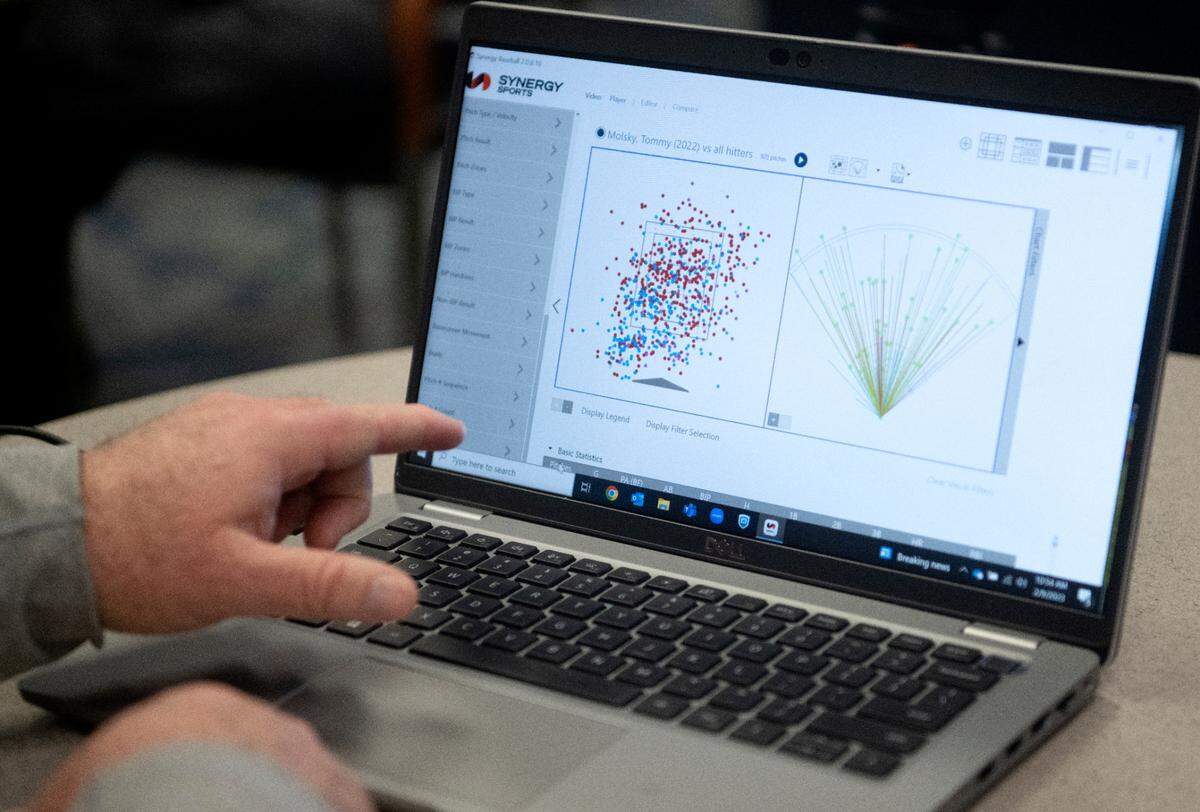
Pitching coach Josh Newman was also watching the screen in Holuba Hall. It was connected to a computer with TrackMan data displaying each pitch and measuring the location, trajectory and spin rate of hit and pitched baseballs.
Pitchers may not be able to pinpoint what their best and worst pitches are without some guidance. That’s where director of baseball operations Jake Stone, a former Baltimore Orioles employee, steps in with TrackMan. It shows them their pitch movement profile, the statistics behind it and where they should be throwing the pitches to get ahead of hitters. Many teams own the technology, but Stone believes that Penn State has found a way to develop its players by using it — and other analytical technology — and better prepare them for professional baseball.
“If you go to any of the pitchers or our hitters on the things that they are working on with them specifically, it’s not just, ‘Oh, I’m working on this feel or changing this movement,’” Stone said. “We have a structured process for implementing our data in player development and there’s a reason and a way to track all of the changes that we’re trying to do.”
TrackMan is just one piece of the sabermetrics boom in baseball. Sabermetrics, aka baseball statistics that measure in-game activity, was coined by baseball writer, historian and statistician Bill James.
“You hear the word ‘analytics’ thrown around a lot, especially in today’s realm of player development, but the game has changed so much in five years for the better,” Newman said. “(It’s) as far as identifying metrics, pitch profiles and tunnels, looking at developing another pitch and you take all of this information and make it functional for our everyday use and for each guy. Each guy is different in how they can handle it.”
Old-school baseball meets new tech
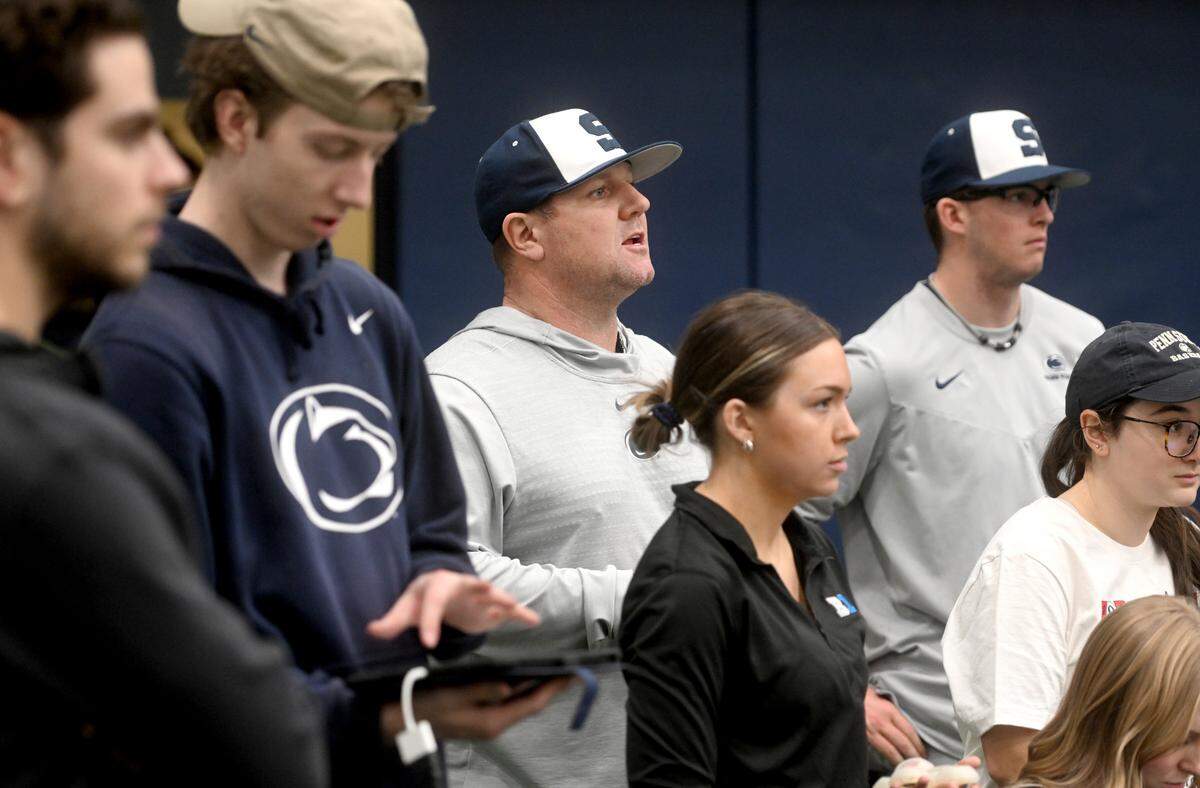
Newman and Penn State head coach Rob Cooper are veterans of the game and have seen many changes throughout their time in the sport. They’re convinced that baseball can marry the old-school game of fundamentals and analytics together and make one big, happy baseball love story.
“It’s another tool for us to put the best team out on the field to give us better chance to win and increase winning percentage, but then it’s also another tool for us to put our guys in the best position to be successful,” Cooper said. “We can show guys via video and statistics to show what your vertical break is and then it makes sense to guys that, ‘There’s a reason why I should throw a slider, rather than a curveball’ or ‘I should throw a changeup’ or a four-seamer, rather than a two-seam fastball. It’s never an always absolute. You have to feel and there’s a human element.”
TrackMan isn’t the only kind of technology used by Penn State baseball. There are three main other types:
Edgertronic: a high-speed camera that can break down pitch design, display the release point of a pitch, allows teams to delve into practice or game film and break down biomechanics.
K-Vest: a swing tracking device that measures the kinematic sequence of a player along with tracking body positions at different points of the swing. It shows the positions and rotational velocities with the heel strike of the front foot of the batter, the first move and contact of the bat. It offers up the sequence, rotational speed and the ability to properly display a hitter’s body position in space.
Rapsodo: a pitch tracking device that analyzes command, movement, spin rate velocity, provides the ability to break down pitching mechanics and display a 3D ball flight and landing location for hitters, which includes launch exit velocities and launch angles.
Penn State has used the technology for nearly five seasons.
Stone and Moore, Penn State’s analytics duo
Stone has been involved in baseball since he was a child, playing the game at the Little League level and throughout high school. Once he decided to go to the University of Iowa, he realized that his playing days were over. That’s when decided to take on a role as the student manager for the Hawkeyes baseball team.
It changed his life forever.
During his first season as a student manager in 2016, Stone threw pitches for batting practice and hit baseballs with a fungo bat for fielding drills. At the same time, Major League Baseball was undergoing a significant change with the onset of video technology becoming deeply incorporated into the game.
The 2016 World Series champion Chicago Cubs used KinaTrax and iMerit, which used motion capture and 3D models to aid pitchers. More than 200 miles away at the University of Iowa, Stone, along with the Hawkeyes coaching staff and other student managers, took a deep dive into analytics for improving the team.
Iowa invested in TrackMan, Rapsodo and Edgertronic. The team went 30-26 in 2016 and improved its record to 39-22 in 2017.
“The coaching staff understood that it was beneficial and they were willing to invest in it, put it on our shoulders to start figuring out how we can start using it to get better,” Stone said. “Over the course of my four years there was a steep learning curve, but we started to create systems to be able to understand, analyze and eventually apply the things we were learning.”
He went to the MLB Winter Meetings in 2018 to search for a position with a Major League organization. Iowa’s unique application of different technologies and data and how it could work at the professional level caught the attention of the MLB. Stone also had his own YouTube channel, Simple Sabermetrics, where he explained different technology and statistics to baseball fans.
Stone went on to work with the in 2019 Aberdeen Ironbirds, the Orioles High-A affiliate, as a minor league video and data assistant. He operated the BATS! System, which allows video and data analysis easier for coaches with stats included, along with TrackMan and assisted with operating Rapsodo and Edgertronic.
From there he caught the eye of Penn State assistant coach Sean Moore. It was a pairing that dated back to Iowa, where Moore served as a volunteer assistant in 2017 and 2018 while Stone was a student manager. He recommended Stone to head coach Rob Cooper after he was promoted from director of baseball operations/player development in 2019.
“(Stone) would travel with us on the road and help out with anything that we needed,” Moore said. “That summer when I went from player development to a coach, after I got off the phone with Rob (Cooper), he was like, ‘Hey. Now that you’re bumping up to a coaching role and we need someone to replace you.’ I said, ‘Don’t worry about it. I know a guy who’s going to be way better than I am and he’s going to bring way more to the table.’”
How it’s applied on-field
The two now take the data and feed it to Newman and Cooper. Each looks to apply it as needed, marrying coaching and analytics. Stone creates visualizations and summaries of the data points that are most important to a player.
Players have access to the data on their phones. They can mull over how each pitch moves, the amount of pressure being applied to the ball and get instant feedback. Penn State’s technology also allows players to go to their different trainers or collegiate summer teams with specific points of reference to improve their play. It could also involve helping with injury prevention and putting less of a workload on a player.
One of the players who has embraced the technology is Travis Luensmann, a 6-foot-6, 240-pound right-handed pitcher for the Nittany Lions. He pitched 15 games (12 starts), pitching 67.2 innings for a 4.52 earned-run average, while striking out 10.4 batters per nine innings and walking 4.5 batters per nine innings in his first year at Penn State. The Altoona native only pitched 2.1 innings while at South Carolina in 2021.
While he was at South Carolina, the junior only used Edgertronic. During games with the Gamecocks, he’d use TrackMan. But the technology and the ability to teach its functionality wasn’t as in-depth as it is at Penn State with Stone teaching him, he said.
Luensmann admittedly doesn’t “try to rely on the technology,” but it’s also been a big help in developing his pitches with aid from Newman. One example is his slider.
“I’ve used it to manipulate things in my bullpens,” Luensmann said. “If (the pitch) is reading too much horizontally, I’ll get around on the ball a little more. It’s all about trying to manipulate little things in your delivery and your pitch motion while you have the technology at your hand. Whereas, you could just try to tamper with things a little bit. Pitching is a feel thing too. I’ve been using technology to track the ball coming out of my hand and incorporating it for the feel.”
Catcher and first baseman Josh Spiegel has a similar career trajectory to Luensmann. He too is a Pennsylvania native, hailing from Jeannette. Spiegel transferred from Oklahoma State to Penn State in the fall of 2020. As a hitter, he slashed .261/.320/.440 with on-base plus slugging percentage of .760, along with four home runs and 22 runs batted through 134 at-bats in the 2021 season. He quickly boosted his line to .300/.374/.546 with an OPS of .920 on 10 homers and 43 RBI in 207 at-bats in 2022.
He credits his improvement at the plate through the K-Vest and video technology that allows him to track his swing. The K-Vest goes on his torso, back and arm and shows his motions throughout his swing. He’s used it before and likes that it “breaks down everything that you do and you can see little faults easier.”
“I think that technology has become the biggest part of the game,” Spiegel said. “It’s an easy technology, but video — video has been around for a long time, but it’s just how in-depth you can get with video now, how you can pick any pitch of any game and see how the ball comes out of the pitcher’s hand or what he tries to do in certain counts has helped me.”
Penn State has had success stories from individual players who have used technology in recent seasons. Former Penn State pitchers Bailey Dees (New York Yankees), Kyle Virbitsky (Oakland Athletics) and Conor Larkin (Toronto Blue Jays), along with corner infielder Justin Williams (Houston Astros) were drafted in 2021. Nittany Lions standout catcher Matt Wood was selected by the Milwaukee Brewers in 2022.
The Nittany Lions will open their season Friday by taking on Miami in a three-game road series beginning at 7 p.m.