Evaluating Penn State men’s basketball near the halfway point of the season
Penn State men’s basketball is just over halfway through its season — its first under the stewardship of new head coach Micah Shrewsberry.
The Nittany Lions are 8-9 overall, with a 3-6 record in conference play, which doesn’t account for one postponed Big Ten game against Minnesota and three canceled non-conference games. They’re in the midst of a rebuild under Shrewsberry and after the team’s biggest contributors entered the transfer portal and several of them left following the 2020-2021 season.
The new head coach made several additions, including multiple starters and rotation players to the roster, that have allowed the Lions to play at a high level at teams — but not enough additions to do it consistently.
Let’s take a look at how Penn State has fared thus far in Shrewsberry’s first season on both ends of the court, along with what the first few months portend about the team’s direction moving forward.
Offense
Penn State’s offense has been decidedly fine so far under Shrewsberry. It ranks No. 112 in the country — out of 358 teams — in KenPom’s adjusted offensive efficiency. The group runs good offense and plays like a well-coached unit. They find lanes to attack and get into the paint, forcing the defense to collapse and try to help on attacking ball handlers. That opens up the shooters on the outside to get open looks from beyond the arc. If the defense doesn’t help, the team’s primary ball handlers get to the rim and can finish, giving the group either of the two most efficient shots on the court — 3-pointers and looks at the rim.
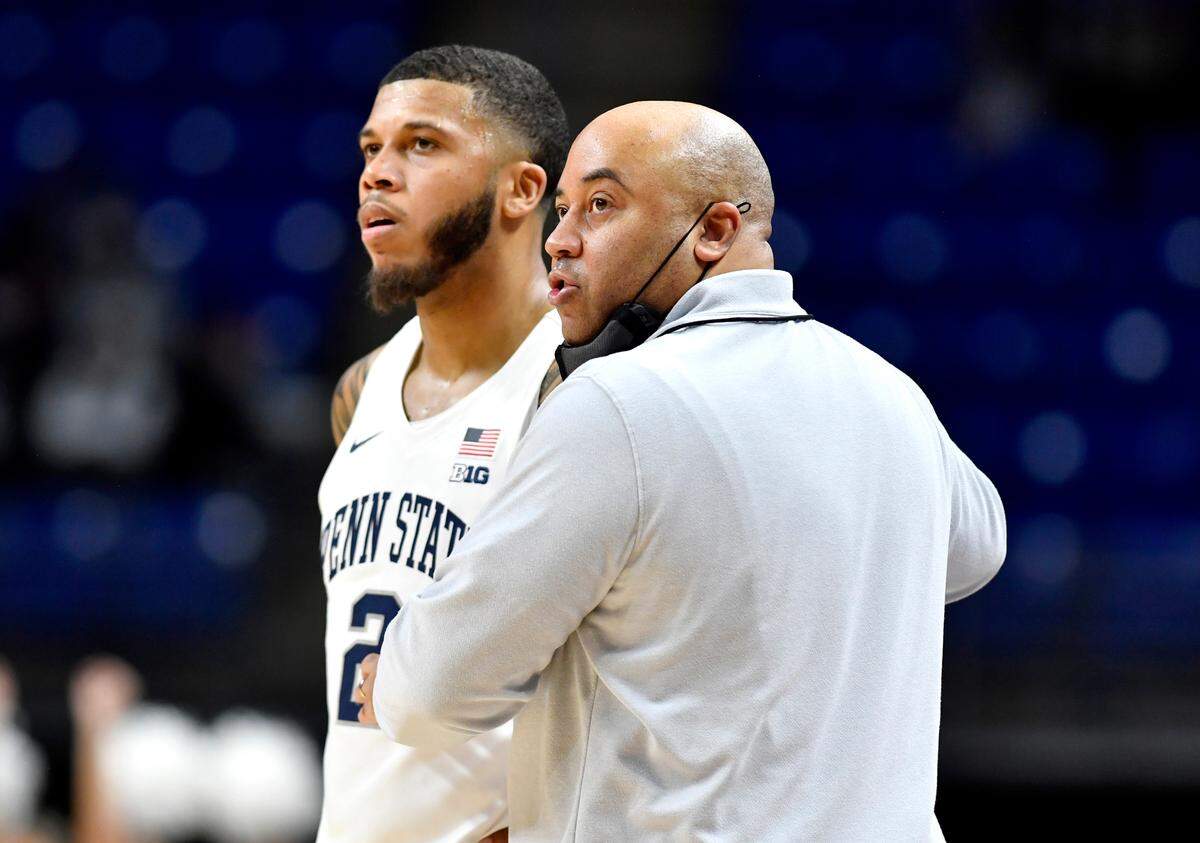
The problem for Penn State is more about its personnel and what the players are capable of doing. The Nittany Lions have two players they can rely on primary ball handlers in senior guards Jalen Pickett and Sam Sessoms. Both can find those creases and get to the rim to force the defense to rotate, but they’re the only two on the team who can do it consistently. Shrewsberry previously said he would like to have more ball handlers on the court at once, and it would clearly benefit the team’s offense. Instead Pickett and Sessoms are forced to carry a massive offensive workload, with one of them having to be on the court at all times to allow Penn State to play how it wants to play.
There isn’t a good short term fix for the Lions, which means the two guards will have to continue to push the offensive forward this season until they can’t anymore. The offense itself gets the exact shots you want in a game, but right now it lacks the ball handlers to do it consistently and to some extent the shooters to knock down the looks that open up from 3-point range.
Defense
The Penn State defense is essentially the polar opposite of what it had been under former head coach Pat Chambers and interim head coach Jim Ferry. That regime prioritized creating turnovers and getting the offense going in transition by doing so. The Lions would jump passing lanes, take chances on steals and be more prone to 5-on-4 situations if a player took himself out of a play trying for a steal.
The current system does none of those things. Turnovers are a byproduct, not the endgame, under Shrewsberry. He wants his defenders to stay with their assignments and prevent easy driving lanes to the rim. The Nittany Lions don’t force nearly as many turnovers, but they also don’t make nearly as many mistakes on the back end. Their opponents generally have to earn their shots in the half court, barring a defensive breakdown. The group makes clean rotations more often than not, with players knowing where they need to be if a teammate is forced to help and causes the rest of the defense to recover.
The results have generally been positive, with the occasional offensive onslaught, like those by UMass and Indiana on the road, dooming the team. Those situations aren’t necessarily indicative of a trend with the new staff. The Hoosiers are a poor shooting team and allowing them semi-open looks was sound strategy heading into the matchup. Sometimes, the other team will make shots they’re not expected to. As a whole, Penn State’s defense has been good, given its personnel. They have solid size at most positions but don’t have the athleticism and length to be dynamic on that end at all five spots. Generally, opponents are put in position to take the kind of shots the Nittany Lions want them to, usually long mid-range shots. They play intelligently and look like a well-coached defense with smart, veteran players who know what they need to do and how they want to do it.
Moving forward
Even with Penn State’s 8-9 overall record, the prognosis is positive for this program beyond the 2021-2022 season. The styles they play with on offense and defense generally emphasize getting high efficiency shots and giving up low efficiency shots. That won’t always lead to a win, but it will make life difficult for opponents more often than not, even without a highly-talented team.
Shrewsberry and the Nittany Lions should have more help next season once the 2022 recruiting class enrolls, with multiple ball handlers on the way and several versatile defenders incoming. The results are what they are, and 17 games isn’t a full season sample to work with, but Penn State is trending positively under a new regime with an opportunity to overperform in its first year based on its coaching ability.