How former Penn State and NFL DL Devon Still and daughter Leah are continuing to fight against neuroblastoma
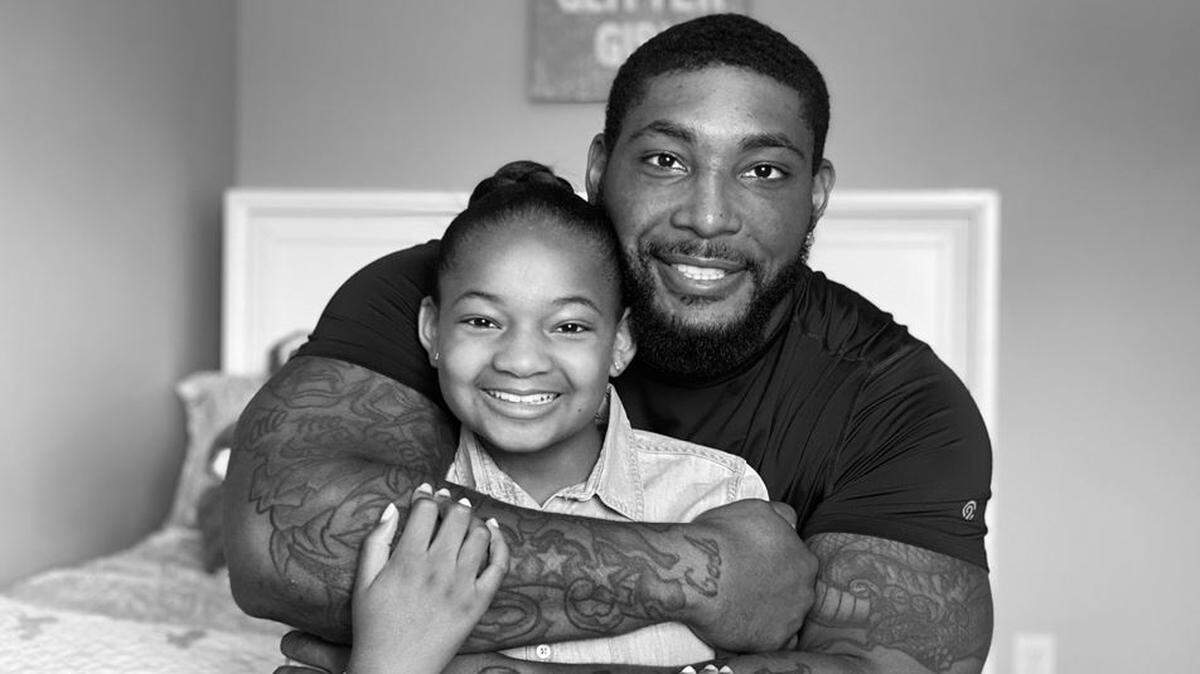
Former Penn State defensive lineman Devon Still once questioned whether or not his daughter Leah would make it out on the other side of neuroblastoma treatments in good health.
Devon announced to the public on June 2, 2014, that Leah had stage 4 neuroblastoma, while he was a member of the Cincinnati Bengals. After months of treatments, along with the days and nights by Leah’s bedside, Devon announced that Leah was cancer free in November, 2015.
“The fact that Leah is here today — she’s 11 years old, although she’s 11 going on 21,” Devon Still said laughing on a call with the media last month. “She’s starting middle school, it’s just a blessing to be able to experience certain moments with her that I wasn’t sure that I’d be able to get at one point in time.”
Leah was in a fog during treatments. The then-6-year-old didn’t understand much of what was going on besides the pain and sadness she felt during treatments. Now, she looks to give knowledge to other families who are going through the same thing.
To accomplish that, the Stills have partnered with United Therapeutics to launch Braving NeuroBLASToma — an educational initiative that includes a series of children’s books aimed to help affected families understand more about the neuroblastoma patient journey.
“I don’t really remember much and it was kind of hard for me to understand what was going on,” Leah Still said. “I could kind of understand that I was sick and I was sad, but other than that, I don’t remember and didn’t really understand the things that I understand now. I feel good about [teaching others] because I like helping people, especially families that are going through it. Now, I relate to them a lot because of what happened. I can understand them.”
The Braving NeuroBLASToma campaign, according to a release, consists of a toolkit of information for patients and families about understanding treatments, questions to ask doctors and caregiver advice, and a series of four children’s books, including the latest release of “Zara Takes Off,” which begins with a a personal forward penned by Leah about her own journey.
Gong through cancer treatments can be a lonely experience. But Devon and Leah Still had the added benefit of the support system of the Penn State and Cincinnati Bengals programs and fans. They made sure that he and Leah never felt that they were alone throughout the journey.
“It meant the world to us because a lot of times, when you go through this battle with neuroblastoma or with cancer in general, a lot of times you feel alone,” Devon Still said. “It’s a very dark process that you go through. So, when you’re able to have that type of support system, when you’re able to have people lift you up when you may be feeling down, it’s extremely important throughout this process. And that’s why now we try to pay it forward because it was done for us, we try to do it for other families.
“That’s why we have our foundation, that’s why we partnered with United Therapeutics, that’s why we’re championing this new book ‘Zara Takes Off.’ It’s because we believe that in order to make it through this battle, families need to have resources and they need things to encourage them and uplift them. I think that Zara and this book does a perfect job of teaching families what to do after the battle with cancer is over.”
Leah would often have to stay back at the Children’s Hospital of Philadelphia while her father played with the Bengals. Being away from her family was hard, Leah Still said, but during that time she learned how to be vulnerable with others, and to open up about her struggles.
She looks to help encourage other kids and their parents to open up to each other about their mental, emotional and physical challenges during treatments.
“Sometimes, when my dad would go to Cincinnati and we would be on the phone, we’d hang up and I would start crying,” Leah Still said. “Later, I would find out that my dad would start crying after we were on the phone, too. We weren’t vulnerable with each other and we should’ve been, but we weren’t.”
Her father concurred.
Cancer treatments are time intensive, and many parents have to make the difficult decision of leaving their child’s side to go back to work or pay bills. This was no different for the Stills. The now-32-year-old Still said he struggled every day he was unable to be by his daughter’s side during treatment, and prayed that Leah would make it to the offseason so they could be back together again.
“Things just start to pile on and the child is trying to be the rock for the parent and the parents are trying to be the rock for the children and they’re just trying to show strength to let them know that ‘We’re going to be able to get through this,’” Devon Still said. “But one thing that I learned from Leah’s battle with cancer is that true strength is allowing yourself to be vulnerable as a parent to show your kid that ‘I’m not having a good day, a lot of this is weighing heavily on me,’ and it’s OK to cry and to talk about it. It’s because that gives the child permission to open up and talk about what they’re going through.”
Dr. Rochelle Bagatell, the leading expert in neuroblastoma research at the Children’s Hospital of Philadelphia, focuses on improving and evaluating current therapies for children with high-risk and relapsed disease. According to Bagatell, finding neuroblastoma early can be the difference between life and death for a child
“The majority of patients are little kids and we’re always dealing with little kids, whose bodies are growing,” Bagatell said. “So, they’re always challenges no matter what your risk group is. It is more challenging to cure this disease when it has spread in the body. Stage 4, otherwise known as ‘Stage M’ — metastatic disease, is much harder to cure. In the setting of disease that has spread in the body, we work very hard to coordinate chemotherapy, surgery, radiation, immunotherapy and other treatments to try to cure this disease.”
Neuroblastoma, according to the American Cancer Society, is a rare childhood cancer that affects nerve cells called neuroblasts, often developing in infants and children under the age of five. Patients of this specific type of cancer are usually diagnosed in later stages with the adrenal glands often being affected first, but the disease could also develop in the spine, neck, abdomen or chest.
The five-year survival rate for neuroblastoma is 81%, with varying factors including low-risk or high-risk tumors, according to the American Cancer Society. Children with low-risk neuroblastoma have a five-year survival rate that is higher than 95%. Other children with intermediate-risk neuroblastoma have a five-year survival rate that is in between 90% and 95%, while children with high-risk neuroblastoma have a five-year survival rate hovering around 50%.
According United Therapeutics, nearly 70% of patients will have advanced or metastatic neuroblastoma at the time of diagnosis, with only half of those patients achieving remission.
Having made it through to the other side, Leah Still feels a responsibility to help others navigate not only through cancer, but also through other challenges such as the COVID-19 pandemic.
“Everything that happened inspired me to live life like any other day and to not take stuff for granted,” Leah Still said. “School has been a little hard when it was online. I just enjoyed being around other kids and being able to do things out of the hospital.”