The Good, The Bad & The Ugly: Reviewing Penn State football’s 20-18 loss to Illinois
Penn State’s offense never seemed to click Saturday afternoon. The Nittany Lions sputtered to 10 points in the first 60 minutes of game action on their way to a 10-10 tie at the end of regulation with Illinois. Then, with two opportunities to score touchdowns in the first two overtimes, the team kicked two field goals.
What came next was jarring for an offense that has generally performed well this season.
In the next seven overtimes, which consisted of each team trying a two-point conversion from three yards out, the Nittany Lions scored only once.
“We were struggling on offense all day long,” Penn State head coach James Franklin said after the game. “Those same issues showed up. ... Obviously, we didn’t get the job done. I think it was nine overtimes, or whatever it was. There was plenty of plays and plenty of opportunities for us to end it, and either we did not execute, or we did not make plays when we had opportunities to do and that’s on the offense and defense.”
It didn’t matter what Penn State tried, nothing seemed to work. Offensive coordinator Mike Yurcich called runs, called passed and called trick plays but his unit just couldn’t break through to make a play.
The loss doesn’t come without consequences, either. The Nittany Lions have almost no chance to make the College Football Playoff after starting the season 5-0 and they have very little chance of winning the Big Ten East and making it to the Big Ten Championship game, even if they win out.
The loss means the team will likely end its season disappointed after striving to make the playoff and win the conference, and the locker room felt that after the game. Defensive end/linebacker Jesse Luketa said the team felt distraught following the game.
Franklin said not immediately coaching the team up was difficult given what had unfolded.
“Probably the hardest part of my job is, after a tough loss, to stand there in the locker room and give them what they need to hear at that moment,” Franklin said. “My natural inclination is to start coaching and go over the issues that we had today on the field. It’s not the right time for it. We’ll save that till Sunday.”
Good
Penn State’s pass defense: Illinois was doomed nearly every time it decided to pass the ball Saturday. Artur Sitkowski threw for 38 yards on 8-of-19 passing, including an interception that was caught by Penn State linebacker Curtis Jacobs on the game’s first drive.
The Nittany Lions were excellent at all three levels whenever the Illini decided to drop back and pass. The defensive line was able to get pressure, including four sacks that led to two forced fumbles, and make it difficult for Sitkowski to get clean passes out. The linebackers operated well in coverage, ensuring the middle of the field was taken care of when the team was in zone and staying with the running backs and tight ends in man coverage.
The secondary stayed tight in coverage throughout the game and made sure no easy windows opened up for Illinois. While there were plenty of negatives to come from Saturday’s games, the pass defense was an overwhelming positive, even if the rest of the game was a mess for the Nittany Lions.
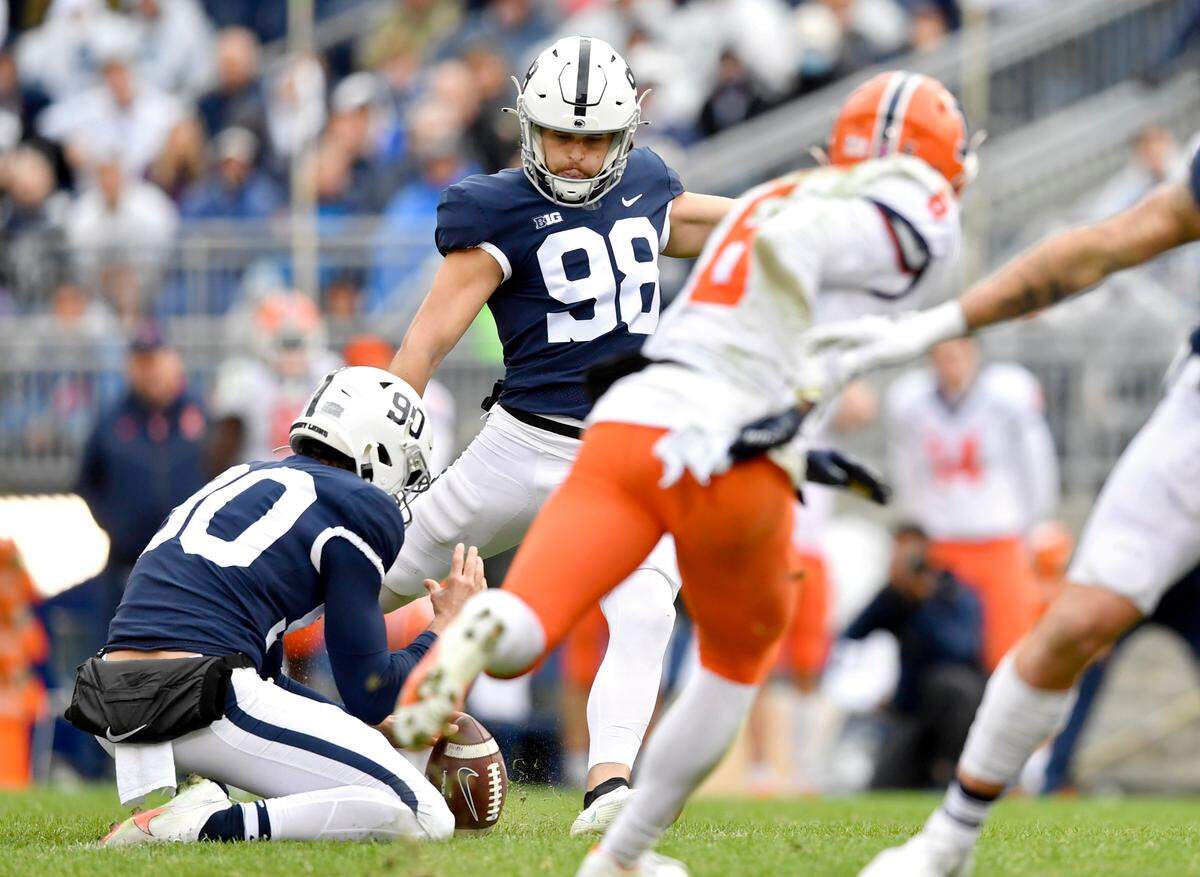
Punting: This is pretty indicative of how Saturday went. The second-best part of the day for Penn State was the punting. Don’t get me wrong, Jordan Stout was excellent as a punter in the game, routinely pinning Illinois deep and forcing the offense into long fields. The problem was, it didn’t matter much with everything else that went on in the game.
Stout deserves credit for the work he did nonetheless. The punter booted eight balls for an average of 46.9 yards, including four that went at least 50 yards and seven that went inside the opposing 20-yard-line.
He played a big role in making sure Illinois had to go as far as possible when it wanted to score and that prevented the Illini from scoring on numerous occasions. Their offense wasn’t good enough to make up that much ground and it became clear that Stout’s punting was giving Penn State an opportunity to get positive field position and score.
Bad
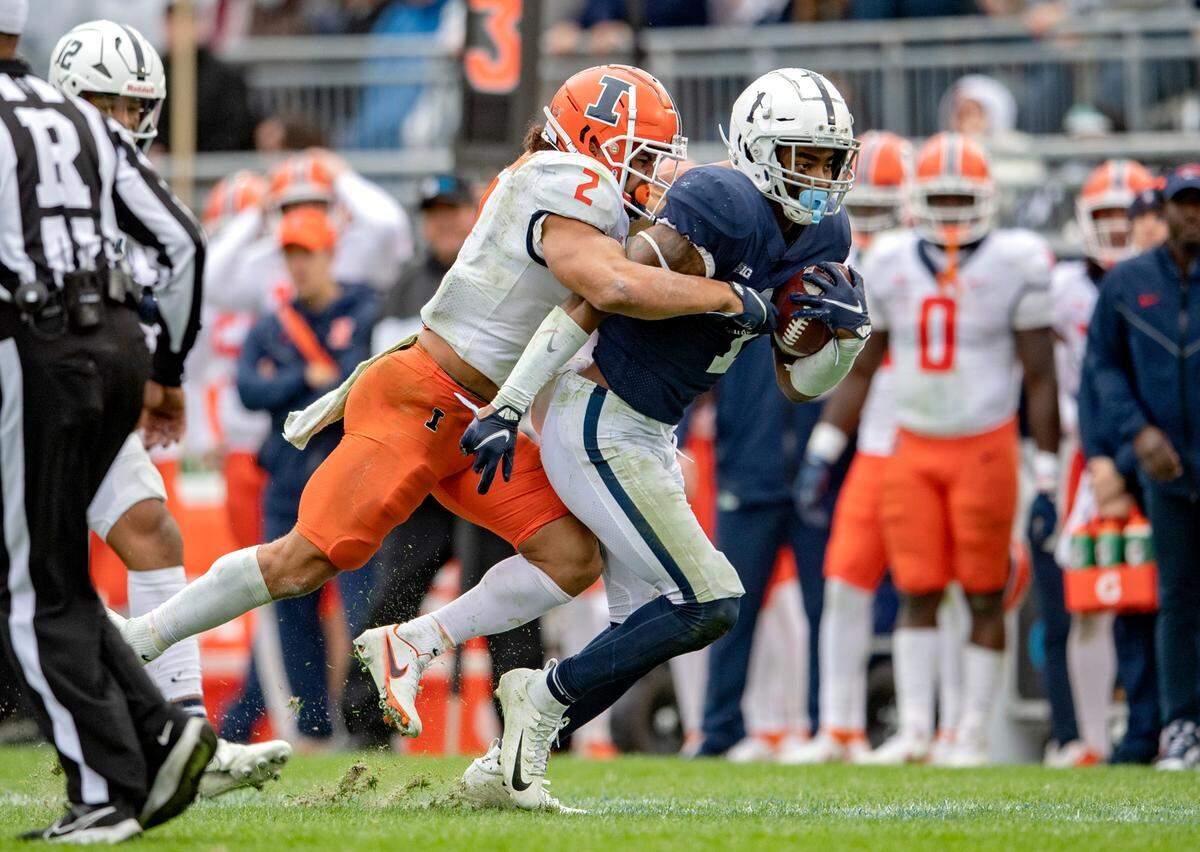
The Nittany Lion run defense: There’s a lot to get to, so let’s start here. Penn State was gashed time and time again by the Illinois offense and it didn’t matter who was in at running back. Sophomore Chase Brown started the game for the Illini and finished with 223 yards on the ground and a touchdown on 33 carries, good for 6.8 yards per carry. That is ... not great. Brown had big holes to run through and when he didn’t he ran through arm tackles by the Penn State defense.
The bright side for Penn State was that Brown’s backup didn’t play as well. Freshman Josh McCray only ran for 5.8 yards per carry, a slight improvement. He carried the rock 24 times for 142 yards.
There’s no way around it, Penn State’s run defense was legitimately brutal. It never had a chance to stop the Illinois offense and that was in part to the personnel package the Illini put on the field quite a bit in the game. They would frequently line up with one running back and two tight ends, but instead of two wide receivers they had two extra offensive linemen. If seven offensive linemen and two tight ends doesn’t scream, “We’re about to run,” I don’t know what does. Still, that didn’t help the Nittany Lions, who gave up 357 yards on the ground, even when accounting for the yardage lost when Sitkowski was sacked.
Penn State’s offense: Yeah, all of it. The whole thing was bad. Penn State couldn’t move the ball against a defense that ranked 84th in the country in ESPN’s Bill Connelly’s SP+, a tempo- and opponent-adjusted measure of college football efficiency, and gave up 42 points to Virginia earlier this year.
There were a lot of reasons why that happened. We’ll get to the main one in a second, so let’s look at the secondary reasons. Franklin has said time and time again the team needs to be able to run the ball when everyone in the stadium expects it to. Well, I have bad news. The team can’t run the ball and it definitely can’t do it when everyone expects it to.
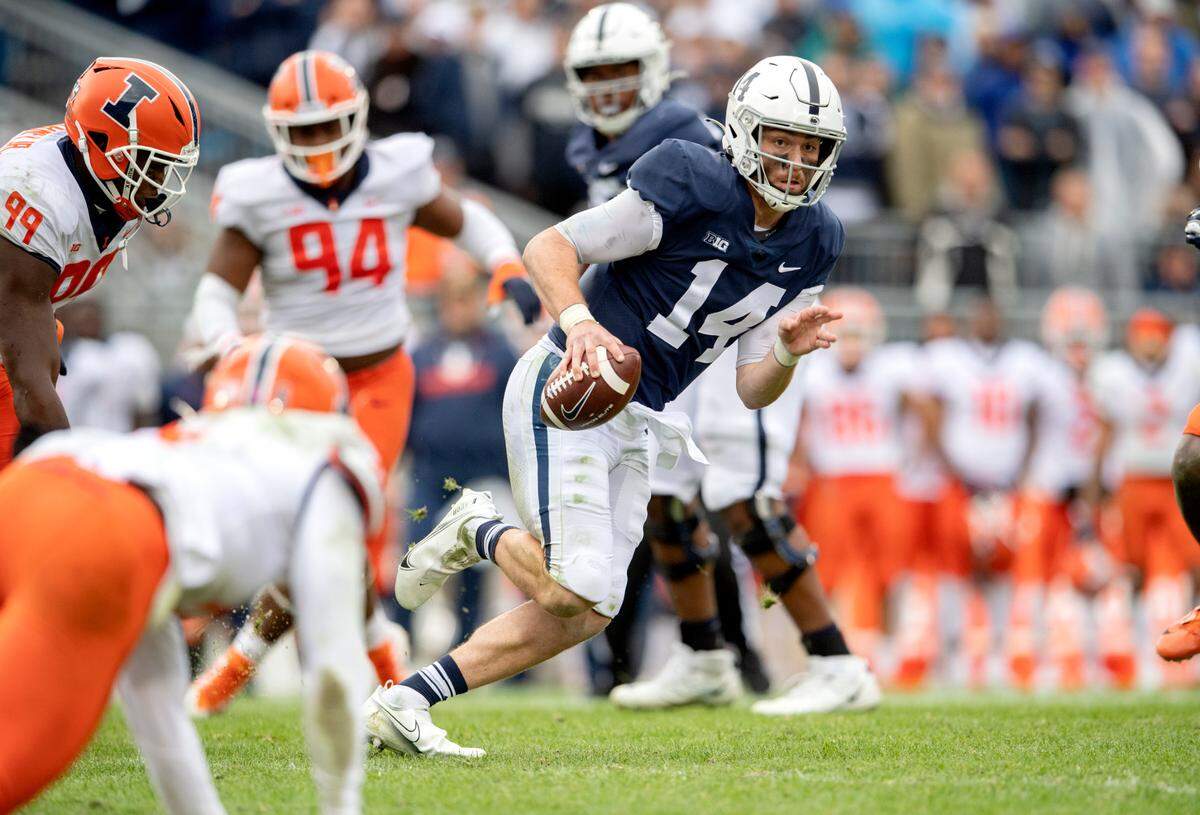
That didn’t stop the Nittany Lions from trying. They ran in several short yardage situations and frankly, I don’t blame them. That’s because the passing offense was just as bad as the rushing offense in the game. Receivers frequently found themselves open down the field, but for one reason or another, redshirt senior starting quarterback Sean Clifford didn’t find them. He missed open targets when he did find them and he lacked the mobility he usually brings to the table, which brings us to ...
Starting Sean Clifford: ... this. Clifford left the game against Iowa with an undisclosed injury and it was clear that injury was still bothering him Saturday afternoon. He winced after throws, stretching out his side or grabbing his side, and was slow to get up after nearly every hit that was levied against him. The inability to run seemed directly related to the injury, considering the redshirt senior had never been shy about taking off and running to this point in his career. As the hits piled up against Clifford, he became more and more hesitant to take any contact, even sliding behind the line of scrimmage on a play that he could have gained a yard or two on.
For all of the issues redshirt sophomore Ta’Quan Roberson had when the Nittany Lions played the Hawkeyes, it’s hard to imagine he couldn’t have helped the offense against Illinois. That’s not a knock on Clifford. He just wasn’t healthy enough to make the impact he usually does and Penn State’s offense appeared to be limited because of it.
Putting Roberson in the game would have at least made the Illinois defense respect the threat of the run more, and that would have been more helpful as the teams traded two-point conversion attempts from the third overtime to the ninth overtime. Perhaps the right decision was made and Roberson wouldn’t have helped, but given how the game played out, that doesn’t seem likely.
Ugly
Penn State’s playoff chances: They’re gone. Penn State isn’t going to make the College Football Playoff with two losses, including one to one of the worst teams in the Big Ten. The rapid downfall of the Nittany Lions has been shocking.
Before the game against Iowa, and even after the first quarter of the game, they seemed like a team that would have a chance to win the conference and knock off perennial power Ohio State along the way. Now there’s reason to believe they might finish 7-5. It’s hard to see them knocking off the Buckeyes in Columbus and games against Michigan and Michigan State will also be uphill battles.
It would take a real disaster, like losing to Rutgers or Maryland, for the team to fall to .500. At this point, however, it’s hard to rule anything out.
This story was originally published October 24, 2021 at 6:00 AM.