Penn State’s Beaver Stadium a step closer to $700M in renovations. Here’s what’s next
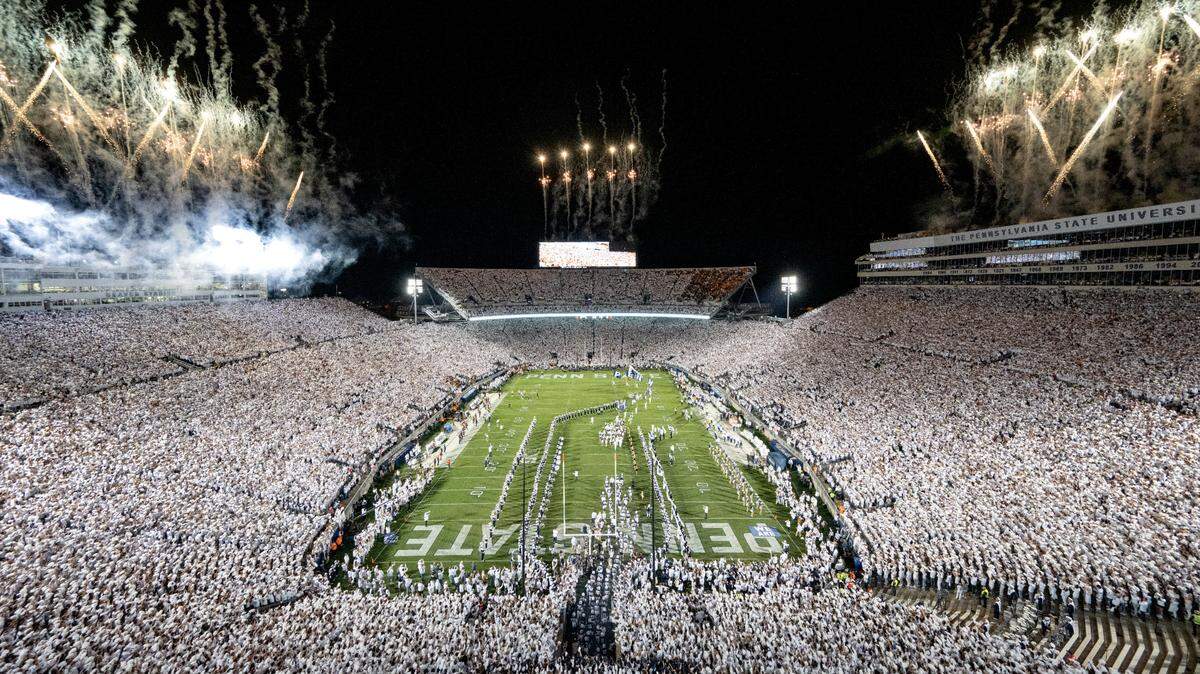
Penn State’s Beaver Stadium, the fourth-largest stadium in the world, is now a step closer to an estimated $700 million makeover.
A committee from the university’s board of trustees unanimously advanced a proposal Thursday to spend $70 million on the first phase of the renovations, which includes design costs, professional consultant expenses, acquisition of permits, stadium winterization costs and related expenses. The full board of trustees will vote on that specific measure Friday afternoon and, if everything goes as planned, construction for the full project would largely begin after the 2024 football season.
Because the final design for Beaver Stadium likely won’t be completed and publicly released until next year, it’s unknown at this early point how many phases of construction there might be. Athletic Director Pat Kraft told the CDT on Thursday it’s possible there might only be two, but approval of the first phase is needed to start the design and get a more accurate final cost.
All of the anticipated renovations are expected to be completed by August 2027, meaning both the 2025 and 2026 football seasons will be at least partially impacted by construction.
“You have to work within the confines of two football seasons, so our fans will notice it — but I think it’s really going to be focused on the west side during the season,” Kraft said. “And so that will be the part that will be most impacted, but we believe we can have a very minimal impact on our seating capacity through this process.”
Public documents show that Beaver Stadium’s capacity will remain over 100,000.
What kind of renovations?
In the short term, assuming the full board approves the Phase 1 measure Friday, about $30 million to $35 million will go toward design costs, $29 million toward winterization (e.g. improved insulation, drainage and plumbing) and the rest addressing pressing issues like field lighting.
The design process is expected to start next month and, Kraft said, will likely take nine to 12 months — another official said 15 months — to complete. The winterization will allow Beaver Stadium to operate in below-freezing conditions, meaning it should be able to host any potential College Football Playoff games for the 2024 season.
In the long term, the full $700 million project should see a number of changes at Beaver Stadium, such as:
- Upgraded concession offerings
- Improved restrooms
- Better circulation
- Increased concourse spaces
- Improved Wi-Fi/cellular service
- Additional premium seating (e.g. suites and boxes)
- Improved access for broadcasting
“I’ve been on this board a decade, and my compliments to Pat and Sara (Thorndike),” trustee Ted Brown said, referring to the athletic director and the vice president of finance/business. “We finally have a proposal to do something. Thank you.”
Who’s paying for this?
In the wake of significant university budget issues, officials repeatedly emphasized that no tuition dollars — and none of the university’s state appropriation — would be used toward Beaver Stadium renovations. Costs would instead be paid for by the athletic department.
Essentially, the university takes on debt with the athletic department paying it all back. According to Thorndike, the university and athletic department run projections to make sure there’s enough incoming revenue to cover new and existing debts.
“As a self-sustaining department — meaning its generated revenues are equal to or more than its operational costs — Intercollegiate Athletics is fiscally sound and will generate the revenue to pay for this project and more,” Thorndike added in a news release. “When the renovation is complete, the return on investment will be significant, bringing in additional financial resources to Intercollegiate Athletics.”
Kraft said the athletic department hopes to fundraise at least $200 million to help pay for the stadium. And, although Penn State’s state appropriation won’t be used toward this, officials said they were “very open” to other state funding — but weren’t counting on it.
“We know that this project has tremendous impact on the whole community,” Thorndike said. “And, if there’s an opportunity at some point, if the state wants to help fund part of this project, we would be very open to that opportunity because that does happen with stadiums.”
Added university President Neeli Bendapudi: “No tuition dollars are being used for this. ... It’s just a hope that the state contributes extra money.”
This story was originally published May 4, 2023 at 1:44 PM.