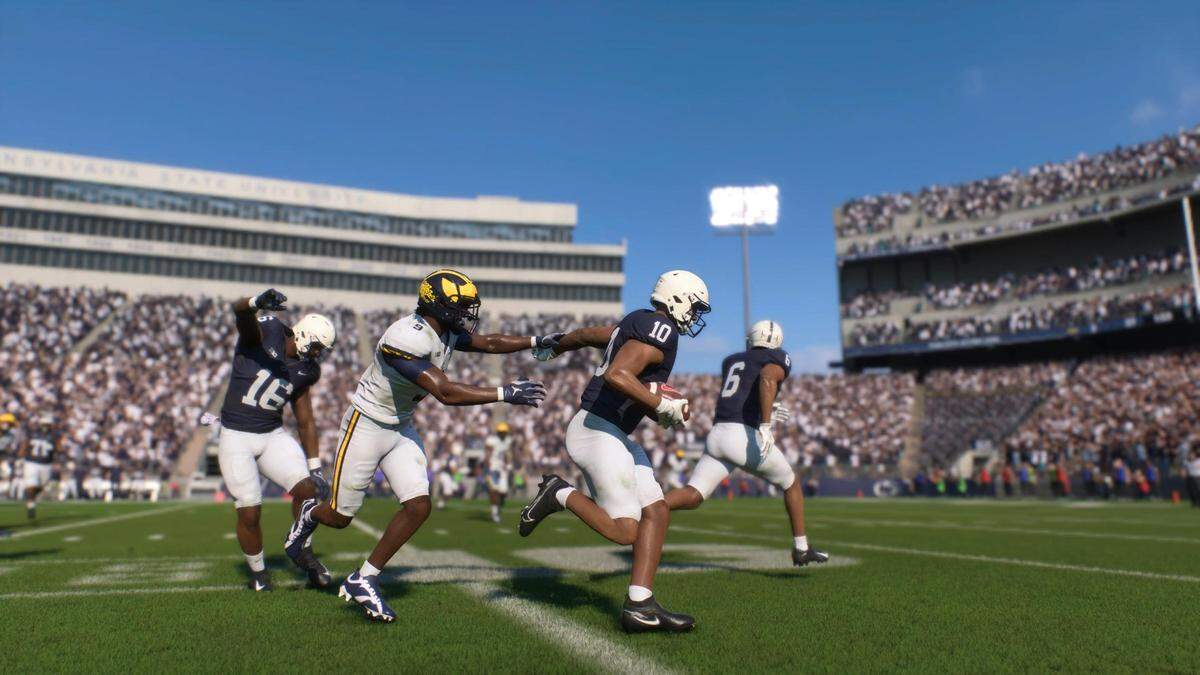
Can Penn State make the playoff? We simulated 100 seasons of EA College Football 25 to see
Wondering how Penn State is going to finish this season? Have no fear, we (sort of) have the answers.
We fired up EA College Football 25 and hopped into the game’s dynasty mode, simulating 100 iterations of the 2024 season. No, we freely admit this is likely not an accurate reflection of true odds this season — but we were curious what outcomes EA’s game engine delivered and, when all is said and done, how close it might be.
We chose the same settings in all 100 simulations for the sake of consistency. Each time we selected Oregon State as our team, as to not have any impact on Penn State or the Power-4 schools, and did not alter any settings of the dynasty.
How did things play out for the Nittany Lions?
Let’s take a look.
How many times did Penn State make the playoff?
- No. of times Penn State made the playoff: 23
- No. of times Penn State hosted a first-round playoff game: 10 (43.5% of time when making playoff)
- No. of times Penn State had a bye: One (4.3% of time when making playoff)
- No. of national titles: Zero
- No. of conference titles: One
- No. of times ranked in top 25 but missed out on playoff: 32
- No. of losing seasons: 11
Penn State made the playoff a surprising 23 times across the 100 simulations — a much lower number than anticipated. Even among those 23 entries, the Nittany Lions rarely found much success, never making the finals and only making the semifinals twice.
Even more surprising were the 11 losing seasons the team had, topping out with seven losses several times.
Despite those failures, the team still managed to be ranked 55 out of 100 times, a number that was still much lower than anticipated heading into the simulations.
How did Penn State play in big games?
- Record vs. USC: 53-47
- Record vs. Ohio State: 21-79
- No. of times with losses to both in same season: 36
- No. of times with wins over both in same season: 10
- Largest margins of victory: 42 points (70-28) vs. USC, 32 points (56-24) vs. Ohio State
- Largest margins of defeat: 31 points (52-21) vs. USC, 45 points (66-21) vs. Ohio State
The numbers bear out what seems like the appropriate number of wins and losses to Ohio State and USC. The 53% win rate against USC lines up for what could be the program’s second-toughest game of the year, and the same goes for the 21% win rate against an Ohio State team that is one of the favorites to win the national title.
Interestingly enough, seven of the 10 times the Nittany Lions defeated both USC and Ohio State, they went on to miss out on the playoff altogether. (In those simulations, Penn State often tripped up down the stretch and/or opened with a loss to West Virginia.) In five of the 36 seasons where they lost to both teams, Penn State made the playoff anyway.
How did the Penn State passing offense do?
- QB Drew Allar’s average stats: 3,064 passing yards, 31 passing touchdown, six interceptions
- WR Harrison Wallace III’s average stats: 55 receptions, 797 yards, seven touchdowns
- WR Julian Fleming’s average stats: 41 receptions, 601 yards, six touchdowns
- WR Liam Clifford’s average stats: 55 receptions, 663 yards, nine touchdowns
This was one of the most interesting aspects of the simulation, in large part because of the consistency in Allar’s numbers. He very rarely hit double-digit interceptions, only crossing that threshold in seven simulations. Despite that (and some seasons where he had Heisman-level numbers, like when he threw for 3,906 yards and 42 touchdowns), Allar never won the Heisman Trophy.
If fans are looking to the simulation for a No. 1 receiver, it seems clear that Wallace remains the most likely top option. With that being said, the spread among each receiver’s stats was usually very close. And Clifford managed to lead the team in receiving 23 times, while Fleming had eight such occurrences and Wallace had 69 of them.
There were two data points taken out of the set to eliminate outliers — one when Allar was injured and missed a significant number of games, and one when Clifford was injured and missed a high number of games. Due to EA’s known issues with simulating rushing stats, we did not track the numbers for Nick Singleton.
National outlook
- National titles: Oregon (31), Ohio State (13), Miami (11), Utah (10), Michigan (8), Alabama (7), Georgia (3), Notre Dame (3), Clemson (2), North Carolina State (2), Oklahoma State (2), Boston College (1), Florida State (1), Kansas State (1), Louisville (1), LSU (1), Texas Tech (1), UAB (1), UCF (1)
- Heisman winners: Alabama QB Jalen Milroe (28), Ohio State QB Will Howard (14), Oregon QB Dillon Gabriel (7), Clemson QB Cade Klubnik (6), Miami QB Cam Ward (6), Kansas State QB Avery Johnson (4), Georgia QB Carson Beck (4), North Texas QB Chandler Morris (3), North Carolina State QB Grayson McCall (3), Oklahoma QB Jackson Arnold (2), Liberty QB Kaidon Salter (2), Indiana QB Kurtis Rourke (2), Virginia Tech QB Kyron Drones (2), Colorado QB Shedeur Sanders (2), Purdue QB Hudson Card and 14 others tied with (1)
Nationally, 19 different teams won national titles, including 11 teams that won multiple titles. A whopping 52 champs came from the Big Ten, with all of them being spread among Oregon, Ohio State and Michigan, while the SEC won only 11 national titles. The ACC won 18 titles — good for second-most among all conferences — while the Big 12 took 15.
The Heisman winners were almost entirely quarterbacks, with 96 signal callers winning the award. The four non-quarterbacks were all wide receivers — Arizona’s Tetairoa McMillan, Florida’s Chimere Dike, North Carolina State’s Dacari Collins and Oregon’s Traeshon Holden.
No Nittany Lions won the award during the 100 simulations.