
How assistant athletic trainer Justin Rogers impacts Penn State men’s hockey on and off the ice
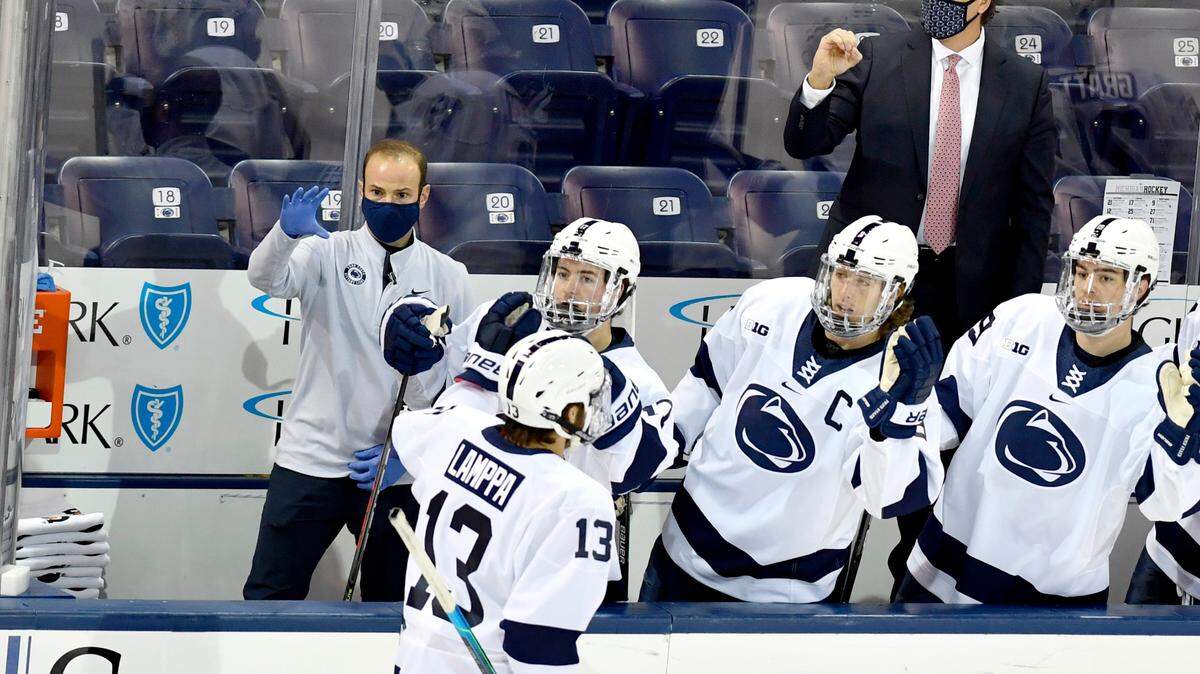
Justin Rogers never had any doubt that he would become an athletic trainer.
The Penn State men’s hockey assistant athletic trainer was the oldest grandchild on his mother’s side of the family, and with a great-grandfather who was a doctor of osteopathy, it was just assumed that he would follow his footsteps into the medical field.
“I grew up playing sports, and in high school helped my high school athletic trainer,” Rogers said. “I would play football, and then once practice was over I would go to the JV game as an athletic training student and help her.”
After attending Michigan State, Rogers fell in love with the profession. He spent the first three years after graduation working as a football trainer, before a job opportunity brought him to Pegula Ice Arena and Happy Valley.
Particularly this year, Penn State hockey coach Guy Gadowsky is grateful to have Rogers with his program.
“Personally, I owe him a great deal of gratitude for how he’s operated during this year,” Gadowsky told reporters in February. “He’s made us all feel safe and supported, but did it in a way that still makes you want to come to the rink. He’s been the most important person in the program this year, bar none. He’s always been — that’s the type of person he is — whether it’s in a pandemic or a regular year. He’s a pro, through and through.
“But, this year specifically, I think the team owes him a great deal of gratitude. But personally, for me, even more so.”
Whether there’s a pandemic or not, Rogers’ impact on the players has been invaluable, and has extended to long after they’ve left the program. Former hockey players still reach out to Rogers about not just injuries they’re facing, but matters in their personal lives, too.
“I wouldn’t have been the player I was at Penn State if Justin wasn’t around,” said Andrew Sturtz, who played at Penn State from 2015-18. “The biggest thing for hockey players, and I bet every athlete in general, is you want to have an athletic trainer that’s easy to go to and easy to talk to — and I think that was the one thing he excelled at. Anyone could go into his room and mess around or tell jokes.
“You just felt comfortable around him. He made everyone feel comfortable.”
During the hockey season, Rogers doesn’t take any days off, according to Sturtz. He’ll even open the training room on Sundays to allow players to use the sauna or the hot tub.
Rogers typically will get to Pegula Ice Arena around 7 o’clock most mornings, about 30-45 minutes before the rest of the staff and players arrive. With COVID testing six days a week, Rogers now gets to the arena even earlier most days.
Once the players show up, Rogers is available to help them warm up or do some quick training before morning lift. While the team lifts, Rogers does paperwork before rehabbing players who are out of the lineup for injuries prior to practice. Rogers has been to every practice since the program began, and is there to help if any player gets injured. After practice, Rogers typically does more paperwork, unless there was an injury at practice that needs attention.
On game days, Rogers’ day is even longer. But, Rogers is more than an athletic trainer. He’s an essential component to Penn State’s program, and goes above and beyond the typical duties associated with athletic training.
“He’s honestly one of the hardest working guys in the program,” Sturtz said. “He does so much behind the scenes, even outside of the injury stuff. He does so much with getting us set up on the road for food and anything that we want … those kind of things mean so much to the players.”
Outside of making sure players have the fuel they need to play the game (including sneaking in some gummy worms on game days, per Sturtz), Rogers also helps former players who are battling sports-related injuries.
Sturtz, who now plays for Rapid City Rush in the East Coast Hockey League, reached out to Rogers when he was dealing with injuries throughout last season. And Rogers responded, even though Sturtz left the program three years ago.
“Over the summer I had a couple shoulder injuries, and I had a sports hernia last summer,” Sturtz said. “This summer, when I was trying to figure out where I should get my sports hernia surgery done … he ended up recommending a guy in Pittsburgh ... and that’s the guy who ended up doing my sports hernia surgery.”
For Rogers, the most rewarding part of his job is getting a chance to see Penn State’s program grow and be able to support the team’s players — both in their collegiate careers and beyond.
Being involved in every detail of the program, Rogers said he has a “once-in-a-lifetime opportunity” to help shape the future of both the young men on the team, as well as Penn State’s young varsity program.
“There’s so often that people want to change things and help things, and don’t get the opportunity,” he said. “But, every day I get to wake up and come in and I have an impact on 27 young men who are trying to grow and mature both on the ice, but also in life — to have families, and careers, and life after hockey and after Penn State. So, I think it’s huge that I’m able to have such a huge impact.”
This story was originally published March 1, 2021 at 5:06 PM.