
Memories at Rec Hall: Penn State coach Russ Rose’s true legacy found in those he pushed to success
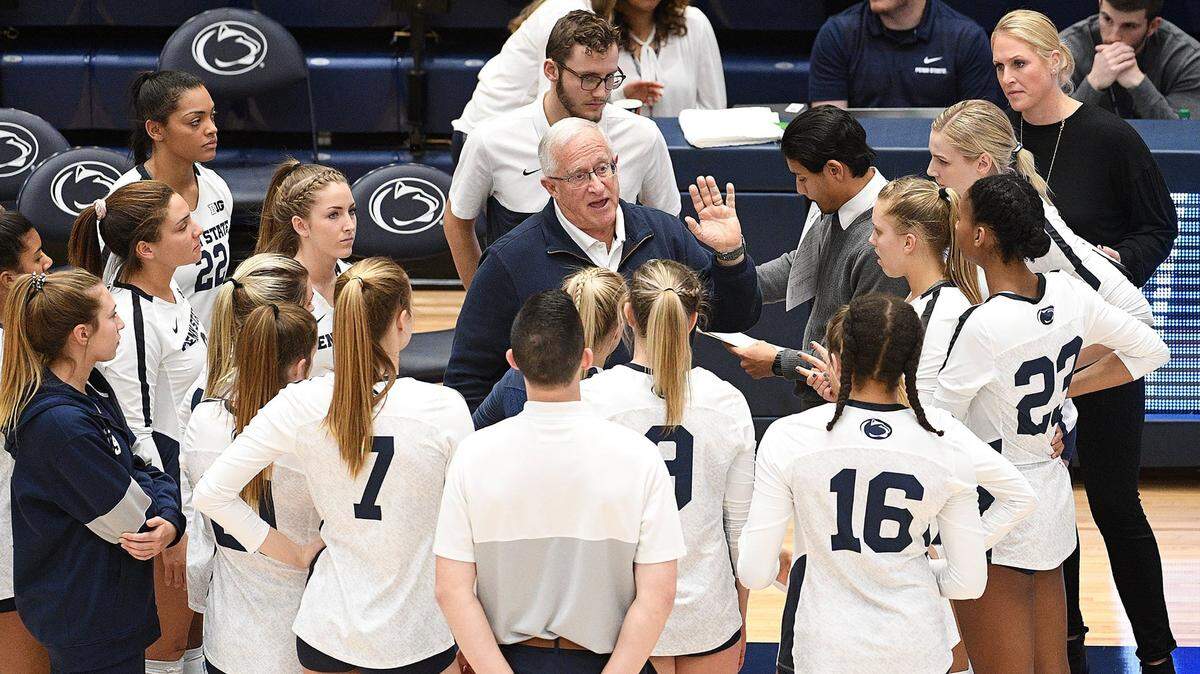
Whenever I catch a whiff of a cigar, I think of Russ Rose. So many memories of time spent with him are tied to that smell.
It makes me think of many conversations he and I — and so many other media members — have had with him in front of Rec Hall, as he sat on a bench that literally has his name on it. Whether he was praising his team, lamenting their struggles, making observations of opponents or waxing about practically any other topic, Russ was rarely at a loss for honest words as a thin trail of smoke rose from his stogie.
It makes me think of late nights leaving Rec Hall after watching so many of his Penn State women’s volleyball team’s victories. More than once I walked out of that building after 11 p.m., when I was done writing my story about an NCAA tournament match, and caught that distinctive odor wafting from an open window in his office.
Perhaps the strongest of those memories was late in the evening on Oct. 20, 2008, in Omaha, Neb. His Nittany Lions had swept Stanford a few hours earlier for the second of four straight NCAA titles, capping perhaps the most dominating season in collegiate volleyball history. The parents of a team member had invited me to the celebration party at a restaurant and bar a few blocks from the arena, and while I usually would politely decline such invitations for ethical reasons, the season was over, the party was across the street from my hotel and I wanted a chance to actually say congratulations. I had been in that bar less than two minutes when my nose led me to their leader, cigar in hand and maybe the biggest smile I ever saw on his face.
Russ Rose announced his retirement Dec. 23 after 43 seasons leading the Nittany Lions. His legacy is unrivaled not only on campus but nationally and internationally. His name appears all over the NCAA’s record books, including the most Division I wins (1,330), most NCAA titles (7) and tournament wins (106), most NCAA tournament appearances (only school with all 41), longest win streaks (overall matches, sets, home wins, road wins) and more. It’s easy to tell a story of his success with a long list of numbers and accolades, to recite names of All Americans and alumni who are now coaches, played professionally or won Olympic medals.
Russ’s true legacy is in the people he recruited, guided and prodded. He always had exceptionally high expectations, and it was easy to tell when those expectations were not met. It is quite understandable that an outsider who doesn’t know Russ, throwing in plenty of dry wit and sarcasm with his straightforward comments, would be baffled by the number of the nation’s top athletes wanting to play for him and his annual success. I met quite a few who professed a dislike for Russ and his style.
Have some conversations with current or former players, however, and his draw is unmistakable. He will push them to their limits, because he knows they are capable of more than they realize. He will have harsh words, but he also makes sure they know they are getting better. And they can be sure of his loyalty and support long after they leave campus, that no matter what he is available to help. That’s why he would never answer questions about best seasons or comparing players or teams. It’s like asking a parent who’s the best kid — and in his terms he’s had hundreds of them.
Even though I was not a part of that group, I still felt Russ had my back if I needed him, and he was always willing to help for a story I was writing. I found that out one summer, when I was writing about former Nittany Lions preparing for the Olympics. I sent a text one evening with a question that did not need an immediate response. I had no idea where he was or how long it would take to get a reply. I heard back in less than five minutes, but he couldn’t talk to me then — he was in Italy, and it was just past 3 a.m. there.
Something Russ did for me for which I was always appreciative was allowing me to occasionally watch practices, even if I stopped by spur of the moment. If it wasn’t a good day he would kindly let me know, but it often wasn’t an issue. Usually he would find a few minutes to talk with me, sometimes on the record about his team, sometimes about topics completely unrelated to volleyball. Once he even inquired about my personal life and what the future looked like for my relationship at the time. When I told him I was thinking of proposing, he was adamant that I shouldn’t waste any more time and get working on the next steps. We’ve been married nearly 12 years, and my wife still refers to him as “my friend Russ” because of his encouragement that led to my proposal less than a month later. (Actually, I had already bought the ring when he gave me the advice, but why ruin a good story?)
Perhaps the most unique day of my journalistic life came during one of those trips to watch a practice in Rec Hall’s South Gym. I was writing a story about the men who were practice opponents, so I asked about stepping onto the court myself. When I walked into the gym on the agreed-upon day, Russ asked if I brought my knee pads, then sent me out to play right back. I had to run and dive and do everything that was expected of anyone else on that court. My biggest fear was running into someone and getting them injured thanks to my stupidity. Thankfully that didn’t happen. But at the end of practice, he decided I hadn’t gotten enough of a feel for how they played, so he sent me onto the court alone while on the other side of the net balls were set for three players, five balls apiece, to hammer spikes right at me. Cassy Salyer, Christa Harmotto and Nicole Fawcett each took their swings, while the rest of the team watched. Out of 15 shots, I managed to get exactly one good pass back to the middle of the net. The rest were shanks or whiffs, and to this day I am thankful no video was taken of that session.
I didn’t always stay on Russ’ good side. In September 2007 his team had just lost to Stanford at an early-season tournament at Yale, and I wrote a column that the team was lacking a killer instinct because they have to beat teams like Stanford if they wanted to be considered a national title contender. I even had the temerity of comparing them to the Chicago Cubs, who had been pretty good at the time but had been coming up short in the postseason. I’m not sure which was worse: that I was harsh on his team or on his beloved Cubs, and I incurred the evil eye from Russ the next time I saw him. However, the team never lost another match that year. Or the next year. Or the year after that. So, 109 consecutive wins later, I decided I should write a column apologizing and admitting I obviously didn’t know what I was talking about. He reminded me of that earlier column more than once.
Russ has spent his life leaving a mark on the lives of people in so many ways. His styles and innovations changed the way the women’s game was played. He was tough on his players with his words and expectations, but it produced results, both on the court and in the returned loyalty of nearly everyone who played for him or coached alongside him.
Two decades ago I interviewed for a job on the Centre Daily Times sports staff, and I asked if they gave much coverage to the volleyball teams, and if I could have a chance to cover them. I knew then this was a special program and had a special leader. Years from now, I will still think of Russ Rose every time I smell a cigar, reminding me of a tough coach, an honest person and a loyal friend.
This story was originally published December 27, 2021 at 5:00 AM.