
Afield: ‘Just a small 8.’ Mark Nale reflects on benefits of antler restrictions
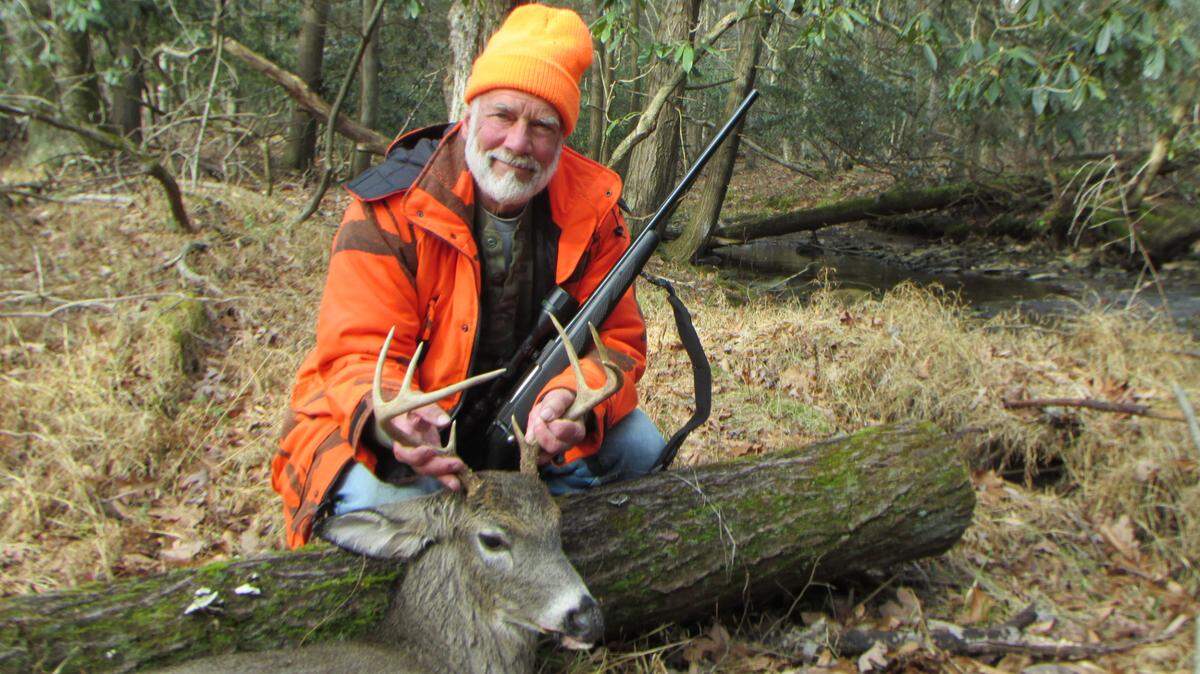
Last year at this time, I was enjoying the fruits of a successful deer hunt. It was the first time in my life that Pennsylvania’s opening day of buck was on a Saturday, instead of a Monday.
The day, Nov. 30, dawned with a beautiful pink sky to the east. I was up in my tree stand to enjoy the show. Two close rifle shots broke the silence at 7:02 a.m. However, no deer came my way. A couple of gray squirrels, as well as chickadees, nuthatches, titmice, a pair of golden-crowned kinglets and a raven kept me occupied.
It was not until 11:15 that I saw my first deer of the morning slowly crossing the hollow above me. Even with my naked eyes, it appeared to be a legal buck — with my scope I made sure. I attempted to get a bead on it through the first two small forest openings, but had no luck. I located one final opening and had just a second or two to make a 95-yard shot. My rifle cracked and the buck bounded out of sight.
I found my target in the rhododendron about 40 yards from where it was when I shot. When field dressing the deer, I discovered that my copper bullet had hit his lungs and liver.
“How big was your buck?” an acquaintance asked.
“Just a small eight,” I replied.
Always a teacher, the more that I thought about those words, the more I Knew that my buck taught a lesson. It prompted me to remind veteran hunters and tell new hunters just how much things have changed for the better.
My last two bucks have been small 8-pointers, or as some refer to them, “basket eights.” My son-in-law John shot a small eight on the opening morning of the 2019 archery season, and my brother Frank harvested a small eight-pointer on the second day of last year’s rifle season. Based on weight and antler mass, these three bucks were likely all two-and-a-half-year-old deer.
I started deer hunting in 1963. It was the “one-deer-and-done” era. Any buck with one antler three inches long was fair game. If you harvested a doe, you could not shoot a buck and vice versa. It was also a time when the vast majority of bucks shot were yearlings —with small antlers and small bodies.
According to Pennsylvania Game Commission data, at the time that I started hunting, approximately 80 percent of the bucks harvested were only 1.5 years old — with their first set of antlers. Maybe 15 percent were 2.5 years old — very, very few were older.
My father was a dedicated Woolrich-clad hunter — the type who used a week of precious vacation from his factory job to hunt deer. He shot a lot of bucks over the years and he had a bushel basket full of antlers to prove it. He loved hunting, but he was not a trophy hunter. His goal was to harvest a legal deer and put venison in the freezer.
As a curious youngster, I peered into his basket often. What was in the antler basket? Spikes, 3-pointers, fork horns, and a couple 5s and tiny 6s made up the contents. During his entire life, he shot three bucks carrying eight or more points. They were not relegated to the basket, they were displayed.
The first was a beautiful, dark-antlered 13-point that he shot on Blue Knob the fall after returning home from his World War II Navy tour of duty in the Pacific. I mounted the rack on a plaque for him and it hung in the family room. In the 1990s, we drove together to the Game Commission’s northcentral headquarters in Jersey Shore to have that rack measured at an official scoring session. Much to our disappointment, it missed the state record book by less than two inches.
His second nice buck was a heavy-antlered eight-pointer that he shot in Bedford County some 20 years later. There were many small-racked bucks in-between.
My, how things have changed since antler restrictions were instituted in 2002. The average buck is older, heavier, and sports a much larger set of antlers. Of the estimated 163,240 bucks that were harvested during the 2019-20 seasons, over 107,700, or approximately 66 percent, were 2.5 years old or older. Only 34 percent were younger.
Many of those 2.5-year-olds were small eights — bucks that might have been mounted or at least proudly displayed back in the 1950s, ‘60s and ’70s. Because there are so many bigger bucks out there now, a “basket eight” is a “ho-hum” deer to many.
Pennsylvania hunters live in an exciting time when eight-point bucks are nothing to crow about, but still a trophy. Other states that have far fewer hunters have achieved this without antler restrictions.
Some Pennsylvania hunters still gripe about antler restrictions. Recently, I read a post from one of those hunters on social media — it accompanied a photo of the hunter with a 10-point buck. Under the photo, the hunter wrote, “I hate to admit it, but antler restrictions are working.”
What a shame that it took this guy almost 20 years to figure that out.
One of the biggest complaints is — sure the bucks are bigger, but there are not as many of them. As I have heard many times, “I’d rather shoot a spike every year than get an eight-pointer every five years.”
The harvest data does not confirm that opinion. We have over 250,000 fewer deer hunters now than we did in the 1970s. Hunters today harvest bucks at almost the same rate as they did when I started hunting. And those deer are heavier, healthier and grow bigger racks.
☆☆☆ ☆☆ ☆ ☆☆ ☆☆☆
My dad excitedly called me the day that he shot his last buck. I proudly made the two-hour round-trip drive to see him and the deer and take his picture. He posed in the backyard with his Woolrich coat, 30.06 Remington pump gun and the buck.
It was “just a small eight.”