Afield: Pennsylvania Game Commission proposes changes for turkey and deer hunting
At their Jan. 23 board meeting in Harrisburg, game commissioners gave preliminary approval to regulations affecting turkey and deer hunting for the fall of 2021. The changes would help bolster wild turkey populations, as well as simplify deer hunting regulations across the wildlife management units by providing more opportunities to harvest an antlerless deer.
Wild Turkeys
Data gathered by the Pennsylvania Game Commission indicate that the wild turkey population is in a decline across much of the state. According to Mary Jo Casalena, agency turkey biologist, turkey populations are declining in 15 of the state’s 23 wildlife management units.
Proposals receiving preliminary approval at the late January meeting included prohibiting the use of rifles during the fall turkey season, closing the fall season in southcentral Pennsylvania’s WMU 5A, and shortening the fall season to one week (Oct. 30-Nov. 6) in six additional WMUs. This includes WMU 4D — the southern two-thirds of Centre County below I-80, as well as parts of Clearfield, Cambria, Blair, Huntingdon, Mifflin, Snyder, Union and Lycoming counties. Shortened fall seasons were also approved for eight other WMUs, including unit 2G — the northern third of Centre County as well as parts of six other counties to the north (Oct. 30-Nov. 13).
Although recent hunter survey data indicate only 14 percent of Pennsylvania fall turkey hunters primarily use rifles, rifles are responsible for 33 percent of the fall turkey harvest. According to the commission, that is because many who harvest fall turkeys with rifles do so opportunistically while hunting other game. By eliminating rifle use in fall turkey season, the agency estimates that the statewide harvest could be reduced by 20 percent, while not affecting most turkey hunters.
According to Casalena, limiting the fall harvest is the best way to correct declining turkey populations.
“The harvest of adult males in the spring works out to be just part of the usual survival, and the Toms have already bred the hens prior to the season,” Casalena said. “However, the fall harvest is additive and affects the turkey population the most because turkeys’ natural survival (without harvest) is highest through the fall and winter.
“With declining population trends in most Wildlife Management Units, the proposal to remove rifles for fall turkey season may help turn the tide more quickly and eliminate the need for additional fall season reductions in the following years.”
On the biological front, the commission is making a major push to update its data by collecting harvest rate and survival data for each of the 23 wildlife management units. Statistics had previously been collected simply on a statewide basis, with no regional breakdowns. In addition, the stepped-up effort to trap and tag more turkeys began last year.
“Last winter, we began a statewide turkey trapping operation, with the goal of trapping and banding 10-15 jakes and 10-15 adult gobblers in each WMU,” Casalena said. “The weather was not conducive for trapping in 2020 and we began later in the winter. In addition, many of our trapping crews were inexperienced and using old equipment. We did not meet our goal.
“This winter, we began earlier, our crews are experienced with new equipment, and we have had more snow, which is better for trapping.”
Agency teams are actively baiting and trapping turkeys right now, and they will continue through mid-to-late March. According to Casalena, last winter’s total catch was 302 male turkeys through mid-March. With more than three weeks of turkey trapping remaining, as of Feb. 18, they had already captured and tagged 301 male turkeys. Their goal for this winter is to tag at least 460 males.
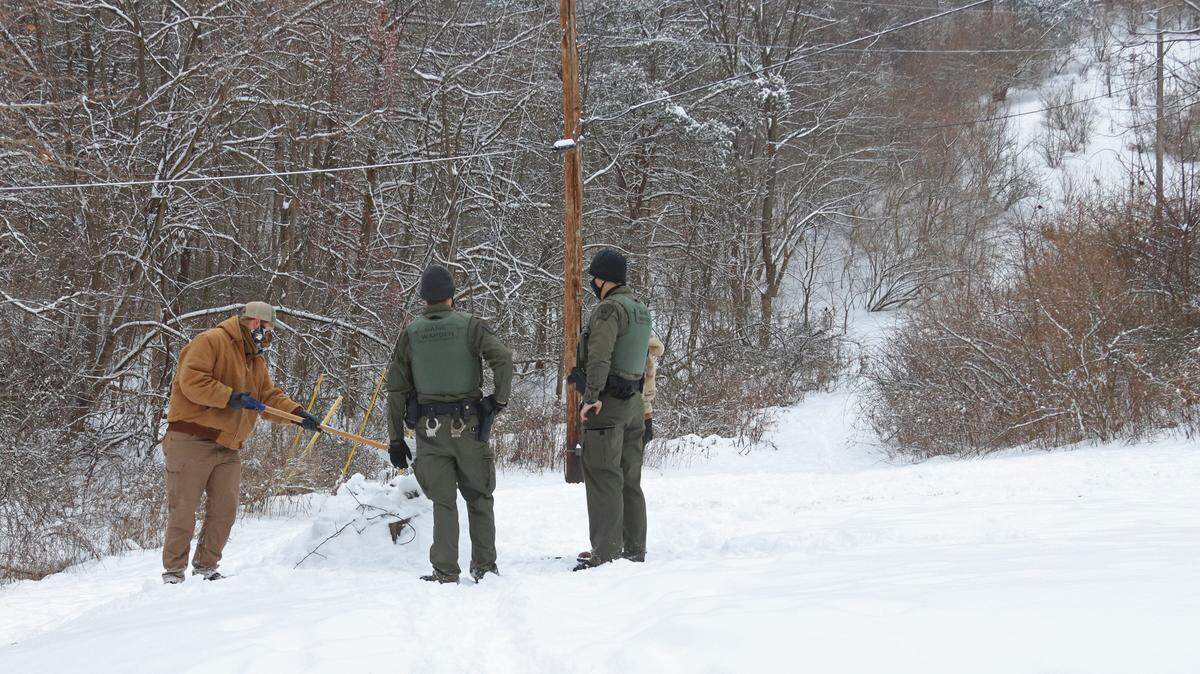
Waiting with rocket nets set over bait is often fruitless, but it is all part of trying to capture that many turkeys. I waited with Casalena and her crew at a trap in Huntingdon County last week — no turkeys showed up. Their most recent success was eight males (four adults and four jakes) captured in Snyder County (WMU 4D) Thursday.
Leg bands have a toll-free number and email address printed on them for people to use to report the leg band number.
“We in turn inform the reporter of where and when it was banded,” Casalena said. “Typical lifespan of a male turkey in PA is 3 years old, but during the last banding program, we had one male harvested at age 7 and one reported alive at a bird feeder, also 7 years old. The reporter read the number using binoculars while it fed on birdseed.”
Deer
The board of game commissioners gave preliminary approval to a slate of deer seasons for the 2021-22 license year, which allow concurrent hunting for antlered and antlerless deer statewide through the duration of the firearms deer season.
The season is proposed to open on Saturday, Nov. 27, and continue for 15 days, including Sunday, Nov. 28. This would be the only Sunday during firearms deer season when deer hunting is permitted. The season would close on Saturday, Dec. 11.
I think that the all-state concurrent deer season is best for hunters because it puts them in control regarding when they might want to harvest an antlerless deer. A similar proposal was passed last January, but was then watered down at the April meeting.
A change to a concurrent season is not intended to increase the antlerless harvest, as the antlerless allocation is the primary tool for managing deer populations. If the proposal for concurrent seasons is approved by the board at the April meeting, the antlerless license allocation will be reduced accordingly to reflect the additional five days of hunting opportunities. Allocation is based on the estimated number of tags required for hunters to harvest the number of antlerless deer necessary to meet population objectives within a WMU. If the season is extended an additional five days, fewer tags will be required to meet the population objectives than would have been required in a shorter season.
In the case of both deer and turkeys, the measures given preliminary approval in January will be brought back to the April meeting for a final vote. Changes will not take effect unless they receive final adoption.