
Afield: The evening grosbeak is in trouble. PA researcher hopes to find answers
Colorful, bold and sassy are good descriptors for this bird that could be said to resemble a huge goldfinch. In the east, the evening grosbeak breeds in Canada and often visits Pennsylvania and other northeastern states during the winter. It is an irruptive species, which means that evening grosbeaks move south irregularly in response to food shortages in the north. Therefore, the numbers flying south during any winter vary greatly.
With males sporting a bright yellow body, a black head with yellow trim, black and white wings and a large beak for opening hard seeds, the evening grosbeak is a welcome visitor at any birdfeeder. Females are mostly gray, with black and white wings, and a hint of yellow. Males are the only yellow, cardinal-sized bird that you are likely to see here in the winter.
As beautiful as they are, the evening grosbeak is a species in trouble.
A landmark study published in 2019 in the journal Science detailed that over three billion breeding birds have been lost in North America during the past 50 years — a staggering number. According to avian researcher and avid archery hunter David Yeany, no species has been hit harder than the evening grosbeak. The nonprofit Partners In Flight pegs the species loss at 92% since 1970.
During some years in the 1960s and 1970s, thousands of evening grosbeaks visited Pennsylvania, often in flocks of 50 or more. Unfortunately, that sight is only a memory. The decline has conservationists puzzled.
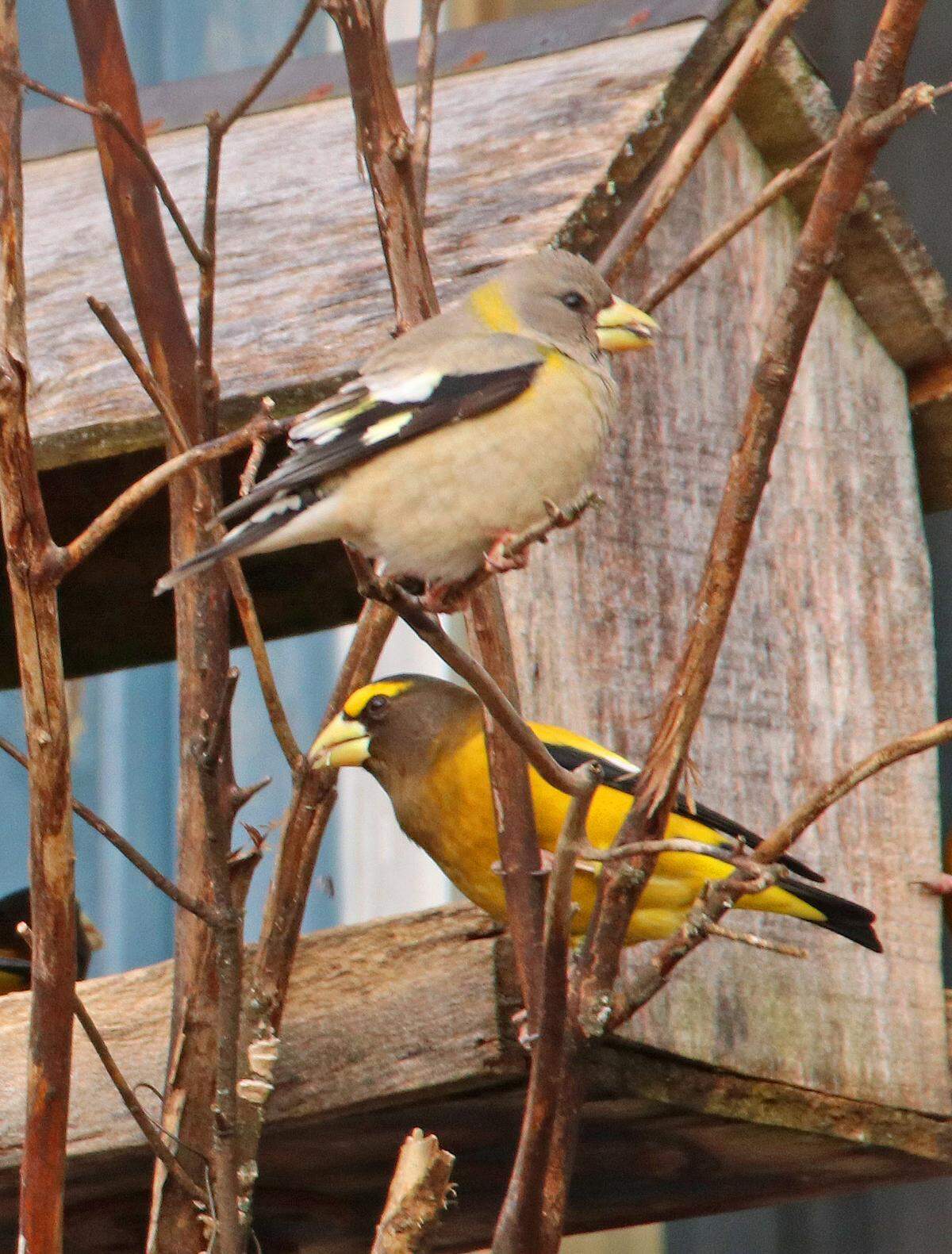
Yeany is an avian ecologist with the Pennsylvania Natural heritage Program at the Western Pennsylvania Conservancy. He puts local numbers to the evening grosbeak decline.
“During the 1970s, staff at the Powdermill Avian Research Center in Westmoreland County banded more than 4,000 wintering evening grosbeaks in western Pennsylvania,” Yeany noted. “By the 1980s, the number was cut in half, and during all of the 2000s, only nine grosbeaks were banded — nearly a 100 percent decline.” It wasn’t that the birds weren’t flying south, it was an overall drastic decrease in numbers in Canada.
Yeany began his evening grosbeak research at his boyhood home in Forest County. Years before, he had erected a platform feeder at their home. Following that, it hosted at least a few grosbeaks every winter. In 2017, he, along with Powdermill scientist Luke DeGroote, began the first ever study to track evening grosbeak movements. He put colored bands on birds’ legs and the following year, tracking tags on grosbeaks captured at the feeder netted immediate results.
He learned that the grosbeaks visiting his father’s backyard feeder were different each winter. He also learned that after leaving Forest County, they moved north and would breed in Quebec. However, he discovered that some of these grosbeaks spend up to six months in Pennsylvania, not just the couple winter months when they visit feeders.
In 2020, Yeany’s research caught the attention of the Finch Research Network (evening grosbeaks are classified with finches). They helped fund the purchase of more radio nanotags. At $300 each, the research needed all the help that it could get. The Finch Network joined his first partner, the Carnegie Mellon Museum of Natural History’s Powdermill Avian Research Center.
In 2021, Yeany’s research became part of the nationwide Road to Recovery project, as the evening grosbeak became one of four pilot species. The Evening Grosbeak Working Group was formed, now with over 80 members across Canada and the U.S. The Knobloch Family Foundation donated $100,000 to the project to kick off more expensive satellite tracking (over $2,000 per transmitter). Research expanded from Pennsylvania into Canada, New York, Maine, Michigan, Utah, Vermont, New Hampshire and Minnesota. Yeany has been part of research at all of these places. The use of technology was upgraded and there are now 86 grosbeaks with satellite transmitters. More recently, the Knobloch Foundation donated another $50,000.
“We are currently in the assessing and learning stage,” Yeany said. “Using satellite transmitters to learn their migratory connectivity, interaction of the different populations of grosbeaks and investigating possible causes of the decline.”
According to Yeany, with migratory connectivity, it is important to understand how threats or other factors across a landscape affect different populations. Their tracking data shows that birds from the non-breeding season in New York and Pennsylvania may be moving more like one unit between the states and breeding areas in Quebec.
How you can help
As of this writing, no grosbeaks have visited the Forest County location this winter. However, a larger number than usual has already moved south — including into other parts of Pennsylvania. The working group is looking for your help in three areas. This data will help determine bird movements and possible mortality causes.
Report banded evening grosbeaks
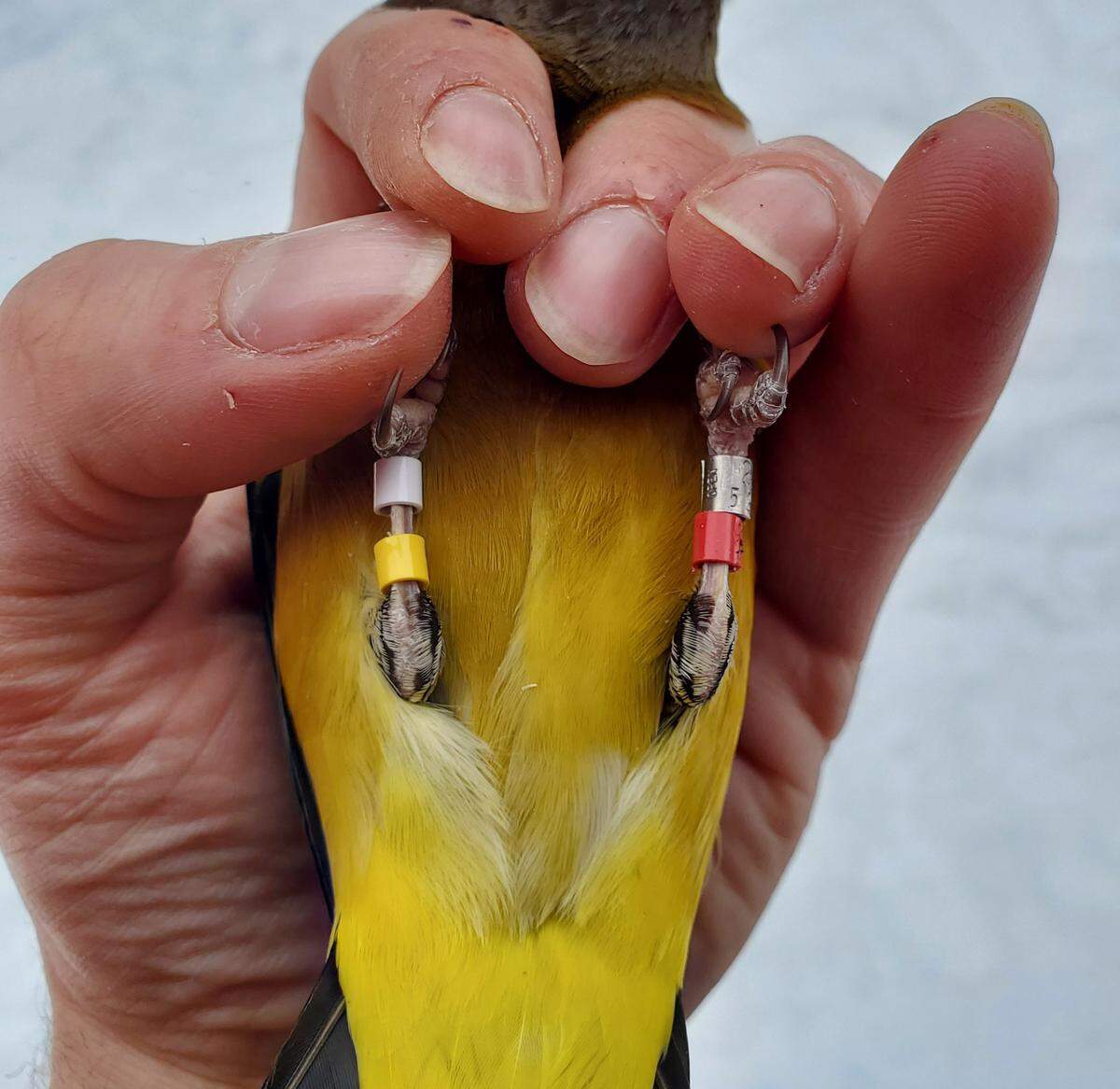
Partners from the Evening Grosbeak Working Group have color-banded hundreds of grosbeaks from non-breeding populations. Birders can help with this effort by reporting observations of color-banded or tagged Evening Grosbeaks at your feeders. Each observation of one of these birds will add valuable information to help connect the dots as to why this bird has declined so much.
Report banded or tagged Evening Grosbeaks to the USGS Bird Banding Lab at www.reportband.gov and email David Yeany at dyeany@paconserve.org.
Please note and record:
1. Location (Latitude/Longitude coordinates or address) and date
2. Sex of bird — male or female
3. Band color combination. Example: Right Leg – white over metal, Left Leg – black over green.
Evening Grosbeak window collisions
Evening Grosbeaks can spend large amounts of time near buildings with feeding stations — and glass windows. Help us learn more about their window collision vulnerability by submitting your observations to the iNaturalist project: www.inaturalist.org/projects/evening-grosbeak-window-collisions.
Evening Grosbeak foraging
Food availability drives finch irruptions and we can better understand these mechanisms across the landscape with more observations that document what Evening Grosbeaks are eating. If you see grosbeaks foraging on berries, tree seeds or any other food items, please add your observations to the Evening Grosbeak Foraging project on iNaturalist: www.inaturalist.org/projects/evening-grosbeak-foraging.
Yeany has been with the Western Pennsylvania Conservancy for 14 years and said he loves his job.
“This job is exciting and rewarding. It is a dream come true,” he said.
Mark Nale, who lives in the Bald Eagle Valley, is a member of the Pennsylvania Outdoor Writers Association and can be reached at MarkAngler@aol.com.