
For some community members, race, accountability issues linger after Osagie shooting
While nearly 200 people attended the commissioners’ mental health conversation on Thursday, with the crowd spilling out into an overflow room on the first floor, all eager to tell their stories and share their experiences — some say talk isn’t enough.
Since the March 20 shooting of Osaze Osagie by State College police officers attempting to serve a mental health warrant, officials from State College to the county have encouraged community conversations, held meetings and proposed task forces to address the issues surrounding mental health and race that Osagie’s death has brought to the forefront.
Those community conversations, State College resident Evan Higgins said during Thursday’s meeting, are just “thinly veiled” ways to divert attention away from the racial aspect and just blame mental health for the 29-year-old’s death.
Higgins, like several others who spoke during the meeting, used his time for public comment to demand that officials release the name of the police officer responsible for firing the shot that killed Osagie, an African American man who had a diagnosis of autism and a history of mental illness.
“The idea is to bring in very nice mental health people who are doing the very best they can ... rather than bringing the officer who has yet to be named,” Higgins said, saying that the official response has been ineffective and law enforcement is unwilling to cooperate.
During a community meeting following Centre County District Attorney Bernie Cantorna’s release of the investigative report that determined police officers were justified in their use of deadly force, Cantorna called for the creation of a a task force to examine potential improvements for Pennsylvania’s mental health system, including the county’s system and the “302” mental health warrant process.
State College Borough Council also announced, at its April 15 meeting, its intent to form a task force specifically aimed at addressing issues of mental health services in Centre County, as well as inclusion, equity and diversity. That task force is intended to pick up where a previous collaboration with Penn State left off in 2016.
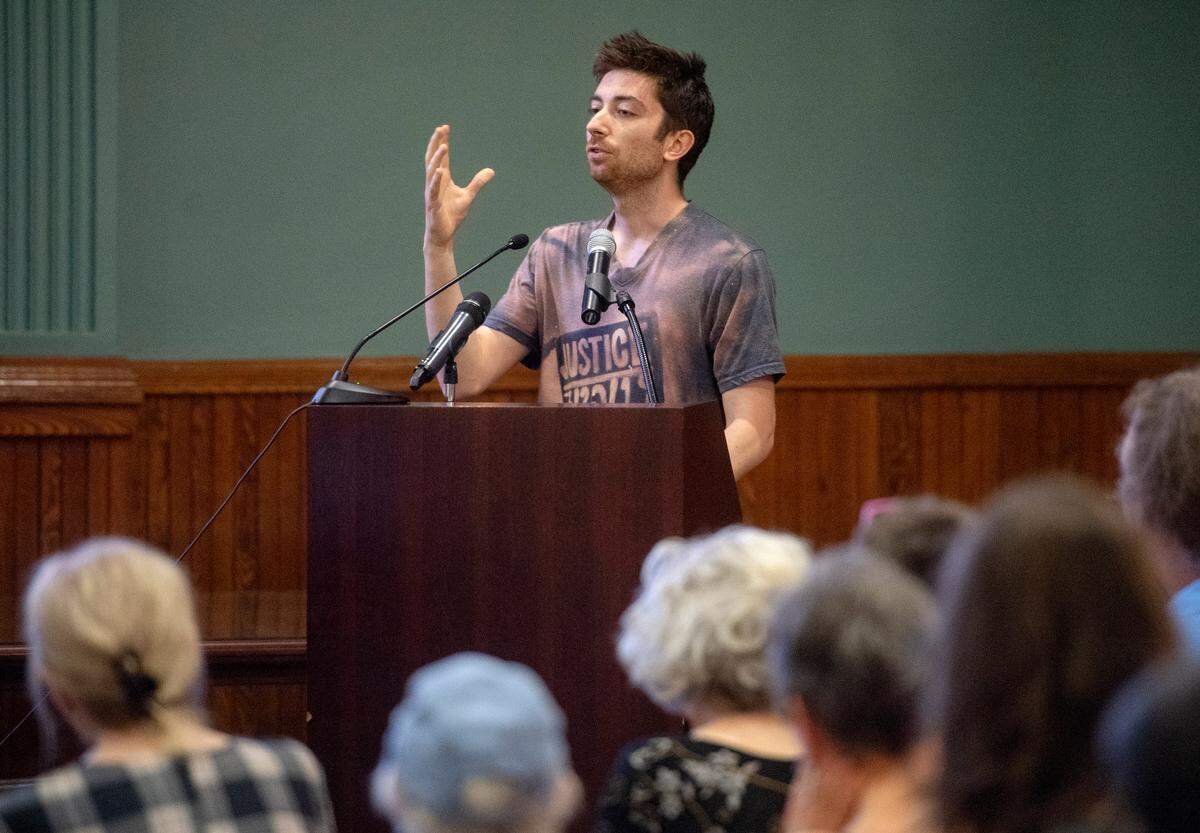
“A task force does nothing if there’s not the willingness to do something,” Higgins said. “There already was a task force before Osaze was killed (that) did nothing ... if there’s no power behind it, it’s irrelevant.”
Community groups that formed after Osagie’s death have also called for the names of the involved officers to be released.
“How can anyone in this room believe for even a second that there’s going to be some sort of change (or) accountability unless you tell us who did it and charge that person?” Higgins said, gesturing to police officers who were present in the Courthouse Annex.
Representatives from the state and county mental health services offices explained the struggle to find funding for treatment facilities and staffing, but Higgins suggested funding for law enforcement offices be reallocated to improving the mental health systems.
“The cops have the money for it. Take it from them,” Higgins said.
Melanie Morrison referenced the district attorney’s report and said the State College community will never see justice because the officers involved were exonerated.
“We didn’t ask for another task force,” Morrison said. “We asked for a community oversight and review board that would be able to plug in and take what the community has as concerns and be able to turn that into actionable change and accountability.”
The task force, Morrison said, is not a proper solution.
Yamina Cunningham, a friend of Osagie’s, suggested the mental health and “302” warrant system needs to be evaluated. Cunningham asked for officers not to be permitted to cover a door’s peephole while serving a warrant, saying officers add additional stress to the situation by appearing unannounced. Cunningham asked what happened in the seconds before police shot Osagie and said it is her hope for communities to be able to trust and feel comfortable around police. Guns, Cunningham said, should not be brought while serving a mental health warrant.
Others at the meeting pointed to the role of race in the shooting, which the DA’s investigative report determined was not a factor in the officer’s decision to use deadly force.
Commissioner Michael Pipe said Centre County officers are committed to becoming better trained in crisis intervention, saying that more individuals will go through the program.
“We’ve had many officers who have gone through that program who have successfully de-escalated (situations),” Pipe said. “So, we know that program works.”
State College operates with a “short-term memory,” Lorraine Jones said. She said the intersectionality or mental health and race should be considered when making legislative and legal changes.
Pipe and Commissioner Mark Higgins said officials will be working with neighboring communities, people with lived experience and experts in order to ensure the task force is properly trained and informed of racial and mental health issues.
Once the State College borough task force has been formed, Pipe said its members will work closely with law enforcement and the mental health services office. In addition to increased training, he said that in a year from now, he hopes to have seen positive change occur within the county.