
Centre County restaurant owners struggle with latest Pa. COVID-19 restrictions
With Centre County restaurants about halfway through a second statewide indoor dining ban, some owners say they’re frustrated and concerned about their business’s long-term survival.
Aside from the new restrictions, which prohibit indoor dining through Jan. 4, many local restaurateurs said they’ve strictly followed state mandates to keep their customers and staff safe, but the cost of doing so exceeds state-provided relief.
Now, they are calling for action from elected officials.
“When you shut down someone’s ability to make money, you need to counteract that with some sort of funding,” said Chris Rosengrant, owner of the Lion’s Den in downtown State College. “They need to put their money where their mouth is. And they just haven’t. They need to take accountability for the debt.”
While local businesses received Centre County small business grants and federal funding through the Paycheck Protection Program, some say it’s simply not enough.
Rosengrant said he lost hundreds of thousands of dollars in revenue due to Pennsylvania’s COVID-19 restrictions and spent tens of thousands of dollars on state-mandated precautions, yet received only a fraction of the costs back in government aid.
Jeff Powers, general manager of Quaker Steak and Lube, said his economic losses from the pandemic are also in the hundreds of thousands. Though the restaurant is affiliated with a franchise, it is locally-owned and operated, and does not receive corporate funding.
“With the governor’s restrictions and the cost of operating a dining room the last few months, the Paycheck Protection Program hasn’t even come close to covering our losses,” he said.
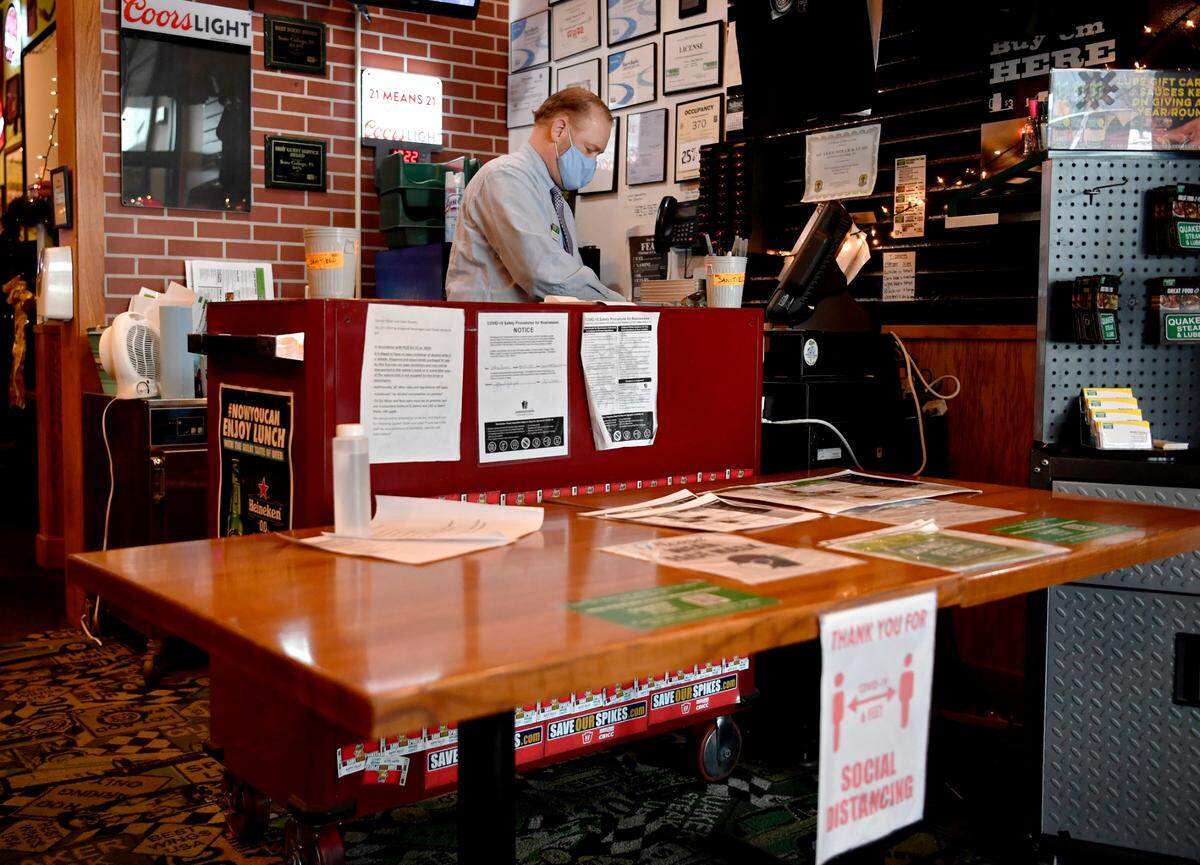
A second round of access to the PPP was included in the $900 billion relief bill passed by Congress on Monday. The bill also includes unique items that will benefit the hospitality industry, the Pennsylvania Restaurant & Lodging Association wrote in a statement Tuesday, including enhanced PPP loan size.
“From the day Pennsylvania restaurants were shut down by the pandemic, the Pennsylvania Restaurant and Lodging Association (PRLA) has worked with the National Restaurant Association to press Congress and the Trump Administration for both long-term and short-term economic support,” John Longstreet, CEO and President of the PRLA, said in a statement. “This bill will help Pennsylvania restaurants with much needed capital that will allow more time for us to work with Congress to create the additional programs to save our beloved community restaurants.”
Powers said his main frustration with Gov. Tom Wolf’s COVID-19 restrictions has been the timing. A business cannot survive when given such short notice to make such drastic changes, he said.
“We spent thousands of dollars on plexiglass dividers in the dining room and the bar,” Powers said. “Bar seating was then taken away from us two weeks after we spent thousands on dividers for those seats.”
Michael “Mo” Olmstead, general manager of Axemann Brewery, agreed. He said the 24-48 hour window that Wolf has given to enact his mandates dealt a serious financial blow.
“What are they supposed to do with all this food that was just ordered?” Olmstead said. “This isn’t an office building, it’s stuff that goes bad. It’s not cheap, I’ll say that.”
Tom Keohane, director of Penn State’s Small Business Development Center, has helped local businesses apply for government grants.
“Back in the beginning, there were a lot of emergency loan programs and funds that were forgivable,” Keohane said. “Many of them went quickly. The longer this has gone on, the more difficult it’s been for businesses to continue to do this without a lifeline.”
For many businesses, the lifeline has already run out. According to the National Restaurant Association, 110,000 restaurants have closed nationwide due to the pandemic.
Tiffany Kellner of Bellefonte is a nurse on the front lines of the pandemic. She also works as a part-time server and empathizes with her co-workers in the restaurant industry.
“The restaurants have done a fantastic job of taking the proper precautions,” said Kellner. “I think what they did to them right before Christmas is flat out cruel to the employees.”
In November, Pennsylvania lawmakers voted to use the state’s remaining $1.3 billion in CARES Act funds to balance the state budget, a move that drew criticism from those who felt the money should go to struggling industries. Most Republicans supported the bill, while most Democrats opposed. Wolf ultimately approved the budget.
State Rep. Jerry Knowles, R-Schuylkill, voted against the bill. He’s also been a vocal proponent of the restaurant industry.
“If we get another wave of funding, the area we need to focus on is the hospitality business,” Knowles said. “Nobody has been treated more unfairly that the restaurant business. They complied, went by the standards, did what they were asked to do, went by the rules, and what do they get in return? They get shut down.”
State Rep. Scott Conklin, D-Rush Township, Rep. Stephanie Borowicz, R-McElhattan and state Rep. Kerry Benninghoff, R-Bellefonte, did not immediately respond to requests for comment.
With state funding for restaurants currently off the table, Wolf has urged the federal government to pass the RESTAURANTS Act, which would provide $120 billion in federal funds to help independent restaurants. That bill was introduced in June.
He also responded to the $900 billion COVID relief bill passed Monday, saying that more aid is needed for the hard-hit service industry.
Pennsylvania Senate Pro Tempore Jake Corman, R-Benner Township, said while more federal funding may provide relief in the short term, it isn’t the ultimate solution for Pennsylvania restaurants.
“You can’t keep restaurants open forever by giving them money, you need to let them open,” Corman said. “We passed a bill that said the minimum capacity the (state) government could pull a restaurant down to was 50%. The governor vetoed that. Ultimately you have to let restaurants open and that’s the only way a lot of them will survive. Unfortunately, the governor won’t do that.”
Wolf’s most recent mandate bans indoor dining until Jan. 4, leaving restaurants open for only takeout and delivery options. And while many in the service industry are calling for more relief, they say what they really want is to get back to work.
“I want to work,” said Olmstead. “I want to bartend. I miss it.”
This story was originally published December 23, 2020 at 7:00 AM.