
State College student’s math project earns $250K science research prize
AI-generated summary reviewed by our newsroom.
- A State College Area School District student won a major science research award.
- Connor Hill, 17, cracked a complex geometric problem to win the $250,000 grand prize.
- Hill plans to use the money for future education in mathematics or physics.
A State College-area high school student will return home from spring break with a major research prize under his belt.
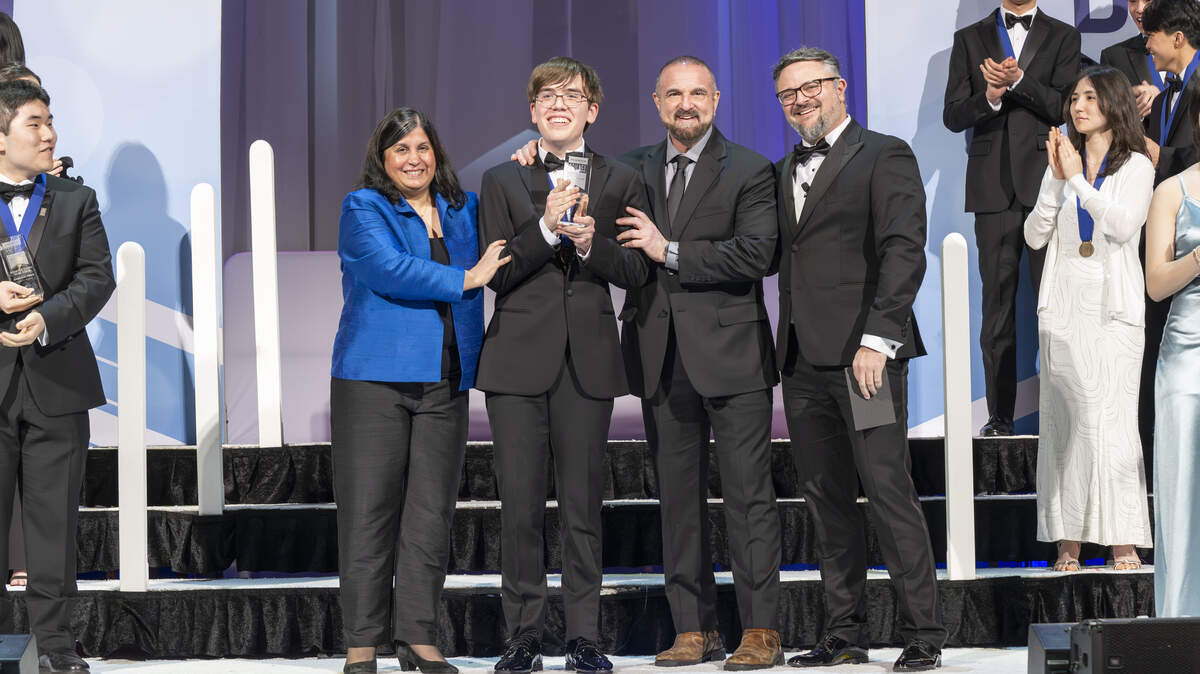
Connor Hill, a senior at State College’s Delta High School, claimed the top $250,000 prize at this year’s Regeneron Science Talent Search, which recognizes science and math research conducted by young scientists across the U.S. The competition, sponsored by the nonprofit Society for Science, celebrated Hill’s accomplishments at a ceremony in Washington, D.C., on Tuesday.
Hill’s breakthrough research concerned mathematical shapes called “noble polyhedra” — a specific type of polyhedron, or a three-dimensional shape with flat sides and straight edges such as a cube or pyramid. Noble polyhedra are unique because their faces are the same shape, and the angles at each corner are the same.
By writing and utilizing a computer-assisted proof, Hill created a full list of all the conceivable ways to build a noble polyhedron. His research concluded there are 146 noble polyhedra split into two known infinite families, more than doubling the 61 isolated examples put forth by mathematicians in the past.
“The very easy explanation is that I solved a complicated problem in geometry,” Hill told the Centre Daily Times.
Hill said he’s excited by the potential to use his research as a building block toward better understanding discrete geometry, which usually focuses on finite sets of basic geometric objects like points, lines and polygons.
“It’s less about the result itself and more about the methods I used for the proof,” Hill said. “So, for any sort of discrete geometry problem that involves points that are symmetric in some way, the methods I used with the computer-assisted proof can be useful for some related problems as well.”
Hill began studying noble polyhedra after first discovering them online as fellow researchers attempted to find examples of the shapes, largely using “educated guesswork.” He started brainstorming ideas for new examples and, soon enough, found his work began to resemble a useful proof.
The 17-year-old Port Matilda native submitted his work to the Regeneron Science Talent Search after studying noble polyhedra for years. He said he was grateful he threw his hat in the ring after nearly skipping the contest entirely.
“In retrospect, it seems sort of silly,” Hill said. “But clearly I was wrong in thinking no one would want to see or recognize my work and research.”
The Regeneron Science Talent Search began with a pool of roughly 2,600 projects before narrowing to 40 finalists who each received at least $25,000 earmarked for future educational endeavors. Hill learned at Tuesday’s award ceremony that he was one of 10 students in consideration for the top prize.
Hill and dozens of other high schoolers participating in the research contest have spent the past few days in the nation’s capital exploring activities, judging sessions, taking field trips and networking. Some of his peers’ projects featured research that analyzed music using mathematics or modeled diseases, including blood cancer, using clams.
“I feel like the most valuable part has been being able to interact with the other finalists, the top 40, and learning about the research other high schoolers are doing across the country,” Hill said. “The variety of what they’ve been able to accomplish is incredible, and talking with them about what they’re passionate about is extremely valuable.”
Hill has always had a passion for math and, he enjoys how so many other disciplines are built atop its principles. He said that’s especially true for “pure mathematics,” or mathematics whose main application is mathematics.
“In that field, there’s sort of fundamental truths about the universe that you’re discovering, like there are ideas hidden there that you’re uncovering,” the Delta senior said. “It’s exciting exploring these new areas of logic.”
Hill said he’s waiting to hear back from several universities before deciding where to study after graduating from Delta in June. Though he expects to study mathematics, he said he could explore other options, including physics.
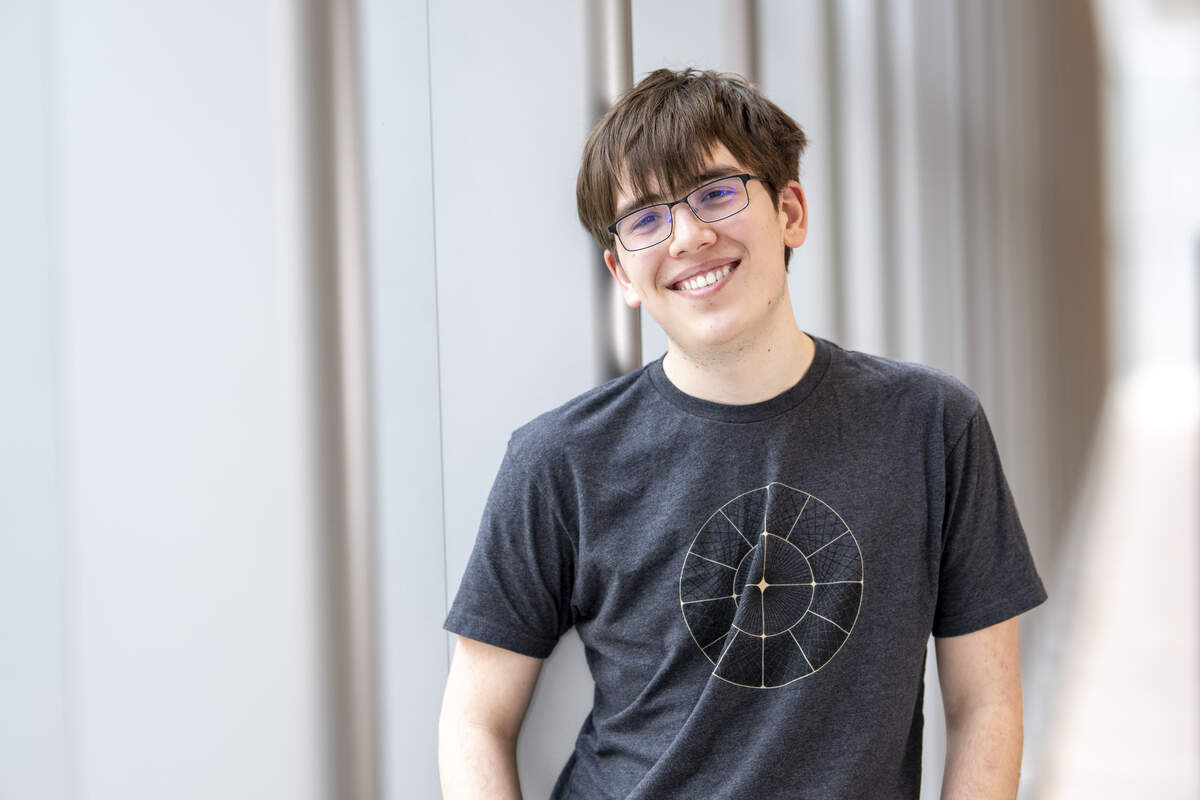
Hill credited State College’s Delta Program with providing a wide range of freedoms that equipped him to get an early start on serious research as an eager teenager. Perhaps no opportunity afforded by the democratically run alternative schooling program was more important than independent contracts, or methods through which students can receive course credits outside the classroom.
For Hill, that meant attending and receiving inspiration from a Penn State mathematics seminar during school hours.
“It’s because of the freedoms Delta provides that I was able to take part in extracurricular activities like that,” Hill said.
%202.JPG)