Penn State’s in-person classes resume Monday. What’s different this semester with COVID-19?
After nearly a three-month break, Penn State’s in-person classes will finally resume Monday — and with those classes will come plenty of change.
Following a fall semester with more than 5,000 student cases of COVID-19, Penn State is stepping up its testing capabilities while also making tweaks to services surrounding students’ mental health and elsewhere. That doesn’t mean everything will change — the previous alternative grading system and the commitment to public masking remain integral — but it’s hoped the spread of COVID-19 will be minimized as much as possible.
Challenges still remain, such as limiting large gatherings, and it’s unknown how new COVID-19 variants might impact the infection rate.
Here are some of the biggest changes that Centre County residents and Penn State students should notice.
More COVID-19 testing
Although Penn State isn’t following some of its peers’ most rigorous testing approaches — Illinois is testing all students twice a week throughout the semester — the land-grant university has still taken significant steps forward.
In fact, outside of those scheduled screenings like Illinois, Penn State is following each of the other five strategies outlined by a fall study co-authored by Dr. Robert Redfield, the former director of the Centers for Disease Control and Prevention. Among them:
- Two-phased universal screening: All Penn State students are required to undergo a COVID-19 test at least 72 hours prior to arrival. (Last semester, about 25% of the student population was tested pre-arrival.) If students refuse? They will be prohibited from “moving in to on-campus housing, entering campus facilities and participating in on-campus activities and programming, including in-person classes,” according to the university’s own FAQs. All students will then again be retested between Feb. 15-26.
- Random screening: Last semester, Penn State “randomly” tested 1% of the student population every day as part of its daily surveillance program. This spring, that will be boosted up to 2%, thanks in part to the university’s Testing and Surveillance Center receiving Clinical Laboratory Improvement Amendments (CLIA) provisional certification. The daily surveillance is “designed to look at background rates of transmission to see whether things are increasing or decreasing, so we can make adjustments to the other testing plans,” said Matthew Ferrari, a researcher at the Center for Infectious Disease Dynamics.
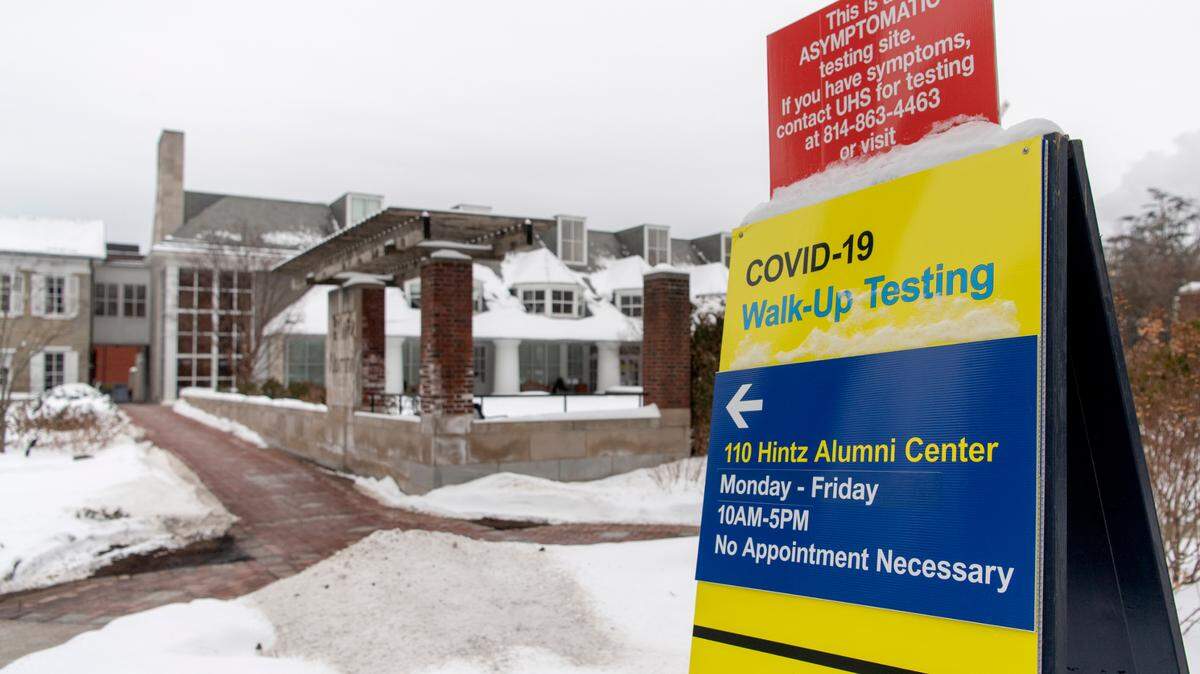
- On-demand testing: Walk-up testing for asymptomatic students and employees will still be made available, at both the Hintz Family Alumni Center and Pegula Ice Arena. No appointment is necessary, and those identified during the contact-tracing process or who believe they might have come in close contact with COVID-19 can get tested. (Employees are encouraged to order a self-test kit instead, but can still use walk-up testing if preferred.) Students who show COVID-19 symptoms are asked to schedule a testing appointment via myUHS so they don’t spread the virus at walk-up testing.
- Wastewater testing: This essentially occurs behind the scenes, as officials will test wastewater from different locations in the hopes it might hint at a potential outbreak earlier than daily surveillance.
In the fall, Penn State briefly considered a temporary move to remote instruction when cases swelled shortly after classes started Aug. 24. By Sept. 4, there were 211 confirmed student cases — 174 in one week — after Centre County boasted just 153 cases in the entire month of July.
The two-phased universal screening is expected to prevent greater spread when students arrive en masse for Monday classes.
“The spring semester testing strategy is built on the testing plan we implemented in the fall, but we have expanded it based on what we learned in the fall semester and changes we made as we responded to the pandemic,” Penn State President Eric Barron said in a written statement last month.
The COVID-19 dashboard will also now be updated three times a week, compared to its twice-weekly update in the fall.
Quarantine & isolation spaces
There are positive changes here on two fronts.
For one, due to new guidelines and rapid-testing, students could see their time in quarantine reduced this semester. According to Kelly Wolgast, director of Penn State’s COVID Operations Control Center, students will be rapid-tested on Day 5 of quarantine — and, if they test negative, they’ll potentially be able to leave on Day 8. (If they test positive, they’ll have to stay up to 14 days. Infected students in isolation will still remain there at least 10 days.) Secondly, the quality of the 400 quarantine and isolation rooms in Eastview Terrace have received major upgrades.
Not only does Penn State plan to have a phone app that will include all menus and nutritional information for the rooms, but it also plans to hold more activities so the students there don’t feel so lonely.
“We’re going to have trivia competitions, yoga, gaming, eSports, some fitness opportunities — like there’s a virtual escape room, artistic performances, discussions with peers. It sounds like a Club Med,” said Damon Sims, vice president of student affairs, before playfully taking back the joke.
“I’m sure it won’t be, but it’s going to be much more appealing than it was in the fall.”
On-campus students remain the priority for the spaces, with off-campus students encouraged to remain in their own residences. But officials said the university will continue to support off-campus students when it comes to quarantine and isolation.
“Our case managers will continue to reach out to those students to make sure they’re provided for in whatever way they need,” Sims added.
Wellness days/engagement
Penn State announced back in the fall that it would not hold a spring break this semester because of the COVID-19 risks such a break might pose. But, in its place, students will instead receive three “wellness days” — essentially just days off — on Feb. 9, March 11 and April 7.
“With three wellness days, we will have one day in each full month throughout the spring semester to take a pause in teaching and learning and to focus on wellness, self-care and the health of our community in these unprecedented times,” Executive Vice President and Provost Nick Jones said in October.
Building off mental health, university officials have said they plan to increase engagement this semester as much as the virus will allow. They’ve formed a four-phase plan for student activities, and the university is currently in Phase 1.
An overview of the four phases:
- Phase 1: Some in-person activities will be allowed, but the focus is on expanding remote and hybrid activities. Still, campus recreation facilities will reopen with reduced occupancy and a reservation process, and organizations can hold small group meetings with prior approval.
- Phase 2: Performing arts groups will be able to practice within limits, and more facilities will be available to student organizations — including the Forum and Thomas Building. Indoor tabling will also be permitted with some restrictions, such as being limited to one hour.
- Phase 3: This phase will allow for additional in-person activities with an emphasis on outdoor activities as the weather improves. Musical and other performing arts groups can perform before limited in-person audiences, the university will erect tents to “encourage outdoor activities,” and more activities will come as the semester progresses.
- Phase 4: This is the final phase, where the approval and reporting processes for activities will be simplified. In-person activities will be expanded, as will opportunities for outdoor activities.
Sims emphasized it was important for the students to have more meaningful interactions in the spring.
“We are going to incrementally increase those opportunities for students, again, as the virus allows, keeping close track of where the virus is, and what the spread may be — pulling back if necessary,” he added during a presentation Monday to the State College Borough Council.
More information and resources on Penn State’s plans related to COVID-19 can be found at virusinfo.psu.edu.