Penn State president offers ‘vision for the future’ on same day DEIB dashboard is released
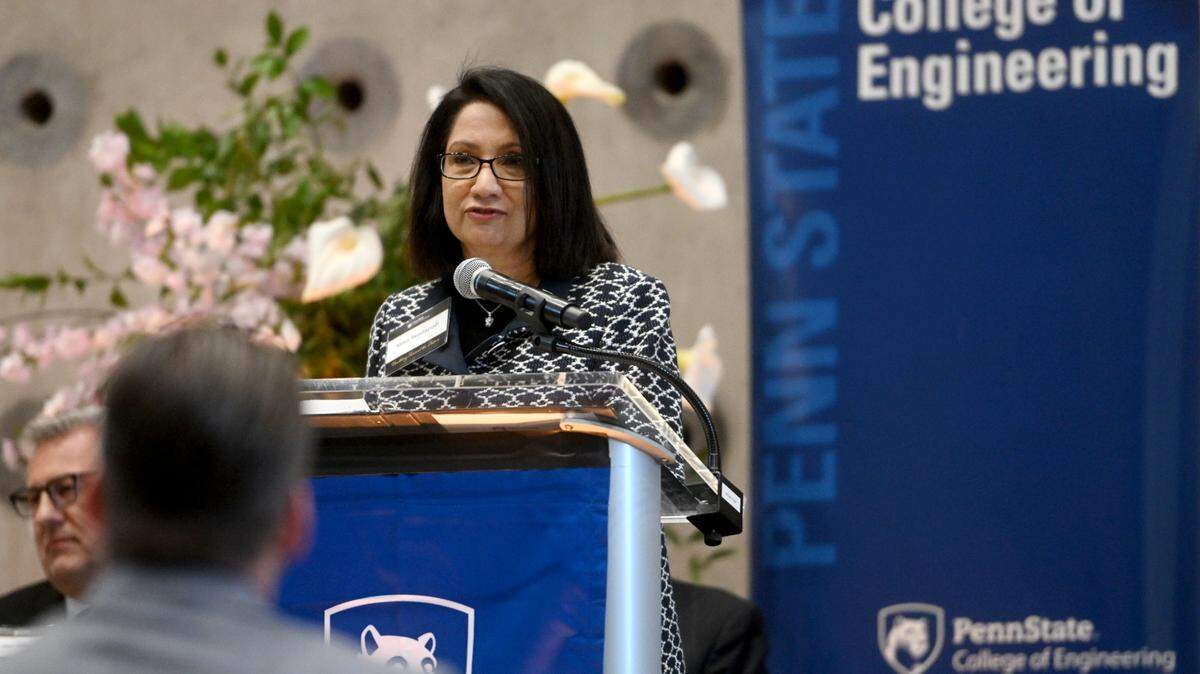
Three months after asking for patience from the university community, Penn State President Neeli Bendapudi outlined her “vision for the future” on the same day the university released a promised dashboard to track progress related to diversity, equity, inclusion and belonging (DEIB).
Bendapudi said in November the dashboard designed to ensure accountability would be made available by “early 2023” and, on Monday morning, that finally came to fruition. The dashboard tracks, by race and ethnicity, metrics involving faculty, the makeup of administrators, undergraduate enrollment and graduation rates. (For example, the number of Black tenure-line faculty has virtually flatlined, from 107 professors in fall 2018 to 108 in fall 2022.)
Bendapudi will host a town hall next month — at a time to be determined — to discuss in greater detail the dashboard and DEIB, both of which comprise her five-part vision. Those key goals announced Monday include fostering DEIB, enhancing student success, growing interdisciplinary research excellence, increasing land-grant impact and transforming Penn State’s internal operations.
“Each of these goals directly relates to how we, as Penn Staters, carry out our academic, research and public service missions,” Bendapudi said in a written statement. “And every Penn Stater — from our students to our faculty and staff to our alumni and our supporters — has an important role to play.
“My vision for our university, which has been informed by time spent at our campuses and conversations I’ve had with our community, is grounded in our shared, collective success. I look forward to working with community members across our great institution to realize these goals and create meaningful outcomes.”
Bendapudi’s announced goals come after a faculty-led town hall Nov. 18, where the president told viewers she expected to share specifics about her goals in early 2023. That town hall was sparked by backlash from her decision to not fund the Center for Racial Justice, a move she defended by saying she felt the university could better address questions of racial justice by “enhancing” support elsewhere.
“What I want Penn Staters to know and the world to know is that my commitment to diversity, equity, belonging and, certainly, racial justice is deep,” she said in November. “It’s genuine, it’s strong, it’s abiding.”
On Monday, the university issued a three-minute video and a nearly 2,000-word news release outlining more than 30 focus areas to Bendapudi’s goals, complete with a list of President’s Council members helping oversee each respective focus. While some focuses were more defined than others, some highlights included:
- Increasing PSU’s state appropriation by a significant amount, so its per-student funding is on pace with other state-related universities in the commonwealth
- Making paid internship opportunities possible for all students
- Increasing recruitment of underrepresented students, faculty and staff
- Achieving a balanced budget by July 1, 2025
- Grow interdisciplinary research
- Building a pipeline of historically marginalized and underrepresented researchers and scholars
- Increasing biomedical and health-related research, translational research and commercialization opportunities
Members of Penn State’s faculty senate have long clamored for greater transparency. And the the chair of the university’s faculty senate said she was pleased with Monday’s announcements.
“Overall, I think this is a very positive initial step,” faculty senate chair Michele Stine said in a written statement. “The senate is delighted to see the dashboard come to fruition. I know it’s an initial effort, and I hope that as it continues to grow and evolve that we might include LGBTQ+ and possibly disability so we have a more robust picture of inclusiveness at Penn State.
“We’re happy to hear about the next town hall and about the president’s vision to increase DEIB in substantive ways for students, staff and faculty across the university.”
According to the university, work also continues for its special adviser for institutional equity in Jennifer Hamer, who’s been tasked with inventorying current DEIB resources and making recommendations on how to improve in relation to peer institutions. Her report is expected to be delivered to university leadership before the end of the spring semester, and it will be shared publicly sometime afterward.
Overall, Bendapudi characterized Monday’s announcements as an important step forward, saying now that the goals are agreed upon, dialogue can take place on how to best reach them.
“Clearly, there’s a lot more work to do,” she added, “but I hope that is a step in the right direction.”
This story was originally published February 27, 2023 at 1:57 PM.