
Up to 9 inches of snow could fall in central PA, but timing is key. See the forecast
Shortly after an unusually warm weekend in central Pennsylvania, snow is already back in the forecast.
According to AccuWeather’s online forecast, precipitation is expected to begin as rain in State College around 8 p.m. Monday before transitioning into snow around midnight. Snow is then expected to continue through about 10 a.m. Tuesday, eventually totaling somewhere between 4 and 8 inches of snowfall, AccuWeather reports.
The storm is expected to produce thick, heavy snow that could bring hazardous road conditions and complicated commutes.
“When the rain changes over to snow, the precipitation is likely going to be on the heavy side,” AccuWeather senior meteorologist Tom Kines said. “With temperatures being above freezing as the storm moves in, the snow is likely to be wet at first, which means it’s not going to the light, dry and fluffy snow that’s easy to shovel. This is going to be, for lack of a better term, a back-breaker.”
The National Weather Service issued a winter storm warning Monday for all of Centre County and much of central Pennsylvania. In the warning, in effect between midnight and 11 a.m. Tuesday, the NWS says it expects between 5 and 9 inches of snow, which could fall at a rate of about an inch or more per hour early Tuesday morning.
Some strong winds are expected in State College Monday night, as well. Gusts could top out at nearly 30 mph Tuesday, according to the latest forecast.
“Snow should be done with just after daybreak Tuesday,” Kines said. “We’d expect conditions to improve as the day goes on, with temperatures above freezing in the afternoon. If you’ve got to shovel tomorrow, get it done as soon as possible before temperatures dip quite a bit below freezing at night.”
Could this storm bring the most snow of the season to Centre County?
The most snow the State College area received in a single storm came pretty early in the season.
An early January storm dumped about 5 inches of snow on State College, snapping what was a record-breaking 345-day drought of measurable snowfall. Since then, subsequent storms have added to the snowfall total, but no major accumulation has come from a single winter storm.
If the upper portions of this storm’s forecast pan out, accumulations of about 6 inches or more would mark a season-high total for State College, according to NWS archive data.
“The potential is certainly there, but it’s going to depend a lot on what the temperature is. A degree or two can make a huge difference,” said Kines. “If the changeover occurs an hour or two earlier than we think, we’ll probably get more snow, while the opposite could provide smaller snow amounts. I think, for 8 or more inches to happen, there can’t be much rain involved. If you’re outside at 1 a.m. Tuesday morning and it’s snowing, there’s a problem — as far as snow amounts are concerned.”
In a follow-up phone call around 3:30 p.m. Monday, Kines said recent developments in the incoming storm are leading the AccuWeather team to expect less snowfall than anticipated.
“It looks like the heaviest precipitation might stay to our south,” Kines said. “For now, we’re leaning more toward 4 [inches of snow] than 8.”
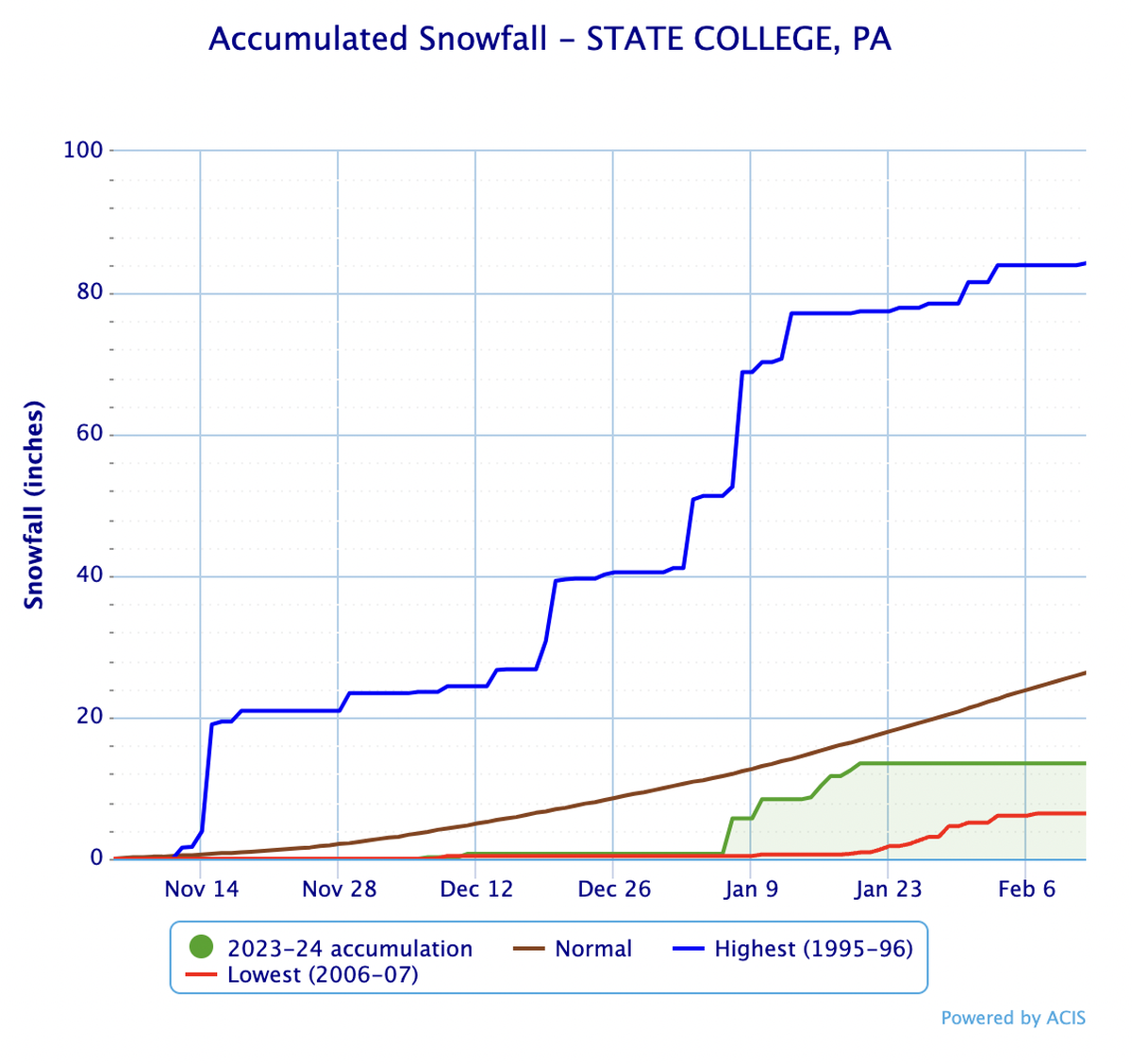
A larger snow total would help the area make up for what has, so far, been a below-average season of snowfall.
State College has observed roughly 13.5 inches of measurable snowfall so far this season, according to NWS records. That’s just about half of the 26.5 inches of snow a “normal” season would produce through Feb. 12.
No season saw more snow between early November and mid-February than the 1995-96 season, which dumped 84.2 inches of snow on State College. The 2006-07 season set a record-low through mid-February with just 6.4 inches of snow in that span.
What’s up with Pennsylvania’s mild winter?
Above-average temperatures and a general lack of snowfall in Pennsylvania can, in part, be attributed to a notable climate system’s influence on the U.S. this year.
El Niño can significantly influence weather across the country by altering natural jet streams and climate processes, usually producing a drier, warmer winter in the mid-Atlantic with above-normal temperatures for much of the country. The National Oceanic and Atmospheric Administration expects the pattern to continue “for the next several seasons,” likely through at least this coming spring.
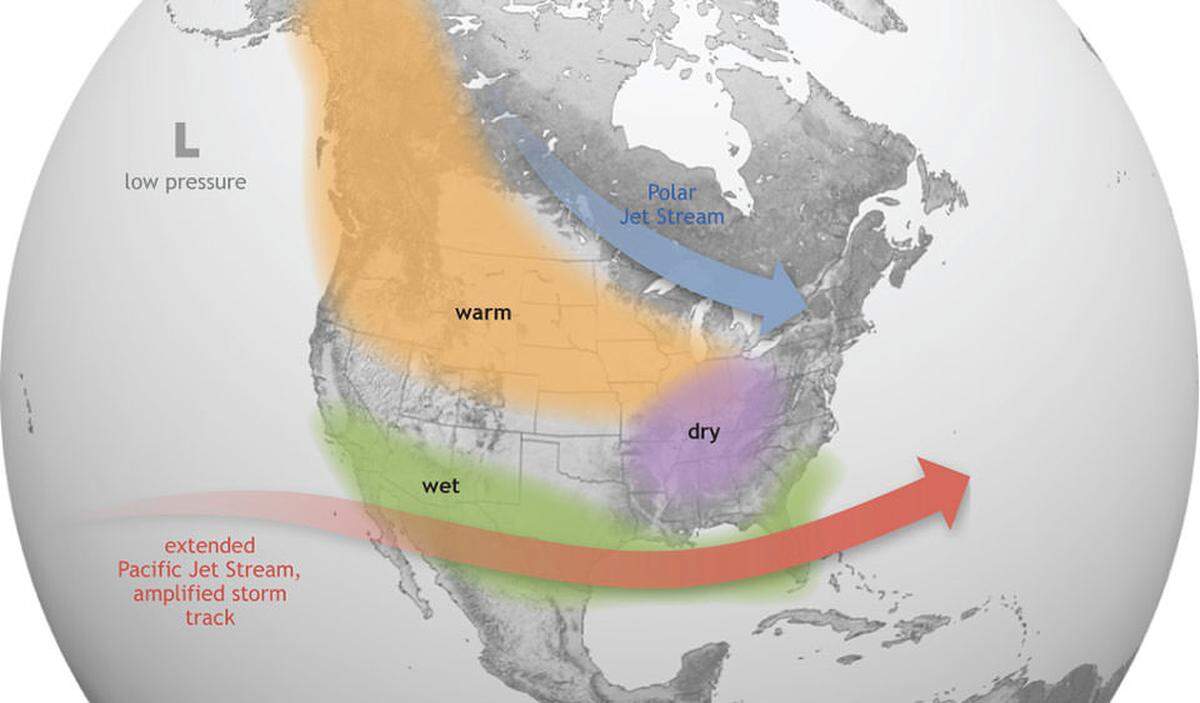
Changes to the jet streams can bring storms to California and the West Coast before pushing them toward the South and, eventually, out to sea. A lack of Arctic air coming down to the U.S. can make snow harder to come by for some northern states.
“So far this month, temperatures here are averaging about 11 degrees [Fahrenheit] above normal, which is pretty phenomenal,” Kines said. “It’s been really warm up in Canada as well. They’ve had some record warmth there. And until the cold air gets back into Canada, which is usually where we get ours, it’s not going to get exceptionally cold around here.”
This story was originally published February 12, 2024 at 2:23 PM.
%202.JPG)