Depth chart breakdown: Here’s where Penn State football stands at safety in 2021
Arguably Penn State’s best defensive player will be playing in its secondary in the 2021 season. The Nittany Lions have a premier talent at safety, but plenty of question marks outside past the team’s best in the group.
The front seven has already been covered, so let’s take our first look at the team’s back four, starting with the safeties.
Projected starters
Seniors Jaquan Brisker and Ji’Ayir Brown
Penn State may have uncertainty at one starting safety spot, but the other is seemingly etched in stone. Jaquan Brisker is one of the best safeties in the conference and arguably one of the most complete safeties in the country. However, the Nittany Lions will still have to find another player to step in alongside him and would usually need another to potentially play the star position, as well. But this season, the star position should be filled by a cornerback, allowing the Nittany Lions to generally focus on only playing two safeties.
BEHIND THE STORY
MOREHow we did this story
This analysis is based off of watching games live, 20+ hours of film study and watching Penn State’s two open spring practices.
Brisker excels against the run and against the pass and doesn’t show any glaring weaknesses. The senior operates well in zone coverage and is more than capable in man, as well. He tracks receivers well in zone and does a good job of staying over the top and breaking up passes when he’s asked to play deep. He prevents receivers from getting by him, while using his ball skills to track passes and make it difficult for opponents to earn completions.
If he does allow a reception, or has an offensive player coming toward him in the open field, Brisker wraps up well and very rarely misses tackles. He takes good angles in pursuit whenever he’s tracking ball carriers — whether they’re operating after the catch or on a run play — and brings down the opponent whenever he has an opportunity to do so.
You won’t find many flaws in Brisker’s game, and that bodes well for his future beyond Penn State.
The second safety spot is much more up for grabs than the first. There are multiple options for the Nittany Lions, but none are well rounded enough to be interchangeable in the defensive backfield in their responsibilities Fortunately, Brisker’s ability should allow the team to use a player who excels in coverage or one who excels against the run if necessary.
Ji’Ayir Brown brings the best combination of ability against the run and pass, although he’s shown more talent against the pass at this point in his career. Brown can play both man and zone from the safety spot, which allows him to match up with running backs and tight ends when necessary. He’s not the most physical player which could make it easier for those types of player to beat him with physicality when fighting for catches, but he’s not going to get blown by frequently.
Brown will likely find his most success as more of a ball hawk. He excels in zone coverage where his instincts can take over and he can try to make plays on the ball in the middle of the field. He’s good at tracking the ball and breaking up passes — or bringing them in for interceptions. The senior needs to continue to add strength to improve in run support and as a tackler, but from a coverage standpoint he’s Penn State’s best option at the second safety spot.
Key backups
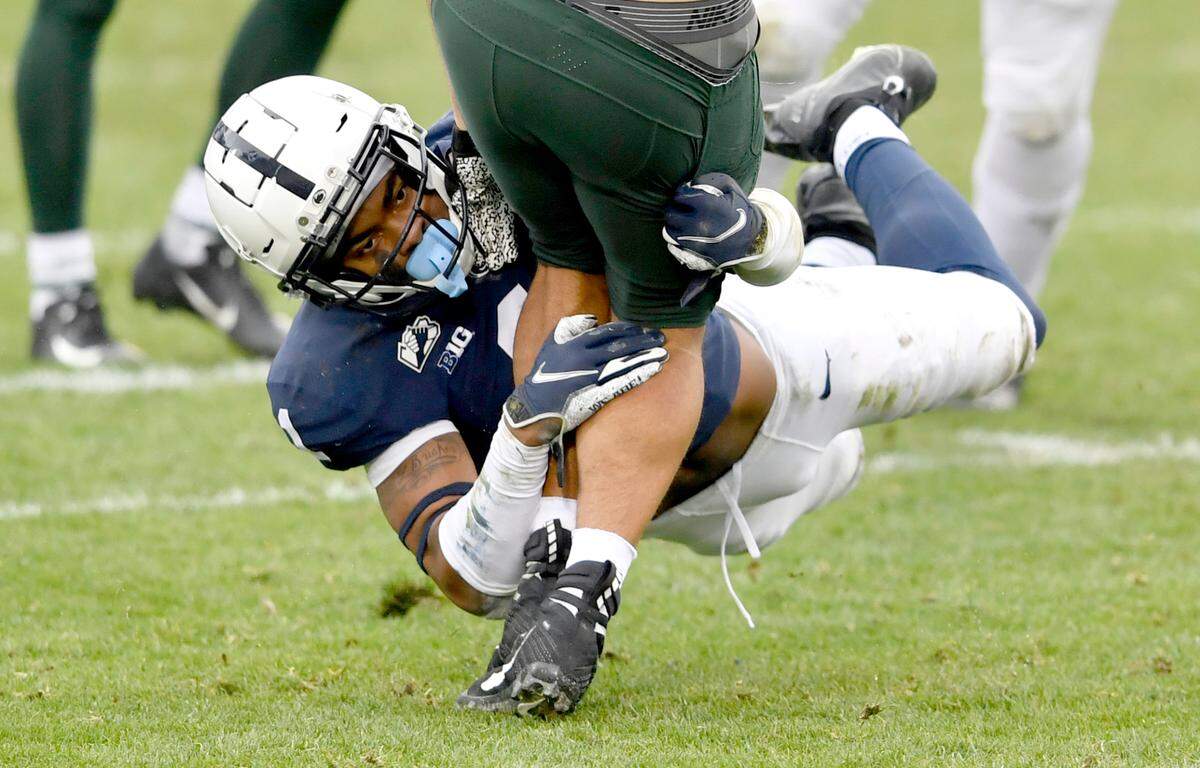
Redshirt senior Jonathan Sutherland and redshirt freshman Enzo Jennings
The backup spots are occupied by two players who could battle for a staring spot and potentially take one by the end of the season. The problem with Jonathan Sutherland and Enzo Jennings, is that both have enough deficiencies to make one think they’re best suited to play rotationally or in specific situations.
Sutherland came to Penn State as an excellent special teams player and a good defender against the run, and that’s mostly what he still is as a player. He’s improved in those areas — and has improved against the pass — but hasn’t done so enough to take over a starting safety spot. Given the nature of offensive football, it’s increasingly difficult to put a player like Sutherland on the field for all three downs.
He doesn’t have the coverage ability to play well against the pass and that is a major issue against most offenses. However, Sutherland can still excel on special teams and has a role for Penn State on defense, as well. He’s an excellent short-yardage safety and can still contribute against teams like Iowa and WIsconsin who will try to beat the Nittany Lions with a power running style. He can essentially operate as an extra linebacker who has better coverage ability in those situations — just enough to defend play-action passes.
Jennings looked more like a cornerback than a safety when he arrived on campus but has added enough strength to be a real factor against the run. His lack of experience — and unproven ability against the run — is the main reason for hesitation when it comes to projecting him as a starter. He’s good in coverage, even showing the traits to line up in the slot and play some man-to-man. He has much more upside than Sutherland and has a greater opportunity to have an increased role because of it.
His biggest weakness at this point is his tackling. He tackled well in high school but got away with flawed technique that wouldn’t work in the Big Ten. He’ll have to polish his form, keeping his head up and wrapping up ball-carriers rather than using his arms and dragging them down without good leverage. Even with those weaknesses, he’ll have a chance to make his mark on this season if he can show enough improvement from his first season to his second season.
Freshman to watch
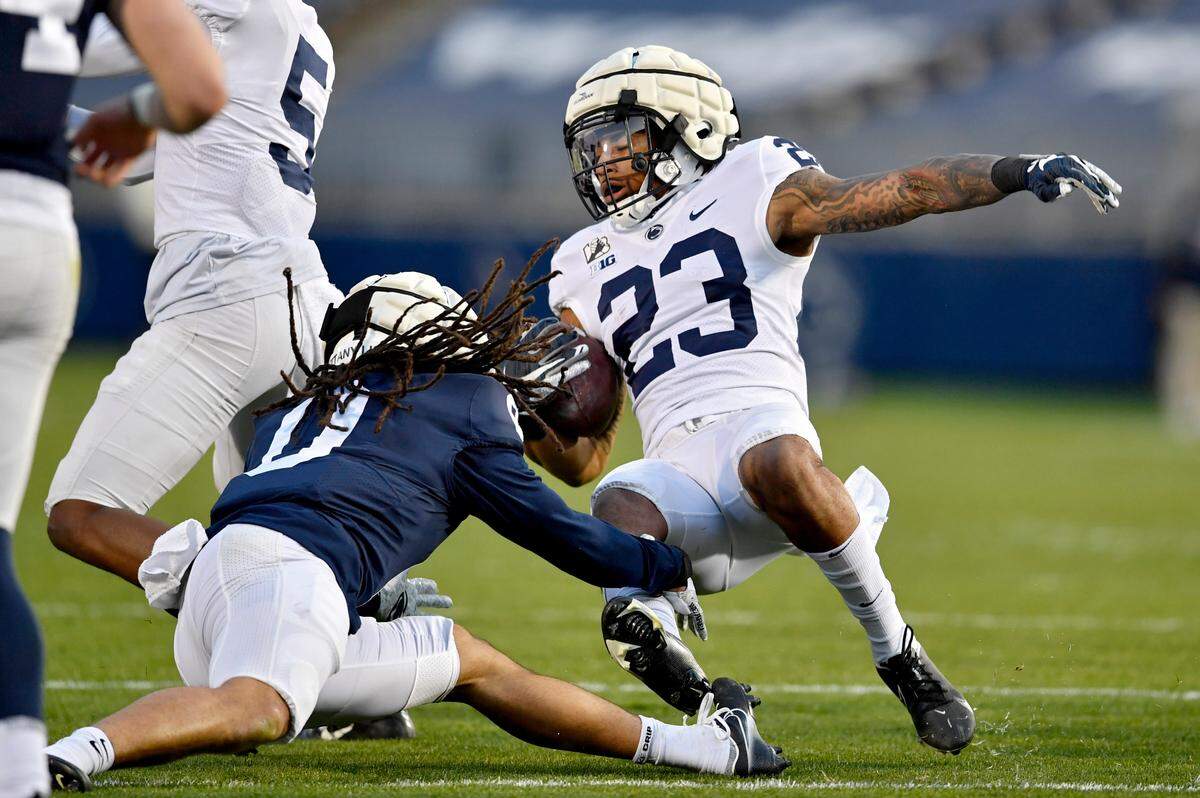
Freshman Jaylen Reed
Penn State’s best true freshman safety could find his way onto the field in his first year on campus. That’s partially because of the lack of a true second starter, and partially because Jaylen Reed has some abilities that should translate quickly from high school to college.
Reed isn’t an imposing player when it comes to height at 6-feet-tall, but he is when it comes to strength. He’s currently listed at 213 pounds and is very strong for his position. He’s at his best against the run — not unlike Sutherland — but showed more against the pass than Sutherland did in high school. Reed relies on his nose for the ball, which most notably shows up when he’s seeking ball-carriers, but occasionally lends its hand when he’s trying to break up passes.
The true freshman should see time on special teams early and could take over a bigger role if he shows he can be trusted against the pass.
This story was originally published July 17, 2021 at 12:10 PM.