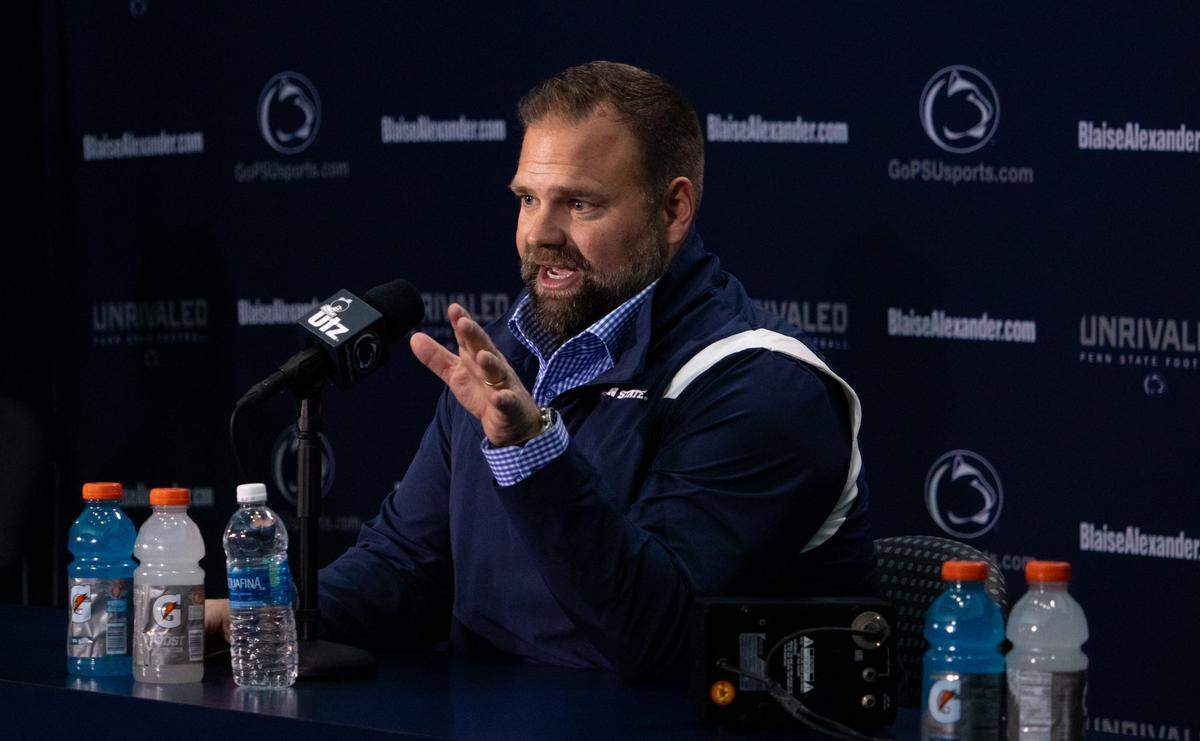
Why OC Andy Kotelnicki can take the Penn State offense to the next level
Andy Kotelnicki is more familiar than most with Penn State. The new Nittany Lion offensive coordinator may have grown up in Litchfield, Minnesota, but he knew all about the football program from a young age.
“I’m five or six or seven years old and my mom brings home a football helmet,” Kotelnicki said Friday at his introductory press conference. “I know what football is, my family weren’t college football players by any means, we didn’t grow up cheering for whoever. But there’s a white helmet with a blue stripe. Sometime in the next year I see either on TV or the paper that there’s a college football team that’s wearing that same helmet. It’s Penn State. I didn’t know anything about it, but I immediately became a Penn State fan because they have the same helmet that I would put on running into trees and things like that.”
The energy in Kotelnicki’s voice was palpable — even turning to a communications staffer and asking if he could meet some of the players he watched growing up, like Lavar Arrington and Curtis Enis — and his passion for coaching came through with what he said.
“My first exposure to teaching somebody else how to do something was when I was in probably sixth or seventh grade,” Kotelnicki said. “Those of you who know anything about hockey, you know that you usually start skating when you’re pretty young and they’re called mites. I was however old, and however many levels above a mite, but I got to be a part of teaching these young kids how to skate. ... But to recognize how much joy it brought me to see people get better at things that you’re instructing them to do, and I can emphatically say that I know that I’m doing it for a reason because that’s still today why I do it.”
There is work to be done with the Penn State offense and Kotelnicki’s performance will be judged by that and not by what he says, but if what he did say carries over, the Nittany Lions may have found the offensive coordinator to push the program into the elite of college football.
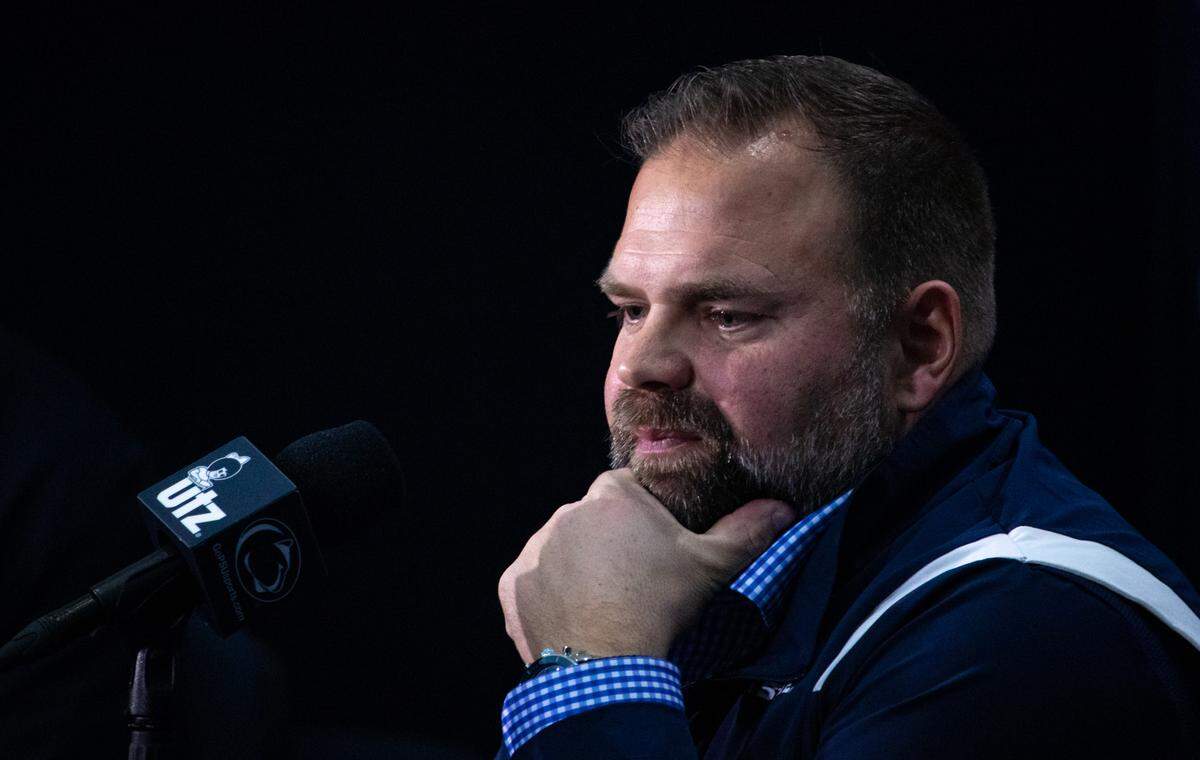
Kotelnicki laid out his schematic philosophy on offense succinctly.
“It’s a multiple, pro-style offense that uses spread concepts and components and an emphasis on the word multiple,” he said.
But what does it mean to him?
“As long as you as a teacher and a coach understand what your players’ capabilities are, and more importantly know what their limitations are, as long as you can work around those and you have a clear definition in your mind and what those things are, you can put them on the field to be successful,” he said. “... There’s really two spectrums when you think about putting together an offense or a defense. You have systems and then you have people. I think when you focus so much on the system, if you’re a person that doesn’t fit into whatever that mold in that system needs to be, it’s really hard to be successful if you don’t fit exactly. And then you have where we tend to lean here, it’s about the people, the players. What do they do well? What are they capable of? What are their limitations? Let’s focus and do things that are gonna put them in position to be successful.”
Kotelnicki’s ability to explain what he wants is all part of what makes a successful coach at any level. He is, first and foremost, a teacher. He just happens to be a teacher of football.
That goes beyond the players. Kotelnicki is in charge of a whole staff of offensive coaches, from position coaches to interns to everyone in between. And he has to motivate them, too.
Penn State head coach James Franklin said frequently that collaboration would be important for the new hire. He emphasized how much more collaborative it was in the weeks that co-coordinators Ty Howle and Ja’Juan Seider took over following Franklin’s firing of Mike Yurcich.
Kotelnicki’s former assistants Daryl Agpalsa and Alan Hensell both told the Centre Daily Times that was something that was emphasized when they worked with him, and he explained Friday why it’s so important.
“Thirteen brains are better than one, right?,” Kotelnicki said. “And I think when you look at college football, it’s about the players. ... (Position coaches) are having the closest and most direct relationships with their positions and players. So when we can get everyone on the same page about what we’re doing and why we’re doing it, getting input from other people makes that process go a lot smoother.”
There’s added importance to that with an offensive staff that has two co-coordinators that will take a step back once Kotelnicki takes over.
Seider and Howle held those titles before Yurcich was fired and will presumably keep them, but their involvement in the offense could change. They’ll go from calling plays — on Friday, they smiled and pointed at each other when asked who was making the calls — to being a piece of the offense.
His management of them and their personalities will matter just as much how he manages his players, and if all of that comes together it will be evident on the field.
Words can only carry him so far, but Friday is as good of a sign as you can get before the games start that Kotelnicki is the man for the job.