Pine Glen ‘X houses’ mark the spot of unique part of Centre County history. Here’s how
READ MORE
America250: Centre County history
We’re highlighting unique parts of Centre County history as the nation celebrates its 250th anniversary. Follow along below.
Expand All
Pine Glen ‘X houses’ mark the spot of unique part of Centre County history. Here’s how
How Bellefonte is honoring, preserving its Underground Railroad history
‘A special place.’ How a new book honors the history of the Mountaintop
Philipsburg was first PA town with electric streetlights. It wants the world to know
New film tells little-known story of Revolutionary War soldiers’ graves in Penns Valley
Earth has several oddities people can see from the sky: think crop circles or Peru’s Nazca Lines.
Centre County has one of its own.
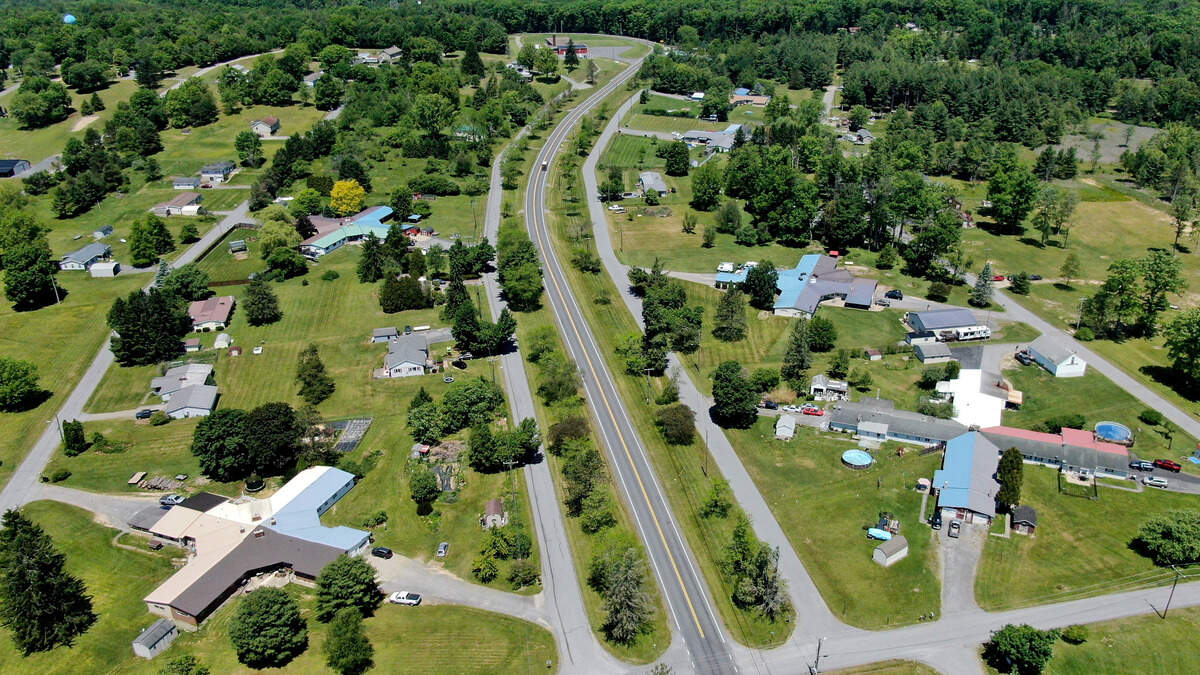
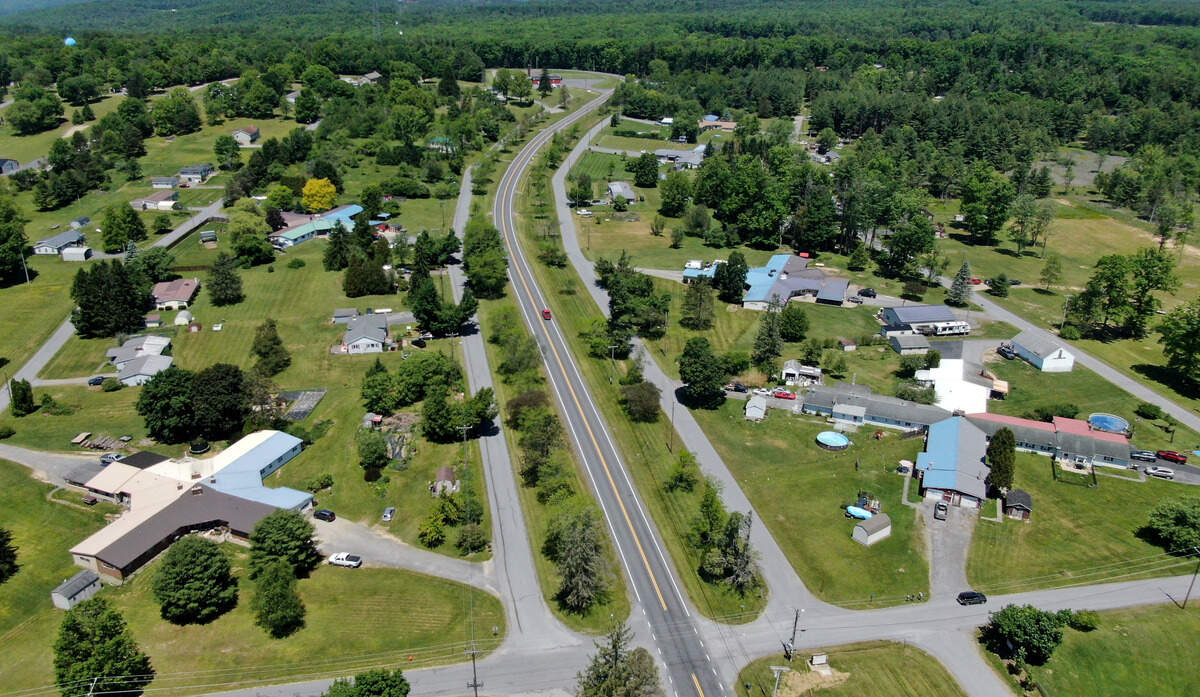
By plane or satellite image, one can easily identify Pine Glen in the county’s Mountain Top region by its seven X-shaped homes. The unusual buildings, or “units” as locals call them, are remnants of a Cold War-era attempt to make what is now the Quehanna Wilds a hub for nuclear and jet engine research.
The project quickly fizzled, and the units, which briefly housed researchers, have for the past 60 years provided a fairly affordable, quirky housing option for those who don’t mind a longer drive to amenities.
Pine Glen rebuilt for the nuclear age
Plans for a research facility began in earnest in 1955, when the Curtiss-Wright Corporation selected a site north of Karthaus to test jet engines. The company, which was a major contractor for the U.S. government during World War II, was looking for a remote area to conduct sound barrier tests, the Centre Daily Times reported at the time. Quehanna provided just that.
The project promised thousands of jobs, and the company needed somewhere to house the workers. One such site was Pine Glen.
Chuck Benton, 90, recalls Pine Glen being “like most country villages” before Curtiss-Wright.
Residents “were either coal working people, or lumber working people, or farmers,” the Pine Glen native said in an interview at his Karthaus market. Neighbors would have festivals with fresh produce and gather in the fall to butcher their livestock for sausages and pork chops.
“A lot of the older ladies back at that time were good cooks,” Benton said. There was a post office in town, but not much infrastructure.
The land that would become Curtiss-Wright housing was owned by a farmer named Harry Beates, incorrectly spelled Bates in some records.
“I remember Harry Beates farming this field right here with team horses,” a shirtless Herb Maney, 84, recalled over a dinner of cold rotisserie chicken and salad. But “Old Man Beates was old” and couldn’t farm the land anymore, Maney said. He died in 1954, and his heirs sold his land to Curtiss-Wright for “probably $200 an acre.”
“I thought that was all the money in the world,” Maney said. The Beateses closed the deal for 350 acres, with an option for up to 500, in April 1956. The deed was signed in May, and the company broke ground in June.
Benton, then 20, hauled shale, lumber and drywall that Curtiss-Wright shipped in via train. Maney, an ancestral trucker, paved driveways and dug foundations.
“These X houses were state-of-the-art construction at the time,” Maney said. Originally painted green, according to Maney, the researchers populated the units, while higher-ranking engineers and management had homes built to spec. Maney lives in one such home, which has downward-facing windows reminiscent of those on a Navy ship.
Maney said he believed the units were the first houses of their kind. Six of the units were split into four V-shaped dwellings, with families taking two adjoining halves of the units’ legs. One unit was split into eight dwellings, with families taking one half of a leg.
Each unit was fitted with a dishwasher and a fireplace and laid out identically. The units, while sharing walls, sit on their own pie slice-shaped lots.
“People came from all over the country to see this,” Maney said.
The planned community was dubbed “the development,” and the nickname sticks today.
Quehanna’s promise and failure
Curtiss-Wright remade Pine Glen in its image, some believe literally.
“Some people think they’re x’s or crosses but supposedly they were to represent the propellers on airplanes!” Beth Steffan of the Burnside Township Historical Society wrote in an email. Maney’s wife, Joann, who, like Steffan and himself, chronicles local history, said the units are sometimes called airplane houses because of their propeller-like shape.
Herb Maney said the reason for their shape was more practical: fewer walls meant more efficient heating and fire protection than in a typical rectangular structure.
In addition to its signature homes, Curtiss-Wright brought with it a school, new paved roads and a fire station to serve the workers.
“I wanted to join the fire company,” Benton said. “I went there to the guy that was in charge of the fire company. I couldn’t belong to the fire company, because only Curtiss-Wright people, that’s all, could belong to that fire company.”
Many of the workers moved to Pine Glen from Curtiss-Wright’s corporate offices in New Jersey, according to Benton. They didn’t always mix well with the small town’s pre-existing residents, he and the Maneys recalled.
“There was nothing in Pine Glen for them at all,” Benton said. “I mean, everything had to be to the city, State College, all their dealings.” But others became more integrated with the community, marrying locals, attending church, joining the Lions Club and hiring local women to do housework.
But it didn’t last long.
At its peak in 1958, the Quehanna facility employed 600 researchers alone, according to the Centre Daily Times, but the number dropped to as low as 200 by May 1960 amid cancelled government contracts. By September 1960, Curtiss-Wright had donated its land to Penn State for use in its own nuclear research.
The company left behind radioactive waste buried in the woods that wouldn’t be cleaned up for decades. The development company behind Pine Glen also went belly up and left the Maney family trucking business, which contracted for it, with $65,000 in unpaid invoices. The Maneys eventually received 10 cents on the dollar.
As for the units, Curtiss-Wright bought them back from the employees and then sold the individual dwellings to locals. One of the dwellings, in an 8-unit, made its way to Gilbert Page and his longtime partner, Virgie Lucas, in 1987.
“Back then, I paid 17,000,” Page said.
Page and Lucas like the size and the sunlight they get in the unit’s big windows. Downsides include sometimes unlevel flooring and thin walls, though 4-unit neighbor Cammy Veres said her walls muffled the noise adequately.
The chief issue of the units, known to residents and the Burnside Township government, is the water lines running through their concrete bases.
“If it breaks, then you got to have your floor jack hammered and repaired and stuff,” Page said.
Even so, Page is satisfied with his unit. It’s much bigger than a trailer.
“I got a good deal on it,” he said.