
What happens inside the pump house at Bellefonte’s Big Spring? Here’s a look
The Big Spring in Talleyrand Park is a local landmark, but the red-roofed pump house alongside it has its own historical significance and critical functions.
While the spring has been in the news lately for the potential removal or replacement of its unsightly baby blue cover, the pump house can be overlooked, despite housing the machinery that regulates, chlorinates and distributes the estimated 15 million gallons of water produced by the spring each day.
The spring has been flowing at that same rate since Bellefonte Borough’s founding in 1795, if not before then, according to the Centre County Historical Society. It was first used as a borough water source in 1807, when local businessman James Smith tapped into the spring using a wooden pipe system.
The spring was eventually deeded to the borough in 1879 by Major William Reynolds for $1, according to the Bellefonte Historical and Cultural Association, with the pump house as it’s known today being constructed almost half a century later in 1926. Its only major renovation came in 2006.
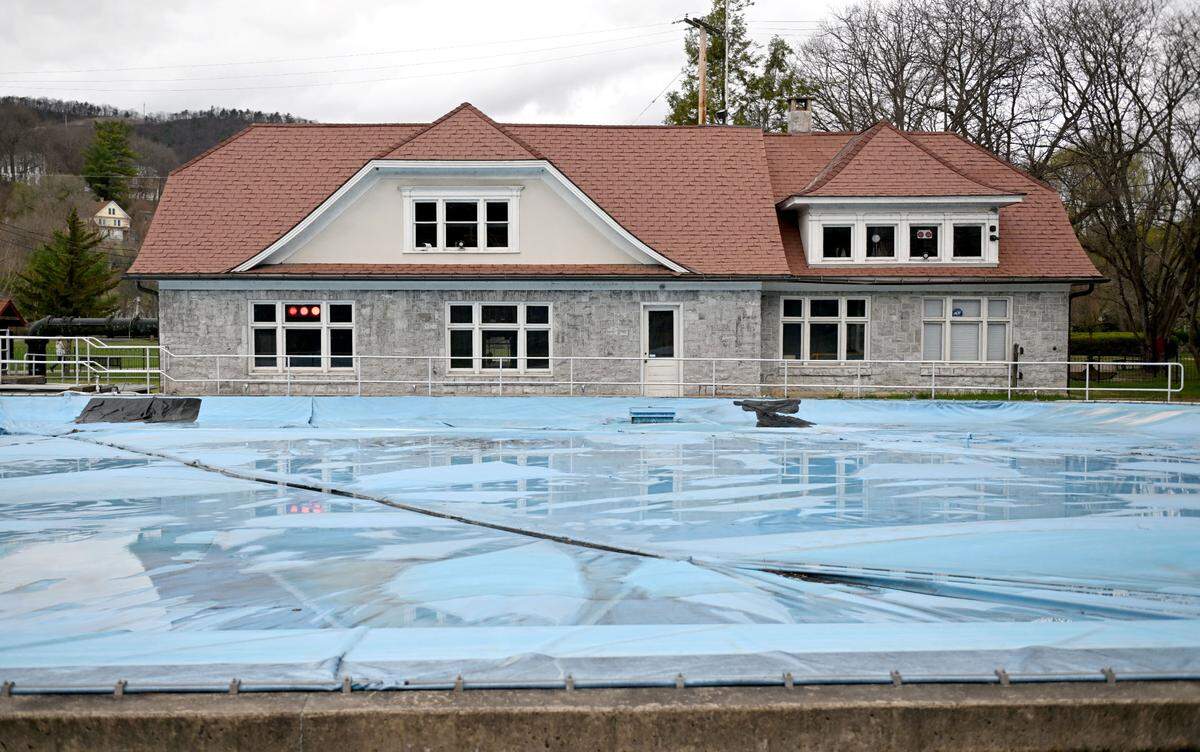
All water produced by the spring interacts with the pump house in some way, with four million gallons being distributed to five municipalities: Bellefonte and Milesburg boroughs, and Benner, College and Spring townships.
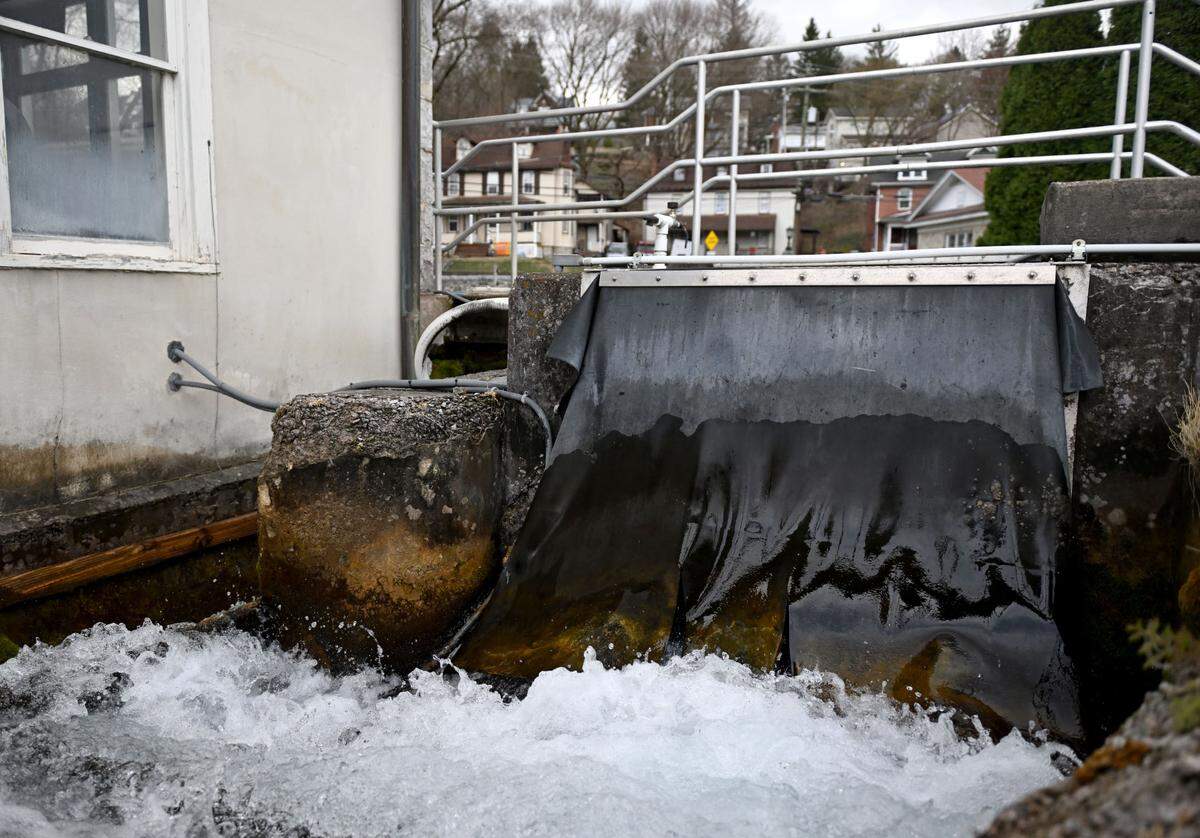
The remaining 11 million gallons of produced water gets redirected around the building’s Talleyrand Park-facing side and discharged into Spring Creek.
“We discharge a heck of a lot more water than we actually use, which is crazy considering how many different sources utilize this spring,” Matt Auman, the borough’s public works superintendent said during a recent tour of the pump house. “Rockview [state prison] uses a bit of it, and there are even a couple of bottling companies that come and use the spring too — even after all that usage, we still discharge so much. It’s wild to think about.”
Coca Cola once used the spring’s water at its bottling plant in Milesburg before selling the plant in 2020 to Niagara Water, which also uses the spring as its water source. Weis Markets also bottles and distributes the water, and Big Spring Spirits uses it as a base for its liquors as well.
Inside the pump house are three rooms, each contributing to the building’s functions — the control room, the pump room and the storage room.
The first room seen when entering the pump house is the control room, which houses the computer system responsible for making sure that the proper amount of water is being sucked in by the building’s three pumps.
If one of the pumps is taking in more water than what’s needed, the system will be alerted and will temporarily shut off that respective pump, preventing it from taking in any more. This is a normal process that can happen multiple times per day.
When a pump is shut off, the system also sends a signal to shut off one of the three red lights displayed in one of the building’s windows, with each light corresponding to a running pump.
The lighting system, while obsolete now due to the installation of an automated alert system, was implemented about three decades ago so that people living across from the spring could call and alert the borough when a light was shut off.
“Even though we don’t need them anymore, we keep the lights up and running to pay homage to the building’s history,” Auman said. “At one point the borough actually tried to do away with the lights, but we kept getting calls that something was wrong with the pump house, so we eventually just had them all turned back on. I guess after being on for around 30 years people got used to them.”
Located adjacent to the control room is the pump room, which houses the machinery responsible for taking in, chlorinating and distributing the spring’s water. The three pumps pull the water up through the floor using a series of intake pipes, where it’s then treated with chlorine.
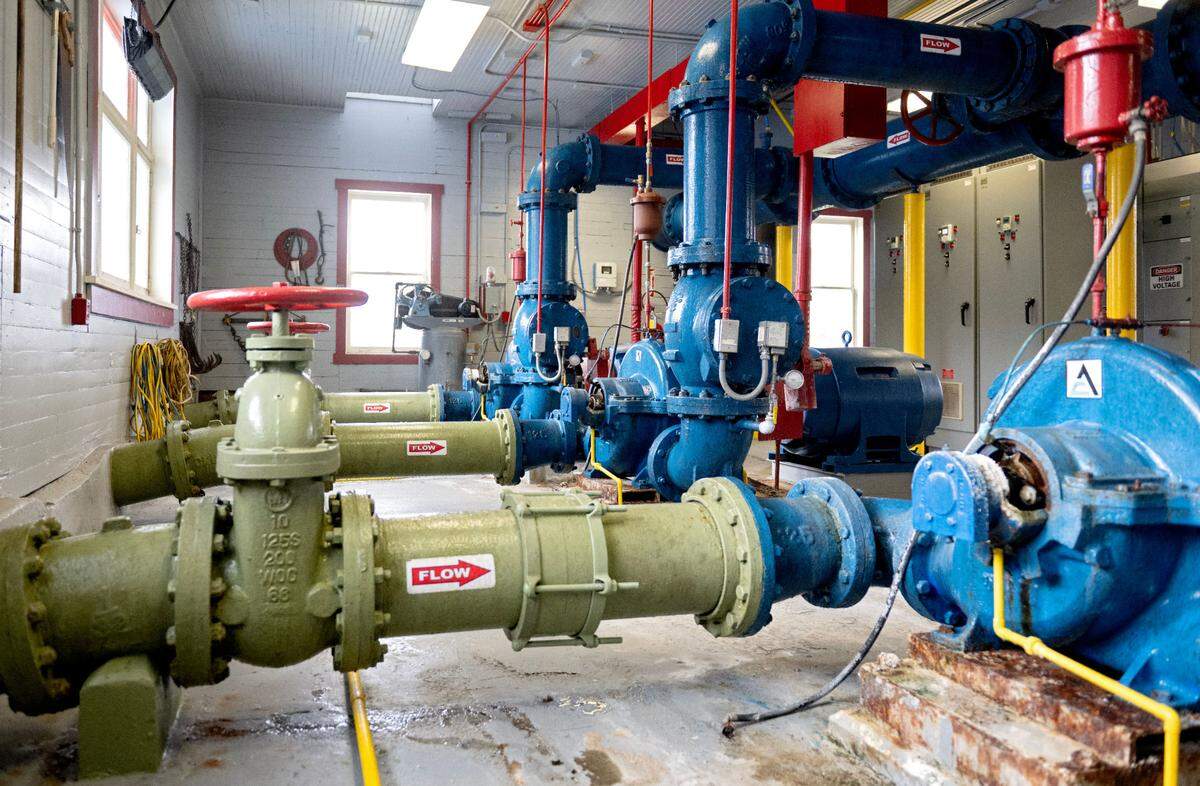
The pumps have been painted so that operators know when the water flowing through the pumps has been chlorinated — untreated water flows through the green-painted parts of the pumps, and treated water flows through the pumps’ blue-painted parts.
Following treatment, the water is guided upward into a large, overhead pipe, where it then flows outside the pump house and into the ground to two containment sites: a man-made, covered reservoir atop South Allegheny Street’s hill and a large, blue holding tank located along Hughes Street, behind Bellefonte Area School District’s new football field.
From the containment sites, the water is then piped to all those in Centre County that use it.
Eventually, according to Auman, the borough will undertake a project to renovate and upgrade the pumps. He estimates the project would cost “around $110,000,” although a timeline not provided.
The pump house’s storage room cannot be accessed from the other two rooms — a short walk around the building to a side door is required, and while the small room’s purpose isn’t nearly as integral to the pump house’s functions as the others, Auman has a theory that the room once had a different purpose all together.
“To me, it seems like this small room was at one time used as a small jail or holding cell,” Auman said. “There are hard wooden bars on each of the windows, and the door locks tight. That’s just an educated guess of course, but who knows all the potential uses this building has had throughout the years.”
As for the pond underneath the spring’s cover, Auman said it has an average depth of around six to seven feet, with its deepest point sitting at around 10 feet.
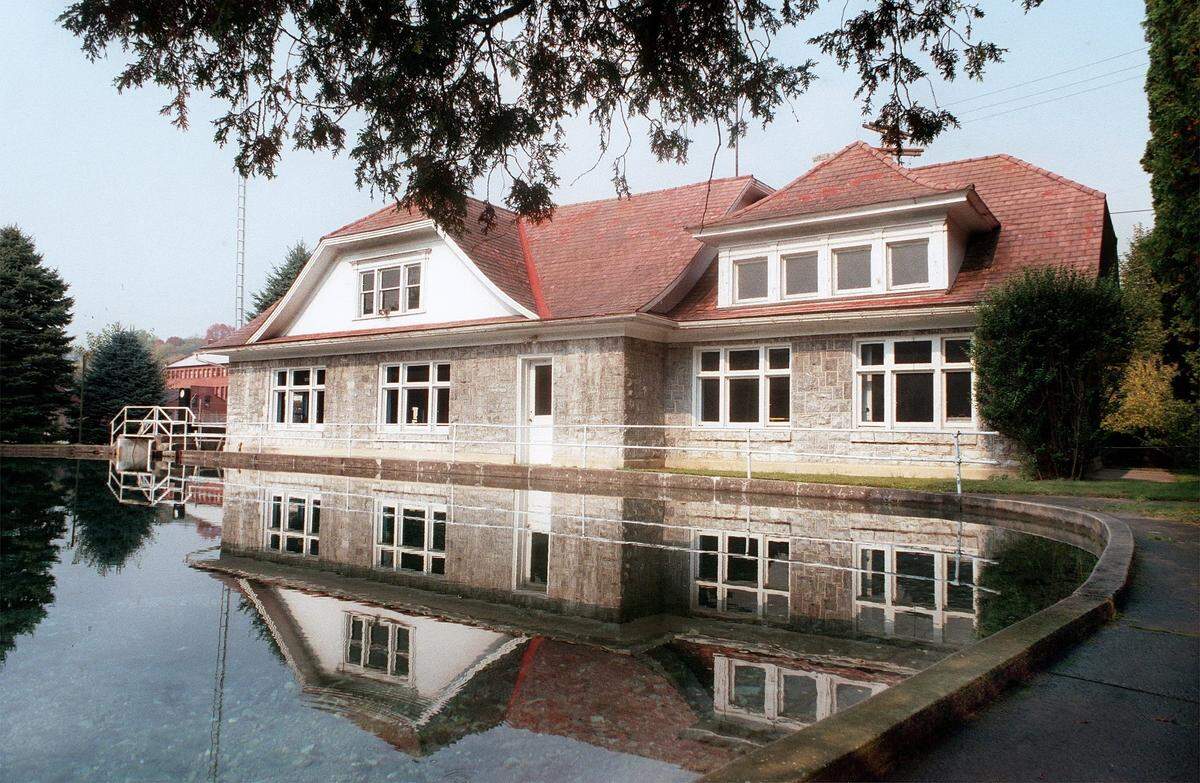
The spring has remained covered since 1998 due to environmental standards mandated by the Pennsylvania Department of Environmental Protection, although it was temporarily uncovered in 2016 for studies to be conducted on the spring.
The pump house has served a critical role for years, Auman said, and will continue to do so.
”The pump house and everything that’s inside it is incredibly important,” he said. “It keeps every aspect of what’s going on with that spring in check, and if anything were to happen to it, we could be in big trouble.”