
Why homeless Penn State students are the hardest to find and hardest to help
READ MORE
Hidden Homeless
In Centre County, homelessness looks much different than what most people have in mind. It’s not people sleeping on streets, but in cars, on couches, in temporary housing arrangements arranged by nonprofits. With no full-time, drop-in homeless shelter, and other shelters and services clustered within the Centre Region and inaccessible to rural residents, officials say the problem is growing and is in need of a collaborative solution. “Hidden Homeless,” a multipart series from the CDT, explores services and potential solutions.
Expand All

‘One size does not fit all.’ How Centre County works to help its ‘hidden’ homeless
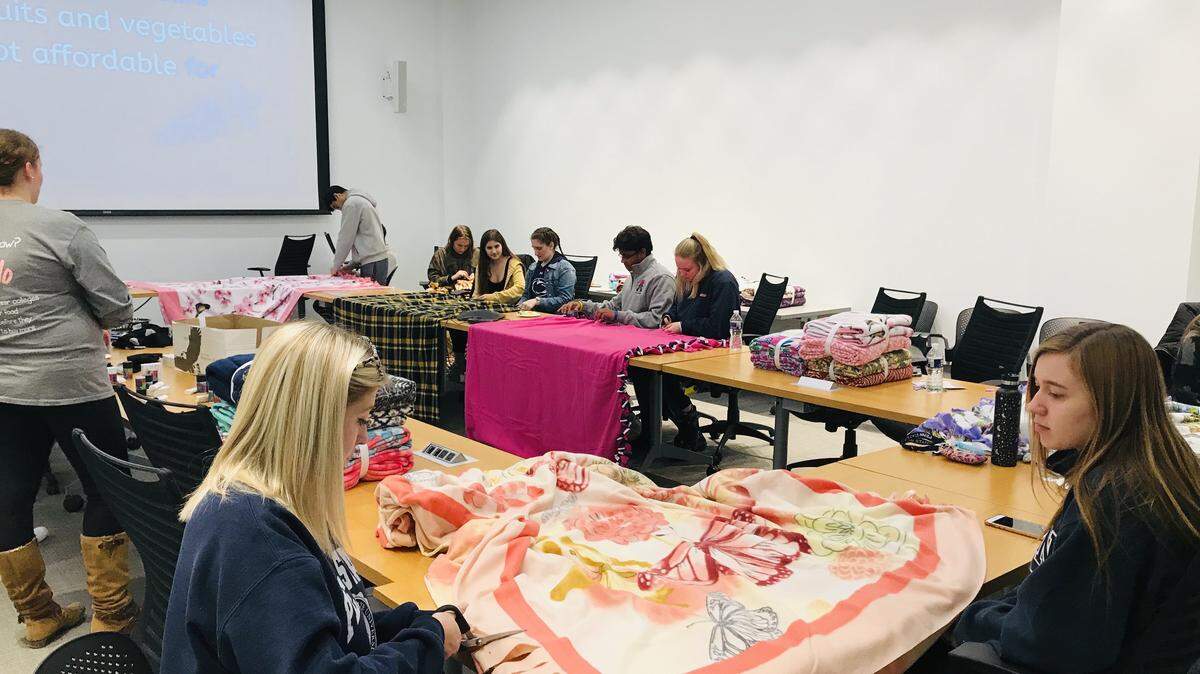
Why homeless Penn State students are the hardest to find and hardest to help
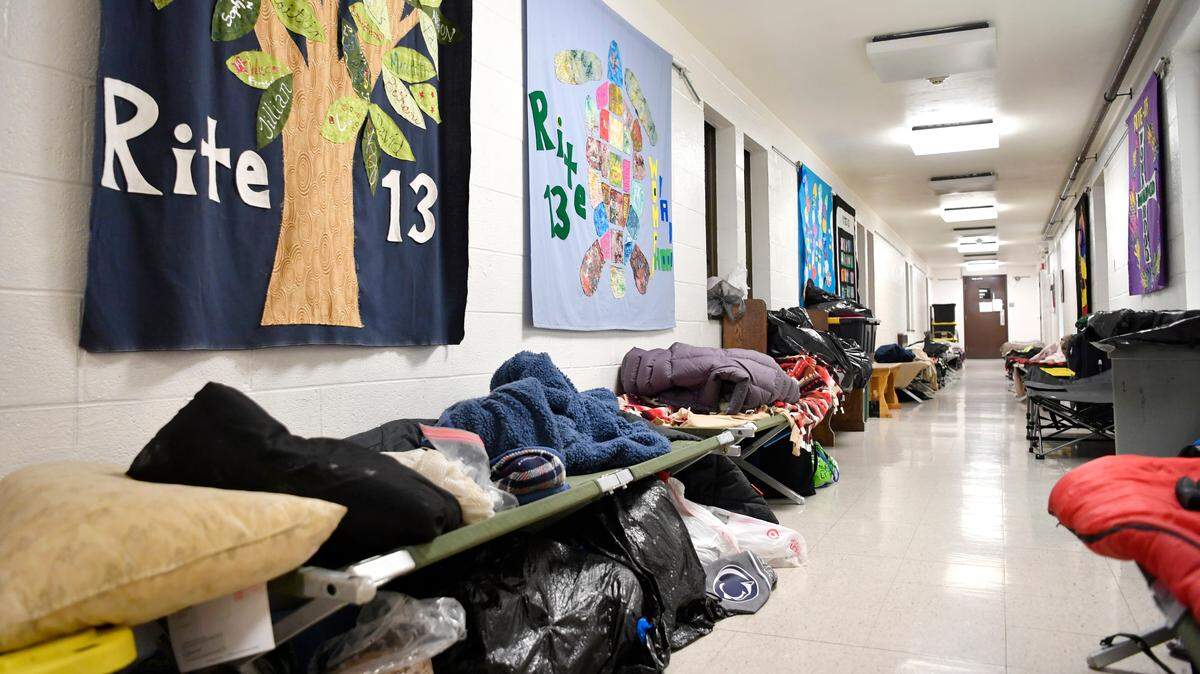
Amid transition, Out of the Cold sets its sights on opening full-time homeless shelter
Rural homeless face unique challenges. Here’s how one central Pa. community is responding
In the beginning of 2018, Maureen Safko, the senior planner in the housing and community development division of the State College borough, heard rumors about a number of homeless students who were staying in university buildings.
With the arrival of the annual Point-in-Time count organized by the U.S. Department of Housing and Urban Development to count the number of unsheltered and sheltered homeless individuals in communities nationwide, Safko and her team searched various on-campus locations like the Lewis Katz Building, the HUB-Robeson Center and The Arboretum at Penn State. They targeted buildings that had welcoming furniture that would allow for sleeping, an open floor space and showers that may have been used during off-hours. They also spoke to faculty and custodial staff.
“We were not able to find a place or confirm that there was a group of students sheltering in a building at night anywhere on campus,” Safko said, adding that the borough is aware of homeless people who take shelter in the Schlow Centre Region and Pattee libraries. “More likely, friends stay with friends for a while and you just sleep on the couch there in the friend’s house.”
Government officials, universities and housing advocates find it difficult to track down homeless college students because their situations often do not reflect what would typically be defined as homelessness — staying on a friend’s couch, living doubled up in a small space, etc. Despite not having an exact number, some student organizers and community members say they recognize a need and are determined to understand the scope of the issue.
Temporary housing solutions lead to invisibility
According to a national survey conducted by The Hope Center in April, 10% of the college students surveyed reported that they temporarily stayed with a relative, friend or couch surfed and 14% reported living with others beyond the expected capacity of housing.
“You know, nobody thinks it’s a permanent situation. They think, ‘Oh, well, I’m just staying here for a while until my internship comes through, or until my loan comes through, or until I earn enough money to go back to school,’” Safko said.
Because of the invisibility of couch surfing and doubling up, it is hard to identify how prevalent homelessness among students may be.
“The students don’t want to be seen as homeless because you’re amongst all your peers. It’s not a time to draw attention to yourself as needing housing,” Safko said. “So, there’s not an incentive on the part of the student to be visible.”
Safko said the borough questions workers at cafes and eateries about frequent visitors or any rumors of homeless people who might not have received assistance already. Through those interactions, in 2018, the borough was able to identify 12 couch surfers.
Students help their own through programs, outreach
At Penn State, student organizations are helping with the process of counting and providing aid to the housing insecure student population.
Project Cahir, a student organization that is working to mitigate poverty among students, is developing methods to track down students with food and housing insecurities and provide them with necessary resources.
The organization hosts awareness events like Poverty Fight Night and connects with local organizations to develop collaborative events and resources. It also organizes financial aid for students needing meal points, toiletries and textbooks.
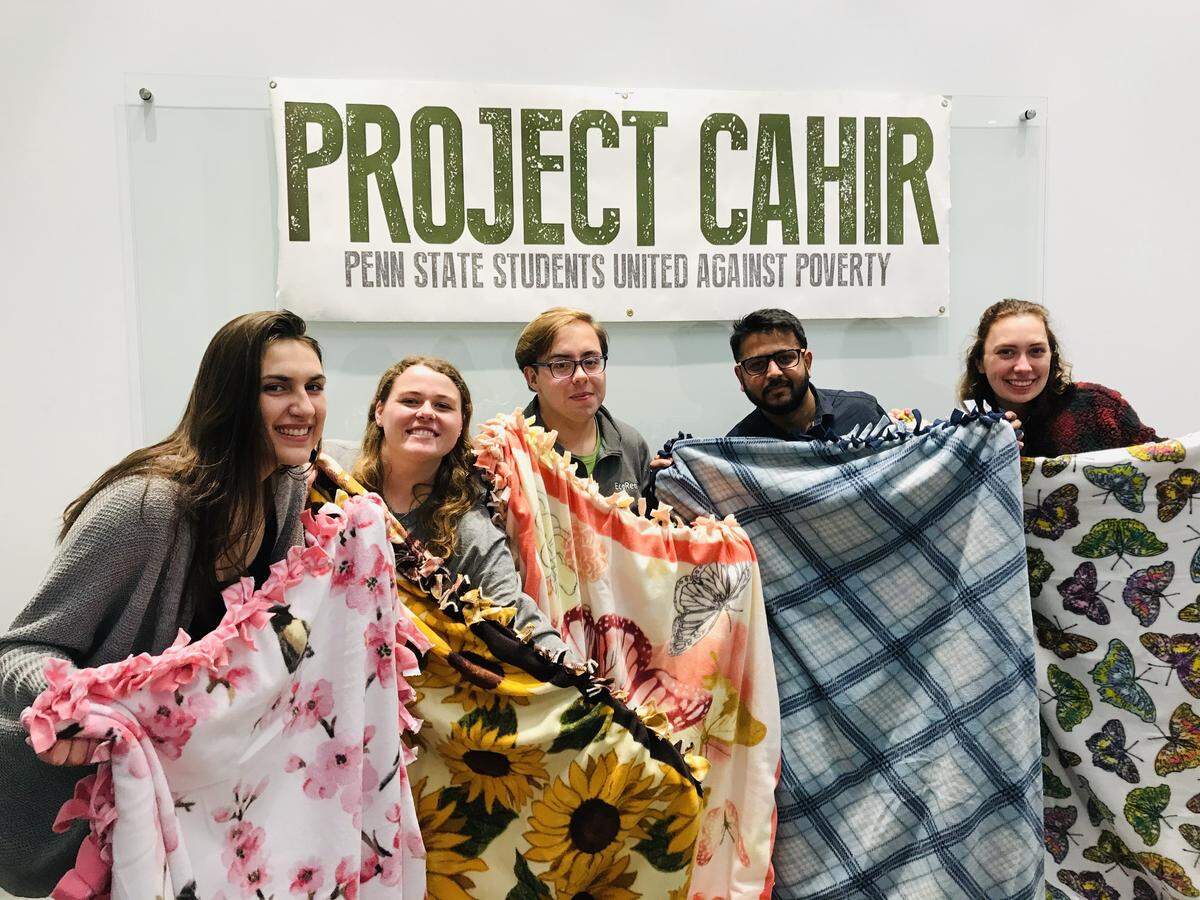
The organization’s faculty adviser and the director of The Center for Character, Conscience, & Public Purpose, Tim Balliett, said the group works with Student Care & Advocacy, a Penn State Student Affairs department that focuses on providing assistance to struggling students.
In the spring, Project Cahir conducted a survey that aimed to gain insight on student experiences with accessibility to basic needs like food and housing. Although the survey was mainly focused on food insecurity, it did include a section on housing insecurity.
Of the 791 students who completed the survey, only two self-identified as being housing insecure. One reported sleeping in academic buildings and places not meant for human habitation.
Sidharth Agrawal, a doctoral candidate involved with Project Cahir for nearly three years, said it is hard to identify student homelessness for two reasons.
“First thing is the stigma where people don’t want to talk about it. Someone paying close to $20,000 in tuition and not having a home … there’s a stigma that comes with it,” Agrawal said. “And the (second) thing that I think is most challenging is reaching out. Sometimes students don’t know that resources exist for them.”
In the spring, Balliett said that Student Affairs used students’ FAFSA applications to calculate the number of people who indicated housing insecurity. They found 55 students across all Penn State campuses who self-identified as homeless. However, this indication was only applicable for financially independent students — those who receive no income or financial support from their parents.
Balliett said that because of this limitation, most of the reported homeless students are adult learners.
At University Park, Project Cahir found that over 13% of survey takers reported that they had to choose between paying for food or housing and utilities.
To help fill that gap, the Lion’s Pantry student organization provides essential food, groceries and convenience items to students in need. Run by students for students, the donation-based pantry reported that more than 50 students visit the pantry on a weekly basis.
“I would say, typically, (the number of people using the Lion’s Pantry) remains consistent throughout the year except for at the end of the semester when more students are running out,” said Sayre Bradley, president of the Lion’s Pantry.
Housing assistance programs exclude students
Homelessness among college students is an issue Safko is hearing more about than ever before.
With every year, students pursuing undergraduate and graduate degrees are faced with increasing tuition rates, high living costs and snowballing student loan debt. In September, Penn State was found to have the highest student debt in the Big Ten, with in-state students graduating with an average of $36,044 of debt and out-of-state students at $40,770.
In addition, The Hope Lab found that students who identified as homosexual or bisexual were found to be at higher risk for housing insecurity, nationally — with over 20% and 19%, respectfully, reporting that they were homeless.
Still, HUD policies exclude most students from qualifying for housing assistance under various programs like housing choice vouchers and low-income housing tax credit that are typically designed to help low-income individuals or families.
“I think (it is), largely, because people think that students are provided for by their parents,” Safko said. “HUD allows students to be in subsidized housing in very few circumstances. And I think everybody else just sort of follows the same standard. It’s a rule that comes down from HUD and the whole industry follows it.”
In Centre County, students who are not financially independent are not eligible for affordable housing units. Additionally, shelters like Housing Transitions that provide housing programs and other forms of aid do not provide assistance to most students because they are not residents of the county.
“If we did that, our shelters would just be full of Penn State students,” said Jennifer Stahl, the Centre House shelter manager for Housing Transitions. She added that residents of the county are the organization’s first priority. “I know it sounds cold, but it’s out of our scope.”
That’s where Project Cahir and Student Affairs try to step in.
“If a student did not have a regular place of domicile, while they’re here at school, we would consider that, actually, a student that’s housing insecure and that we would want to be aware of and be able to provide services for that student, regardless of whether the family has a domicile at home where the student may be staying,” Balliett said.
Compared to Penn State, other universities have reported higher populations of students experiencing homelessness or housing insecurity, with California State University at 11% and City College of New York at 43%. Although Penn State’s current numbers are not nearly as large, it is still significant.
“It’s the population that’s hardest to help because they’re the hardest to find,” Safko said.
This story was originally published December 12, 2019 at 8:12 AM.