There’s a lack of diversity in Centre County government. Candidates are trying to change that
Tierra Williams never considered a job in politics until she became involved with the Centre County community.
Williams co-leads the 3/20 Coalition — an organization created in 2019 after the fatal police shooting of Black State College resident Osaze Osagie — and hosted an online discussion series called “Black Tea,” which addresses topics including politics, religion and race.
“I realized I can talk about these issues, but what can I actually do to fix some of these issues?” Williams said.
Now, Williams is running to become a Ferguson Township supervisor. If elected, Williams, 29, said she would be the first Black person and youngest female to serve on Ferguson’s board.
“It’s kind of shocking to be able to say that in 2021,” Williams said, reflecting later that maybe it isn’t so shocking, as the first Black president and vice president took office within the past 12 years.
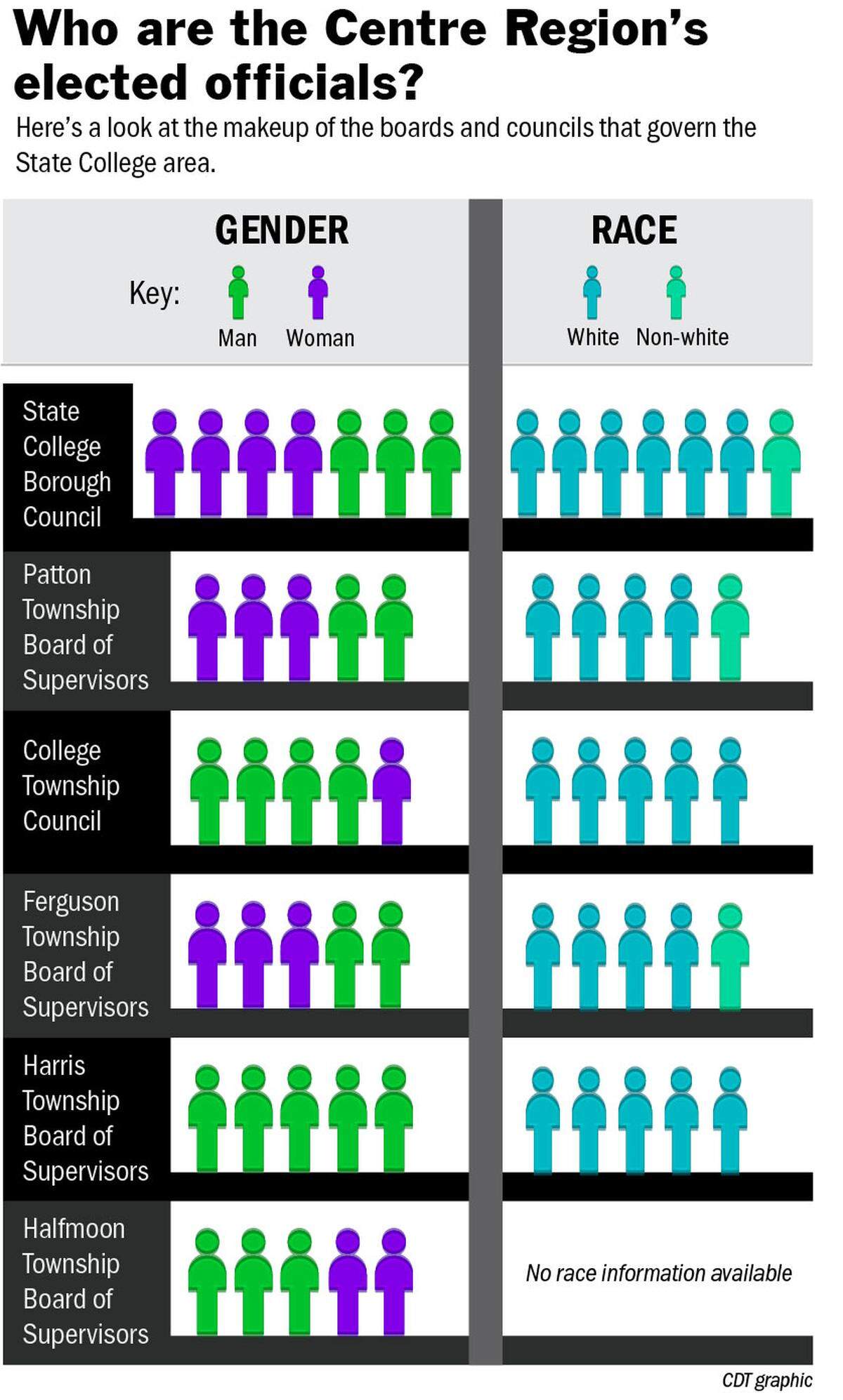
According to 2019 data from the U.S. Census Bureau, Centre County’s total population is 89.8% white, 7.3% Asian, 4.4% Black or African American, and 3% Hispanic or Latino. In the Centre Region municipalities of State College Borough and Patton, College, Ferguson and Harris townships, only three of 27 elected representatives are non-white and 11 are women, according to information provided by the boards.
“Being unapologetically Black is a very hard thing to do in a predominantly white area,” Williams said. “Sometimes you just feel like that black dot in the room.”
Community involvement
Jesse Barlow, State College Borough Council president, said the borough has had “very few” non-white elected officials. There are currently three men and four women serving on Borough Council, and Katherine Oh Yeaple is the only person of color.
“It is not representative of the population,” Barlow said. “There’s a lot of issues here, and there hasn’t been as much appreciation for diversity in local government as there should be.”
Barlow said it’s vital for people to engage with the community and get involved with local government. He added State College is working to create a community oversight board; establish a diversity, equity and inclusion officer; and make a civilian response team to work with local law enforcement.
“These are all changes that come out of living in a more diverse community,” Barlow said.
Shoba Sivaprasad Wadhia, director of the Immigrants’ Rights Clinic at Penn State Law, said via email that it’s important for governments to represent the diversity of America.
“Representation matters,” Wadhia said. “Like with other professions, when people see who look like them in elected offices, this can have a profound impact on their sense of what is possible and whether they belong.”
When people of color run for office, Williams said it’s imperative that they are listened to and taken seriously. She added that the focus of the conversation when discussing issues like racism should be on one’s experiences, rather than their tone or emotion.
“At no point in time in an African American’s experience can we escape racism,” Williams said. “To not validate those experiences ... it’s a problem when you can’t sympathize or empathize with that, and it’s an even bigger problem when you just completely ignore it.”
Williams emphasized the importance of white people using their privilege as a means to foster an anti-racist — not simply non-racist — community, which she said can happen through the election of diverse candidates.
“When people are making decisions that affect you, yet there are no persons who reflect you, that’s an issue,” Williams said.
Impact of representation
Gopal Balachandran, assistant professor of clinical law at Penn State Law, is running for a seat on the State College Borough Council. He was inspired to run by Osagie’s death and the 3/20 Coalition, as well as the Black Lives Matter movement as a whole.
Balachandran said having diverse representation in government, especially in State College, might inspire younger people of color.
Additionally, he said academic research shows that diverse groups — like governments — devise more creative solutions to problems and function better.
“I hope it’s not just tokenism, that we have (governmental) bodies that look like the communities but that these diverse institutions end up actually functioning better,” Balachandran said.
In the same vein, Divine Lipscomb, candidate for State College Borough Council, said via email having representation by those who look like you is “only half the battle.”
“Just because someone looks like you does not mean they have the same ethical or guiding principles as you,” Lipscomb said. “So young people need to see themselves in government spaces by those who see them and recognize their value and contributions to society.”
Similar to Balachandran and Williams, Lipscomb was inspired to run for office by the 3/20 Coalition and the deaths of unarmed Black individuals including Ahmaud Arbery and Breonna Taylor.
“Different cultures experience the world through a different lens,” Lipscomb said. “When you bring those identities into one space, it affords us, at minimum, a platform to advocate for the things that impact our respective cultures, with the end goal being how our policies exist to cultivate a space for everyone to be included.”
Younger generations that see a diverse representation of individuals in their government could be more hopeful, Williams said, adding that representation should include all shades of people of color.
“For someone to not only see a Black woman in this position, but a darker skinned Black woman with an afro and a nose ring — I think it’s so authentic,” Williams said. “I think it’s so awesome that it’s not about how I look or how I wear my hair, but it’s what I am trying to do.”
Wadhia added there have been racial disparities throughout the pandemic, including 3,800 hate incidents against Asians and Asian Americans in the last year and police shootings of Black people.
“While these communities feel more ‘seen’ there is still a lack of political leadership,” Wadhia said.
Barlow said increased representation would show children they can have a seat at the table.
“I hope that they see that there’s a future for them here, their voice can be heard here and this is a place they can live and thrive,” Barlow said.