Penn State searching for answers after Black Caucus endures ‘traumatizing,’ racist incident on Zoom
Several members of Penn State’s Black Caucus endured “traumatizing” and overt racism last week, when 51 users invaded the group’s online space to hurl racial slurs — with at least one user allegedly exposing himself — as members of both the university and the greater community are still searching for answers.
Based on interviews and an open letter by the Black Caucus, the incident occurred late Wednesday morning during the university’s virtual Spring Involvement Fair. The caucus had its own room on Zoom, when dozens of unwanted users of varying ages joined and immediately directed racist and homophobic slurs — including the n-word — at three caucus board members.
Some users had swastikas set up as their virtual backgrounds, while others yelled “Black lives don’t matter!” One user pulled down his pants and mooned the caucus members, one member alleged, as the entire incident lasted between 10-15 minutes before all the users could be reported and removed.
“What happened Wednesday didn’t occur in a vacuum; it’s part of a larger societal issue where hate is being spewed, especially in online areas,” said Nyla Holland, president of the Black Caucus and a dual senior/graduate student. “It’s really difficult to imagine and endure this kind of attack in 2021.”
Holland — who was in the Zoom room Wednesday — called the incident “very overwhelming and emotional,” but said it’s becoming easier to deal with, with each passing day. She immediately reported the incident to the university, which she said provided counseling and psychological services. (“We’re doing well, considering the circumstances,” she added Sunday.)
University police are currently investigating.
Penn State President Eric Barron addressed the incident Saturday in an open letter to the Black Caucus and others, in which he labeled the Zoom bombing “beyond disgusting.”
“The traumatizing experience endured by your group and others has been upsetting and deeply hurtful to many,” Barron wrote. “Please know that university leadership continues to stand in solidarity with you and all individuals who are victims of hate and prejudice as we publicly denounce these disgusting attacks and diligently pursue ways to find and hold accountable the perpetrators.”
Wednesday’s act was just the latest in a string of racist and intolerant incidents in and around Happy Valley. A white supremacist group posted stickers in downtown State College earlier this month, then vandalized Bellefonte’s rainbow-colored Pride Wall. A Penn State professor was threatened in an anonymous letter sent to his home, for political reasons. And verbal threats during a State College council meeting last month were reported to the district attorney.
Other local groups and individuals have offered their support to Penn State’s Black Caucus. Tierra Williams, a member of the 3/20 Coalition, which works closely with the Black Caucus, said she was “disgusted” and “appalled.” She also felt Barron should’ve responded sooner, either Wednesday or Thursday. The State College Borough also condemned the racist act in a statement Sunday.
“This type of activity has no place in our community,” spokesperson Douglas Shontz said, speaking on behalf of the borough. “This is unnecessary and hateful and hurtful. And we just really need to come together as a community and say, no, we don’t accept that here.
“We support Penn State Police and their efforts to stamp this out. Across the street, we’re a welcoming and progressive community, and hate speech has no part in that conversation.”
Although the public’s awareness of such overtly racist acts has increased over the last few weeks and months, at least locally, some community members emphasized the area hasn’t gotten more racist. It’s just grown more aware of the racism.
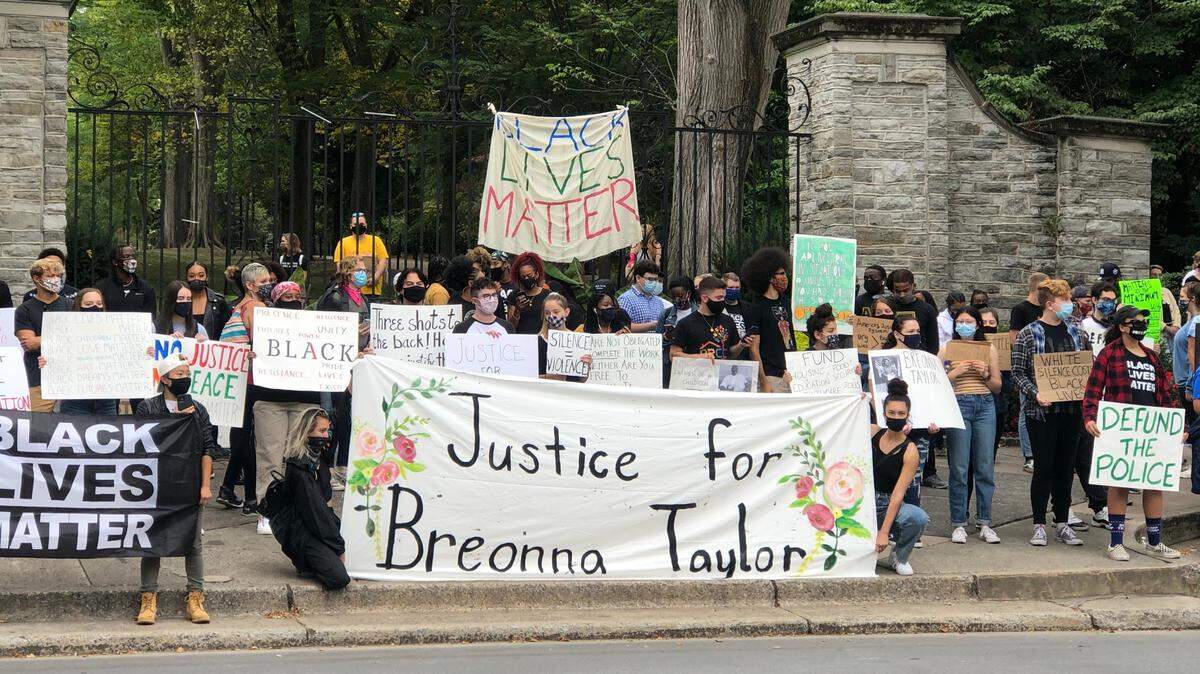
Holland was quick to add experiences vary by the individual, but she was called a “monkey” by a group of students earlier in her college career. Williams pointed to several instances over the summer, during protests related to the Black Lives Matter movement, when individuals hurled racial slurs their way. Or, in some cases, acted more subtly by revving their engines while someone was giving a speech near the Allen Street gates, for example.
Barron emphasized Saturday that it was the university’s goal to educate about equity, inclusion and justice. But Holland said she would like to see some action behind those words, along with a clear plan to achieve that.
In the meantime, Holland said, if you want to help, help educate your own spaces. Speak up within your family, workplace or wherever. Don’t even let microaggressions, or more subtle forms of racism, stand. Look inward, and focus on making change in your own immediate surroundings.
“I often hear this quote that Happy Valley is not happy for Black people, and it rings true in a lot of ways,” Holland said. “And there’s work that needs to be done, I think, in every sector to make that false.”